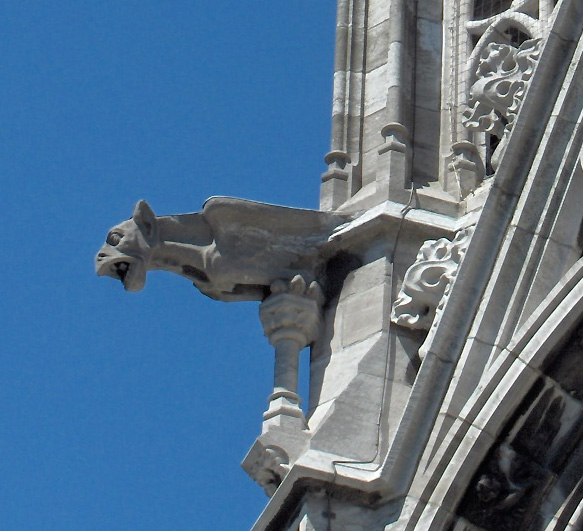
Gargoyle: architectural waterspout and carved grotesque
A gargoyle is a carved stone waterspout on a building, common in medieval architecture. It channels rainwater away and often takes animal or human forms; distinct from non-functional grotesques and preserved as cultural ornament.
A gargoyle is a carved stone figure that projects from a roofline or parapet and functions as an architectural waterspout. The visible figure commonly conceals a channel that carries rainwater away from the masonry, discharging it clear of the wall to reduce erosion and staining. The English word derives from Old French (gargouille, meaning throat or gullet), reflecting the channel through which water passes. In common speech the term is also used loosely for similar decorative figures that are not functional.
Traditionally, gargoyles are carved from durable building stone such as limestone or granite and are integrated into the guttering of a roof. Some are part of a continuous stone gutter or trough, while others are individual projections with an internal lead or stone pipe. The spout outlet is often carved as a mouth or muzzle, and many examples show imaginative stylization: animals, hybrid creatures, human figures or abstract masks. The practical requirement is an internal channel that leads stormwater outwards; without that channel a carved figure is generally classed as a grotesque rather than a functional gargoyle. For discussions of carved ornament and typical stone types see sources on grotesque sculpture and common building stones such as granite.
History and distribution
Gargoyles are most closely associated with medieval Gothic cathedrals and churches in Europe, where they became prominent from the 12th century onward. However, the idea of shaping functional rain-spouts into decorated forms has precedents in earlier and diverse building traditions: classical antiquity and vernacular architecture used waterspouts of various materials and shapes. In medieval Europe the motifs and placement of gargoyles varied by region and workshop, and many notable groups survive on famous buildings. Visitors commonly encounter them on the cathedral of Notre-Dame in France, on churches in the vicinity of the cathedral in Pisa and on civic and ecclesiastical buildings across Italy and beyond. Examples are also documented in cities such as Antwerpen, and on funerary monuments including the Mausoleum for Queen Louise‑Marie in Oostende. Several regional studies treat the subject in more detail; for example, local surveys consider variations found in Pisa and other Italian contexts, and comparative work addresses broader medieval masonry practices in Italy and neighbouring regions.
Function, symbolism and popular belief
The principal function of a gargoyle is practical: to carry rainwater away from the walls and foundations of a building. Over time, these functional elements also acquired decorative and symbolic meanings. Their grotesque or frightening aspects were interpreted in popular belief as apotropaic—capable of warding off evil—or as vivid reminders of sin and the need for spiritual protection, particularly when used on churches. While such interpretations are commonly cited, it is important to distinguish later folklore from the varied intentions of medieval builders and patrons, which could be artistic, didactic or purely decorative as well as functional.
Preservation, repair and modern use
Conservation of historic gargoyles requires careful masonry work, weatherproofing and sometimes the insertion of discreet modern drainage to protect original fabric. Repairs may include replacing eroded stone with matching material, stainless pins for structural support, or the creation of cast replicas where original carvings are too fragile. In contemporary architecture ornamental grotesques are sometimes reproduced as garden ornaments or sculptural features, while modern buildings usually rely on concealed gutters and downpipes rather than carved spouts.
Further reading and study
Researchers and interested readers can find more detailed inventories and technical guidance in specialist publications, conservation guidelines and regional heritage reports. Studies often combine technical description with iconographic analysis, tracing the development of motifs and their reuse in later restorations. For broad introductions and site-specific information see resources on sculptural ornament (grotesque sculpture), stone types like granite, and monographs or guidebooks dedicated to Notre-Dame, the cathedral in Pisa and other European centres. Local heritage bodies publish condition surveys and restoration accounts for cities such as Antwerpen and towns like Oostende, including work on monuments such as the Queen Louise‑Marie mausoleum. For regional architectural context consult studies of medieval building practice in Italy and related bibliographies on sites in Pisa.
Primary function: channel rainwater away from walls to reduce damage.
Forms: animal, hybrid, human, abstract; often dramatic and imaginative.
Materials: durable building stone and sometimes internal metal piping.