
Frobisher Bay: Arctic inlet on southeastern Baffin Island
Frobisher Bay is a long Arctic inlet on southeastern Baffin Island, Nunavut, Canada, notable for its Inuit heritage, glacially carved coastline, the city of Iqaluit, and its role in exploration and northern shipping.
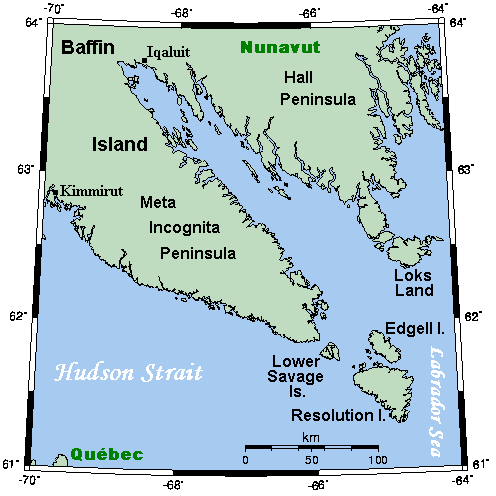
Frobisher Bay is a prominent Arctic inlet on the southeastern coast of Baffin Island, opening into the Labrador Sea. It lies within the territory of Nunavut in Canada and is closely associated with the territorial capital, Iqaluit, which sits near the head of the bay. The bay is long and narrow, with numerous small islands and complex shoreline features created by past glacial activity.
Image gallery
3 Images

Physical characteristics
Geographically the inlet extends for many tens of kilometres from its mouth to the inner basin and reaches its greatest width near the central reaches. Its coast is irregular, cut by side bays and fiord-like arms, and dotted with rocky islets. Sea ice covers much of the surface during the colder months; open water is typically limited to the warmer part of summer, allowing only seasonal marine access to coastal communities.
History and name
The bay was the site of long-standing Inuit settlement long before Europeans arrived. The European name commemorates English explorer Martin Frobisher, who as an English navigator searching for the Northwest Passage reached the inlet in 1576. Early contacts and subsequent visits by explorers shaped the bay's place in maps and in maritime history, while Indigenous presence and place names remain central to its identity. The modern settlement at the bay's head was once commonly referred to by the bay's name but now uses the Inuit name Iqaluit.
Ecology and climate
Frobisher Bay lies within the High Arctic to subarctic climatic zone. Temperatures are cold for most of the year, with brief, cool summers. Ice conditions, tides and cold waters influence local marine life: seals, a variety of seabirds and Arctic char are commonly associated with the bay, and larger mammals such as polar bears may transit coastal areas. The shoreline supports tundra vegetation and seasonally productive nearshore ecosystems.
Uses and significance
- Iqaluit functions as a regional administrative, transport and service hub, relying on the bay for seasonal shipping and access.
- The bay is used for traditional subsistence activities by Inuit communities, including fishing and hunting, alongside growing tourism and scientific research in the region.
- Because access is seasonal and weather-dependent, marine activities are planned around ice conditions and local knowledge of tides and shoals.
Frobisher Bay remains important both as a geographic landmark in Canada’s Arctic and as a living landscape shaped by Indigenous culture, exploration history and contemporary northern life. Visitors and researchers are encouraged to consult local authorities for safe travel and to respect cultural and environmental protections in the area.
Labrador Sea | Nunavut | Canada | Baffin Island | Iqaluit | 1576 | Martin Frobisher | navigator | Northwest Passage
Related articles
Author
AlegsaOnline.com Frobisher Bay: Arctic inlet on southeastern Baffin Island Leandro Alegsa
URL: https://en.alegsaonline.com/art/36791