
Fuji Speedway: history, layout, and motorsport significance
Fuji Speedway is a major Japanese racing circuit near Mount Fuji, known for its long straight, historic Formula One races, sports car events and redevelopment under Toyota ownership.
Overview
Fuji Speedway is a motor racing circuit located in the foothills of Mount Fuji in Oyama, Suntō District, Shizuoka Prefecture, Japan. The site sits at the base of the iconic volcano and is often described by fans and drivers for its dramatic backdrop and variable weather. For geographic reference, see the track's coordinates. The circuit has hosted international formula, sports car and domestic championships and remains one of Japan's best-known venues.
Image gallery
7 Images


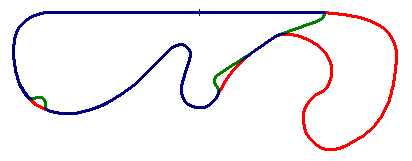


Characteristics and layout
The track is notable for its long, high-speed sections, including a very long straight that has allowed exceptionally high top speeds in many categories; this feature is often referenced when describing the circuit's character and is linked here as the long straight. Multiple configurations have been used over the decades to accommodate different types of racing, safety standards and spectator facilities. The combination of fast approaches, heavy braking zones and placement near a mountain means weather and visibility can change rapidly.
History and development
Built in the early 1960s, Fuji Speedway initially opened under the management of Mitsubishi before passing through other owners. It hosted Japan's first-ever Formula One World Championship race in 1976, an event that helped establish the country's presence on the global motorsport calendar. During the 1980s the venue became a regular stop for international sports car series including rounds organized under the FIA banner and also served as a focal point for national competitions.
Modern era and ownership
In 2000 the circuit was acquired by Toyota Motor Corporation, which invested in upgrades and redevelopment to meet contemporary standards for top-level competition and to improve facilities for teams and spectators. Those investments enabled the track to host major events again in the 21st century. Fuji remains an important location for both competitive racing and manufacturer testing, and Toyota has used the site for corporate motorsport activities.
Events, uses and significance
Fuji Speedway has hosted a variety of international and domestic series, from historic Formula One rounds to endurance sports car races and national touring-car championships. It is commonly mentioned alongside other Japanese venues such as Suzuka as a centre of motorsport in Japan. The circuit also supports grassroots events, track days and manufacturer test programs, contributing to the development of drivers and engineering projects in the region.
Notable facts and context
- Location: the circuit lies in Shizuoka Prefecture, a region with strong ties to mountaineering and nature tourism — see Shizuoka for local context and Mount Fuji for the surrounding landmark.
- Legacy: its early hosting of top-level international races helped introduce Japan to the global motorsport community.
- Versatility: the track has been modified several times to adapt to changing safety rules and motorcycle or car-specific requirements.
Today Fuji Speedway combines historical significance with modern facilities, making it a persistent fixture of motorsport in Japan and a memorable venue for drivers and fans because of its setting and high-speed challenges.
Questions and answers
Q: What are the coordinates of Fuji Speedway?
A: The coordinates of Fuji Speedway are 35°22′18″N 138°55′36″E / 35.37167°N 138.92667°E / 35.37167; 138.92667.
Q: Where is Fuji Speedway located?
A: Fuji Speedway is located in Oyama, Suntō District, Shizuoka Prefecture, Japan.
Q: When was it built?
A: It was built in the early 1960s.
Q: When did it host its first Formula One race?
A: It hosted its first Formula One race in 1976.
Q: Who managed it when it first opened?
A: It was managed by Mitsubishi when it first opened.
Q: Who owns Fuji Speedway now?
A: It is owned by Toyota Motor Corporation since 2000.
Q: How long is the straight at this track?
A:The straight at this track is 1.5 km (0.93 mi) long
Related articles
Author
AlegsaOnline.com Fuji Speedway: history, layout, and motorsport significance Leandro Alegsa
URL: https://en.alegsaonline.com/art/36911
Sources
- motorsport.com : Fuji: Duval, Couto weekend summary
- grandprix.com : Suzuka responds to Fuji pressure – December 23, 2000
- mdn.mainichi.jp : "Toyota to pull out of hosting 2010 Japan GP"