
Fracture (geology)
A fracture is any break or discontinuity in rock. This article describes types (joints, faults), formation processes, controls on fluid flow, measurement methods, and importance in engineering and resources.
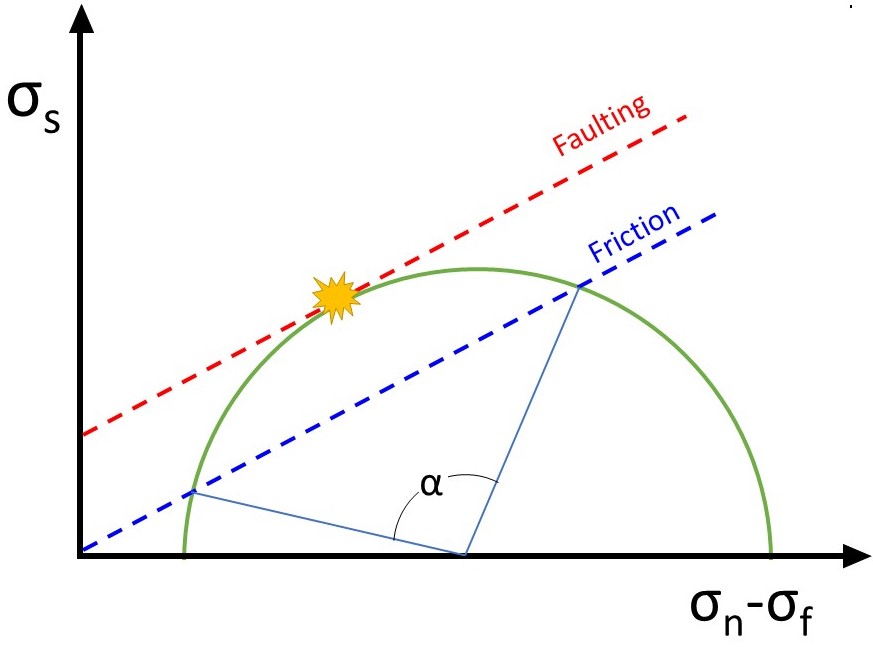
In geology a fracture is any separation or break in a continuous body of rock. Fractures range from microscopic cracks to extensive breaks that offset strata or form major discontinuities. They are characterised by their geometry (orientation and length), aperture (opening), surface roughness and persistence. Fractures form when applied stresses exceed the rock strength and can propagate as tensile, shear or mixed-mode breaks.
Image gallery
7 Images


Types and descriptive features
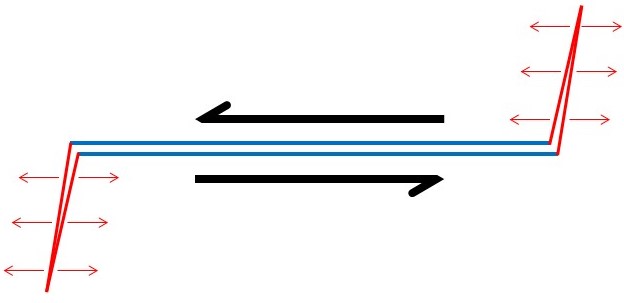
Basic categories include joints (cracks with little or no displacement) and faults (breaks with measurable offset). Other terms commonly used are fissures, veins (filled fractures) and shear zones (wider zones of distributed deformation). Geologists describe fractures by strike and dip, spacing, connectivity, aperture distribution, surface morphology and whether they are open or mineral-filled.
Formation processes
Fractures develop from a variety of processes: regional tectonic stresses that produce brittle failure, unloading and expansion during erosion, cooling and contraction of volcanic or intrusive rocks, pressurisation by fluids, and human activities such as excavation or hydraulic fracturing. The orientation of a fracture set often records the direction of the prevailing stress field at the time of formation, and preexisting weaknesses or layering influence their location and evolution.
Role in fluid flow and resources
Fractures are critical pathways and barriers for subsurface fluids. Open, connected fractures can greatly enhance permeability and control movement of water in aquifers, the migration and trapping of hydrocarbons, and the circulation of geothermal fluids. Mineral-bearing fluids may precipitate within fractures to form veins or to seal them, altering their hydraulic behaviour. Understanding fracture networks is therefore essential in groundwater management, petroleum geology and geothermal development.
Engineering and environmental significance
In civil and mining engineering, fractures influence rock mass strength, slope stability, foundation design and tunnel performance. Fractured rock responds differently to loading than intact blocks; fractures can concentrate stresses, guide rockfalls, and create preferential pathways for contamination or leakage. Rock mass classification systems and numerical models account for fracture geometry and persistence when planning works.
Study, mapping and modelling
Geologists document fractures using field mapping and scanline surveys, core description and borehole imaging tools, and imaging techniques such as LiDAR and photogrammetry for digital outcrop models. Geophysical methods and microseismic monitoring can reveal hidden or active fracture networks. Quantitative parameters—fracture density, orientation distributions, aperture statistics and connectivity—are used in models ranging from equivalent continuum approximations to discrete fracture network (DFN) simulations to predict flow and mechanical behaviour.
Important practical topics include the distinction between isolated fractures and connected networks, the effects of sealing and mineralisation, and how fractures evolve under changing stress or fluid pressure. For introductory coverage see general geology references and applied texts in hydrogeology and petroleum geology.
Related articles
Author
AlegsaOnline.com Fracture (geology) Leandro Alegsa
URL: https://en.alegsaonline.com/art/35965
Sources
- books.google.com : page 9