
Hydrocarbon: Chemistry, Types, Sources and Uses
Hydrocarbons are organic compounds of hydrogen and carbon that form fuels and petrochemical feedstocks. This article summarizes their types, bonding, sources, industrial processing, uses and environmental and health impacts.
Overview
A hydrocarbon is an organic compound composed only of hydrogen and carbon atoms. A simple definition emphasizes that hydrocarbons range from the simplest molecule, methane, to very large and complex molecules found in fossil fuels and biological materials. Their carbon framework and attached hydrogen atoms determine shape, volatility and chemical behavior. Because the C–H and C–C bonds are essentially nonpolar, hydrocarbons are generally hydrophobic and have limited solubility in water.
Image gallery
8 Images





Types and structure
Hydrocarbons are classified by the types of carbon–carbon bonding and by whether the structure is open-chain (aliphatic) or cyclic. Major classes include:
- Alkanes: saturated hydrocarbons with single C–C bonds.
- Alkenes: unsaturated hydrocarbons with one or more C=C double bonds.
- Alkynes: unsaturated hydrocarbons with C≡C triple bonds.
- Aromatic hydrocarbons: cyclic, conjugated systems such as benzene and its derivatives.
Structural differences control reactivity and properties. For example, unsaturation (double or triple bonds) makes molecules more reactive toward addition reactions, while aromatic systems have distinctive stability and substitution chemistry.
Bonding and basic properties
Hydrocarbons consist of carbon atoms bonded to hydrogen and to other carbons through covalent bonds. See more on atomic and molecular bonding concepts for background. Bond types and hybridization dictate molecular geometry: sp3-hybridized carbons form tetrahedral arrangements, sp2 give planar trigonal shapes, and sp produce linear fragments. Physical properties such as boiling point, melting point and viscosity vary with molecular mass, shape and degree of branching.
Occurrence, extraction and separation
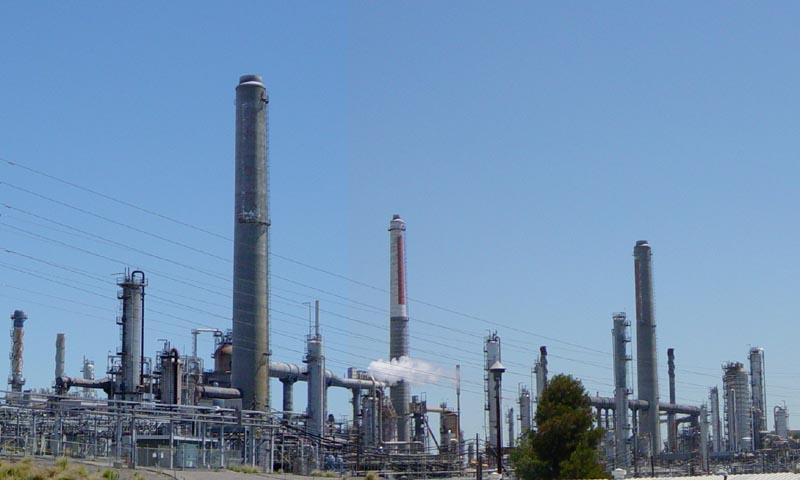
Natural sources include crude oil, natural gas and coal, where complex mixtures of hydrocarbons coexist. Petroleum refining separates these mixtures into useful fractions by techniques such as fractional distillation, and subsequent processes like cracking, reforming and treatment modify molecules for fuel and chemical feedstocks. The atoms involved are the basic elements hydrogen (H) and carbon (C), which are rearranged in many industrial transformations.
Reactivity and common reactions
Typical reactions include combustion (oxidation), which releases energy and produces CO2 and water under complete combustion, addition to double or triple bonds, free-radical substitution in saturated hydrocarbons, and polymerization of small unsaturated monomers to form larger macromolecules. Reaction conditions and catalysts largely determine the outcome in industrial chemistry.
Uses, environmental and health impacts
Hydrocarbons are central to modern energy systems and the chemical industry: fuels (gasoline, diesel, natural gas), solvents, lubricants, and as feedstocks for plastics, synthetic fibers and many other materials. Their combustion is a major source of energy but also emits greenhouse gases and air pollutants. Some hydrocarbons, particularly certain polycyclic aromatic compounds and volatile organic compounds, pose health risks and environmental persistence concerns. Management of extraction, refining and emissions, plus development of alternatives, are ongoing social and technical challenges.
Practical notes and safety
Because many hydrocarbons are flammable and some are toxic or irritating, handling requires appropriate ventilation, fire precautions and personal protective equipment in laboratory and industrial settings. For detailed safety data consult material safety resources and regulatory guidance.
Questions and answers
Q: What is a hydrocarbon?
A: A hydrocarbon is a chemical compound made of hydrogen and carbon atoms.
Q: Where can hydrocarbons be found?
A: Hydrocarbons can be found in crude oil and other sources.
Q: How are hydrocarbons separated?
A: Hydrocarbons are separated by fractional distillation, which separates them into different groups.
Q: What type of bonds are formed between hydrogen and carbon in hydrocarbons?
A: Hydrogen and carbon are bonded with non-polar covalent bonds in hydrocarbons.
Q: Why are hydrocarbons hydrophobic?
A: Hydrocarbons are hydrophobic because they cannot create hydrogen bonds with water.
Q: Can hydrocarbons create hydrogen bonds with water?
A: No, hydrocarbons cannot create hydrogen bonds with water.
Q: What makes hydrocarbons different from other chemical compounds?
A: Hydrocarbons are unique in that they are made of only hydrogen and carbon atoms, and are not capable of creating hydrogen bonds with water due to their lack of polar covalent bonds.
Related articles
Author
AlegsaOnline.com Hydrocarbon: Chemistry, Types, Sources and Uses Leandro Alegsa
URL: https://en.alegsaonline.com/art/46084