
Gabbro: coarse-grained intrusive rock of the oceanic crust and rift zones
Gabbro is a dark, coarse-grained intrusive igneous rock chemically similar to basalt, common in oceanic crust and rift-related intrusions; it records magmatic processes and has practical uses in construction and geology.
Gabbro is a group of dark, coarse-grained intrusive igneous rocks formed when magma cools slowly beneath the Earth's surface. It is chemically equivalent to basalt but differs in texture because it crystallizes at depth. Gabbro typically forms large, crystalline bodies with visible mineral grains and is a fundamental component of the lower sections of the oceanic crust. The term covers a range of compositions and textures but is most often applied to rocks dominated by calcium-rich plagioclase and pyroxene.
Image gallery
9 Images


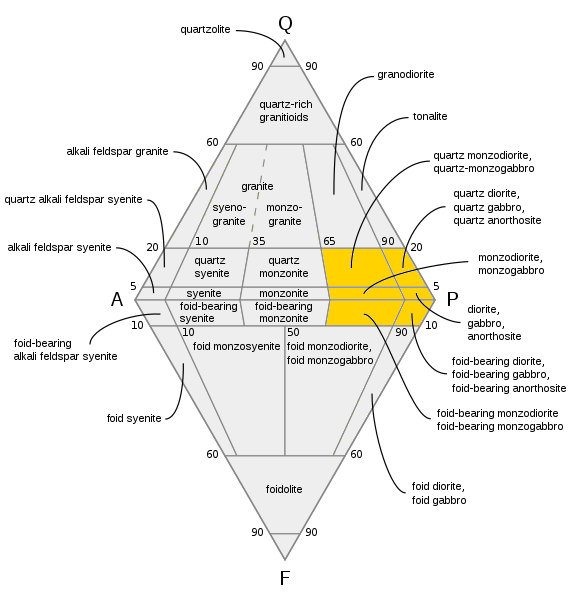

Characteristics and composition
Gabbro is commonly medium- to coarse-grained, with most crystals exceeding 1 mm in size. Typical mineral constituents include:
- Plagioclase feldspar (commonly labradorite or bytownite), forming light-colored, blocky grains
- Pyroxene (usually augite), giving gabbro its dark color
- Olivine, in more mafic varieties
- Iron–titanium oxides (magnetite, ilmenite) and accessory minerals
The overall chemistry is mafic — relatively high in magnesium and iron and low in silica — which explains its close relationship with extrusive basalt. Textural varieties include coarse equigranular gabbros, porphyritic types with larger phenocrysts, and layered gabbros produced by accumulation of crystals in magmatic chambers.
Origin, setting and geologic context
Gabbro forms when molten magma intrudes into the crust and cools slowly enough to allow large crystals to grow. These plutonic bodies are emplaced beneath the Earth's surface and often occupy deep-seated parts of volcanic systems. The most extensive occurrences are beneath mid-ocean ridges, where upwelling mantle produces basaltic magma that crystallizes to form layered sequences: mantle rocks below, mantle peridotite at depth, overlain by gabbro and capped by sheeted dikes and pillow basalts at the seafloor. Gabbro also forms in continental rift zones and in large intrusions associated with ancient magmatic provinces and ophiolite complexes.
Geological importance and examples
Gabbros are important records of magmatic processes. Layered gabbro intrusions preserve evidence of crystal settling, fractional crystallization, and mixing of magmas. Because most of the oceanic crust is constructed from basalt and gabbro, studying gabbro helps geologists understand sea-floor spreading and plate tectonics. Exposed gabbro bodies on continents — often brought to the surface by tectonic uplift or ophiolite emplacement — provide accessible windows into deep crustal processes.
Uses, economic significance and distinctions
In practical terms, gabbro is used as crushed stone, aggregate, and sometimes as dimension stone where a dark, durable rock is desired. Certain layered mafic intrusions with gabbroic composition can host concentrations of chromite and platinum-group elements; these occurrences are notable but localized. It is useful to distinguish gabbro from related rocks: unlike extrusive basalt, which cools quickly at the surface and is fine-grained, gabbro crystallizes slowly underground and shows coarse grains. Compared with ultramafic rocks such as peridotite, gabbro contains more plagioclase and less olivine.
Key settings and pathways of formation
- Mid-ocean ridges and spreading centers where basaltic magmatism produces layered crustal sequences
- Proto- or active rift zones and rifted margins that host long belts of gabbroic intrusions
- Large igneous provinces and ophiolite complexes that expose deep crustal slices on land
For introductory context on rock types, see general resources about igneous rocks and crystalline textures (crystalline fabrics). Field and laboratory study of gabbro continues to refine our understanding of crustal formation, magmatic differentiation, and the links between deep processes and surface volcanism. For further reading on mid-ocean ridge structure and seafloor formation consult specialized literature and syntheses available through geological surveys and academic reviews (Earth's surface, oceanic crust references).
Important links for additional topics: mantle, magma, and regional studies of rift zones.
Questions and answers
Q: What is gabbro?
A: Gabbro is a group of dark, coarse-grained, plutonic igneous rocks that are chemically equivalent to basalt.
Q: How is gabbro formed?
A: Gabbro is formed when molten magma is trapped under the Earth's surface and cools into a crystalline mass.
Q: Where is gabbro found on the Earth's surface?
A: Gabbro is found mostly in the oceanic crust, produced by basalt magmatism at mid-ocean ridges.
Q: What lies above the Earth's mantle and below the basalt when gabbro is formed?
A: When gabbro is formed, it lies above the Earth's mantle and below the basalt.
Q: What is the texture of gabbro?
A: Gabbro is generally coarse-grained, with crystals in the size range of 1 mm or greater.
Q: Why is gabbro an essential part of the oceanic crust?
A: Gabbro is an essential part of the oceanic crust because most of the Earth's surface has gabbro in the oceanic crust.
Q: Where are long belts of gabbro intrusions typically formed?
A: Long belts of gabbro intrusions are typically formed at proto-rift zones and around ancient rift zone margins.
Related articles
Author
AlegsaOnline.com Gabbro: coarse-grained intrusive rock of the oceanic crust and rift zones Leandro Alegsa
URL: https://en.alegsaonline.com/art/37146