
Fluid dynamics: principles, history, and applications
Overview of fluid dynamics: core principles (continuity, momentum, viscosity), historical development, practical applications (aerodynamics, oceanography, medicine), and computational modeling (CFD).
Overview
Fluid dynamics is the branch of science that studies how fluids — both liquids and gases — move and interact with their surroundings. It sits at the intersection of physics, mathematics and engineering, using mathematical descriptions and physical reasoning to predict flow patterns, forces and energy exchange. The subject covers flows that are steady or time-dependent, slow or fast, smooth or chaotic.
Image gallery
4 Images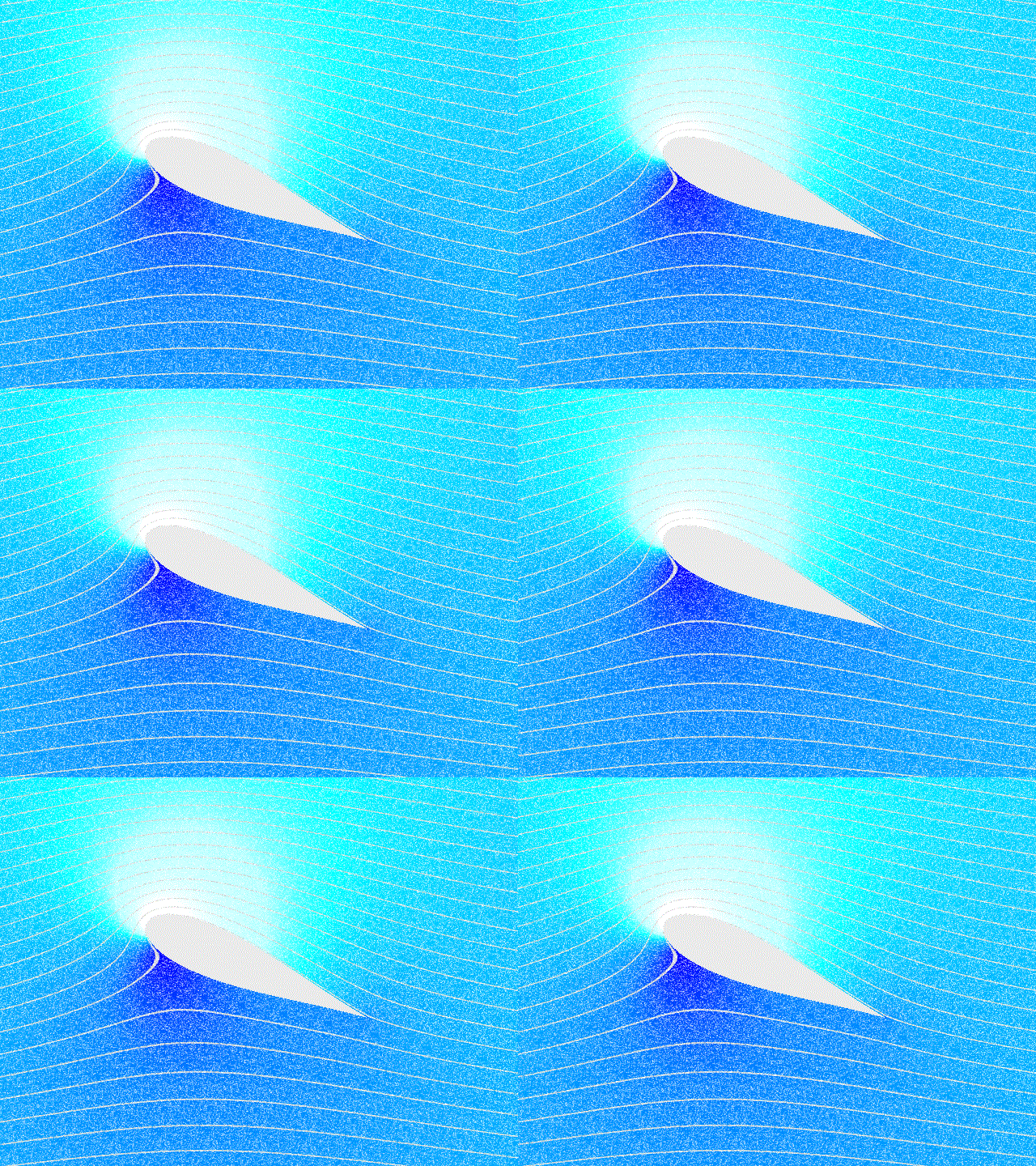



Fundamental principles
At its core, fluid dynamics applies a few conservation laws to continuous media. Conservation of mass leads to the continuity relation; conservation of momentum produces equations that express how forces accelerate fluid parcels; and conservation of energy governs temperature and work interactions. These relations are expressed through mathematical equations such as the Euler equations for ideal (non-viscous) flow and the Navier–Stokes equations when viscosity matters. Important concepts include viscosity, pressure, boundary layers, and the qualitative distinction between laminar and turbulent flow, often characterized by nondimensional numbers like the Reynolds number.
History and development
The study of moving fluids has ancient roots in engineering and shipbuilding, and it matured as a formal discipline between the 17th and 19th centuries with contributions from investigators such as Daniel Bernoulli and Leonhard Euler and later extensions by Claude-Louis Navier and George Gabriel Stokes. Over time, advances in experimental methods, mathematical analysis and later computing transformed fluid dynamics from largely empirical rules into a quantitative science with predictive capability.
Applications and examples
Fluid dynamics explains many everyday and industrial phenomena. It underpins the design and performance of aircraft through aerodynamics, enables analysis of weather systems and ocean currents, and guides the design of pipes, pumps and turbines. Specific examples include:
- Aircraft lift and drag in relation to flight.
- Resistance and stability of ships and the hydrodynamics of submarines.
- Atmospheric circulation and the formation of storms.
- Physiological flows such as blood circulation and airflow in the lungs.
Computational fluid dynamics (CFD)
Modern work often relies on numerical simulation. Computational fluid dynamics (CFD) uses discretized forms of governing equations to approximate flows around objects or within systems. CFD enables virtual testing of designs, visualization of complex flow features and investigation of regimes that are difficult to reproduce in the laboratory. Simulations require choices about grid resolution, turbulence models and boundary conditions; results improve as computing power and algorithms advance.
Distinctions and notable facts
Fluid dynamics is distinct from fluid statics (which treats fluids at rest) and from specialized subfields such as gas dynamics (focused on compressible gases) and hydraulics (often concerned with liquids in engineering contexts). Turbulence, the chaotic state that many flows adopt at high speeds or large scales, remains a central practical and theoretical challenge: it is difficult to predict in detail and often requires empirical modeling. Despite this, fluid dynamics provides essential tools for disciplines ranging from meteorology and oceanography to aerospace, civil engineering and medicine.
Further reading
Students and practitioners typically study the governing equations, canonical flows (pipe, boundary layer, wake), and experimental methods before moving to applied topics and CFD software. Introductory texts and online resources can provide stepwise guidance for learning advanced analytical and numerical techniques.
See also
- Bernoulli and Venturi flow
Norm data (subject term): GND: 1172567794
Questions and answers
Q: What does Fluid Dynamics talk about?
A: Fluid Dynamics talks about how fluids (liquids and gases) work.
Q: Who studies Fluid Dynamics?
A: Fluid Dynamics is studied by physicists, mathematicians, and engineers.
Q: How can Mathematics describe how fluids move?
A: Mathematics can describe how fluids move using mathematical formulas called equations.
Q: What are the fluid dynamics of gases called?
A: The fluid dynamics of gases are called aerodynamics.
Q: Why is it important to understand how fluids behave?
A: Understanding how fluids behave helps us understand things like flight or ocean currents.
Q: How can computer programs use the mathematical equations of fluid dynamics?
A: Computer programs can use the mathematical equations of fluid dynamics to model and predict the actions of moving fluids.
Q: What is the name for studying how fluid dynamics can be done with computers?
A: Studying how fluid dynamics can be done with computers is called computational fluid dynamics (or CFD for short).
Related articles
Author
AlegsaOnline.com Fluid dynamics: principles, history, and applications Leandro Alegsa
URL: https://en.alegsaonline.com/art/35263