
Flight: Principles, Types, History, and Uses
Overview of flight: aerodynamic principles, natural and mechanical forms, historical milestones, common uses, distinctions between atmosphere and space, and contemporary trends in propulsion and autonomy.
Overview
Flight is the movement of an object through a gaseous medium or, in the broader sense, across a vacuum. In everyday use it most often refers to motion through Earth’s atmosphere produced or sustained by aerodynamic forces or by buoyancy, propulsion and orbital mechanics. For a basic definition see movement through a gas and for the properties of the medium consult gaseous environments. The contrast with travel outside the atmosphere is described in discussions of vacuum and spaceflight.
Image gallery
10 Images




Basic principles
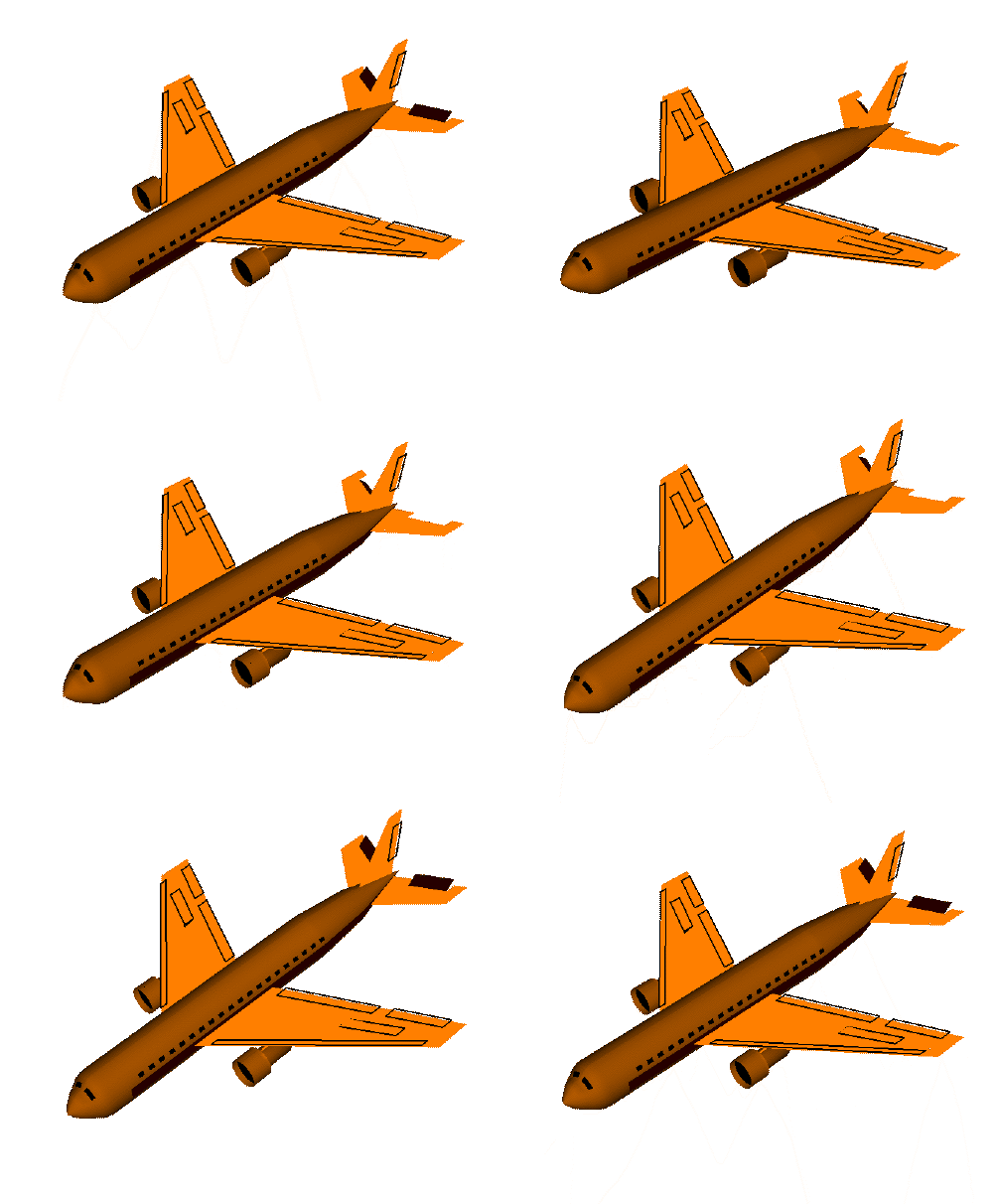
Atmospheric flight is governed mainly by four forces: lift, weight, thrust and drag. Lift usually arises from pressure differences around lifting surfaces, while thrust is produced by engines, propellers or rotors to overcome drag. Stability and control require design features such as tailplanes, ailerons, rudders or control software on unmanned systems. Small animals and insects exploit unsteady aerodynamics, while large fixed-wing aircraft rely on steady-state wing lift.
Types and examples
- Natural flight: birds, bats and insects use flapping, soaring and gliding.
- Heavier-than-air craft: airplanes, helicopters and multirotor drones.
- Lighter-than-air craft: balloons and airships that use buoyancy.
- Ballistic and spaceflight: rockets and re-entry vehicles operate partly or wholly in vacuum.
History and development
Human experiments with flight range from kites and gliders to hot-air balloons and powered aircraft. The first sustained, controlled, powered heavier-than-air flight is attributed to the Wright brothers in 1903; later innovations included piston and jet engines, rotorcraft and spacecraft that enable orbital travel.
Uses and importance
Flight enables rapid transport of people and goods, military operations, weather observation, scientific research and emergency response. Drones add capabilities for inspection, mapping and delivery. Civil aviation and airspace operations are regulated for safety and environmental impact.
Distinctions and trends
Aerodynamics governs motion within the atmosphere, whereas astronautics deals with spaceflight and orbital mechanics. Current trends include electric and hybrid propulsion, noise and emissions reduction, autonomy and urban air mobility. For practical introductions to air motion see air and atmospheric motion.
Further reading: introductory textbooks, pilot training guides and popular accounts cover detailed performance, historical developments and the biology of bird and insect flight.
Related articles
Author
AlegsaOnline.com Flight: Principles, Types, History, and Uses Leandro Alegsa
URL: https://en.alegsaonline.com/art/35121