
Fibrous protein (scleroprotein): structure, types and biological roles
Fibrous proteins (scleroproteins) are elongated, mostly insoluble structural proteins—including keratin, collagen, elastin and fibroin—providing mechanical support, elasticity and protection in tissues and materials.
Overview
Fibrous proteins, also called scleroproteins, form one of the principal classes of proteins and are primarily adapted for structural roles. Unlike compact, soluble globular proteins, fibrous proteins are extended, often insoluble molecules that assemble into long fibres or sheets to give tissues mechanical strength, elasticity or protection. For context within broader protein taxonomy see protein classification, and compare typical globular proteins and membrane proteins.
Image gallery
2 Images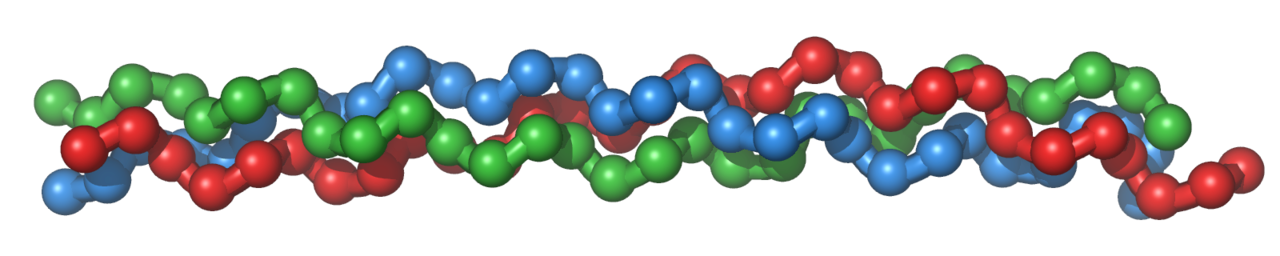

Structure and properties
At the molecular level, fibrous proteins frequently contain repeated amino acid sequences that promote regular secondary structures—alpha-helices, beta-sheets or specialised motifs—that stack or twist into higher-order fibres. Many are rich in residues that enable cross-linking (for example disulfide bonds in some keratins) or permit elasticity (as in elastin). Their insolubility and resistance to proteolysis reflect their role as long-lived structural components in cells and extracellular matrices.
Major types
- Keratin: a family of fibrous proteins found in skin, hair, nails, feathers and claws; keratins form rigid or flexible filaments depending on cross-links and packing.
- Collagen: the principal component of connective tissues, forming triple-helical fibrils that provide tensile strength in skin, bone matrices and cartilage; widely abundant in animals.
- Elastin: an elastic, resilient protein in arteries, lungs and skin that allows tissues to stretch and recoil.
- Fibroin: the silk protein produced by insects and spiders, rich in beta-sheet structure and notable for strength and flexibility.
Biological roles and applications
Fibrous proteins underpin the mechanical architecture of organisms: they compose connective tissue, form tendons and ligaments, support skin and contribute to protective coverings. In medicine and technology they are used as biomaterials (for sutures, scaffolds and wound dressings), and as inspiration for synthetic fibres and composites because of their strength-to-weight ratios and durability.
Distinctions and notable facts
Key distinctions from other protein classes include shape (elongated vs compact), solubility (insoluble vs soluble), and primary function (mechanical support vs catalysis or transport). Fibrous proteins often show slow turnover in tissues and can accumulate post-translational cross-links that alter mechanical properties with age. Their predictable repetitive structures have also made them useful models in materials science and protein engineering.
Related articles
Author
AlegsaOnline.com Fibrous protein (scleroprotein): structure, types and biological roles Leandro Alegsa
URL: https://en.alegsaonline.com/art/34177
Sources
- drive.google.com : Low resolution structure and packing investigations of collagen crystalline domains in tendon using Synchrotron Radiation X-rays, Structure factors determination, evaluation of Isomorphous Replacement methods and other modeling
- doi.org : 10.13140/2.1.4776.7844
- ncbi.nlm.nih.gov : "SCOP2 prototype: a new approach to protein structure mining"
- doi.org : 10.1093/nar/gkt1242
- pubmed.ncbi.nlm.nih.gov : 24293656