
Collagen: structure, types, biological roles and common uses
Collagen is the most abundant structural protein in animals, forming triple‑helical fibrils in skin, bone, cartilage, tendons and other connective tissues; used in medicine, food and research.
Overview
Collagen is a family of naturally occurring structural proteins found only in animals. As the dominant component of the extracellular matrix it gives tissues tensile strength and mechanical integrity and is widely regarded as the most abundant protein in mammals. Collagen occurs as elongated fibrils and fibers and contributes substantially to the protein mass of many tissues, including skin, bone and connective tissues broadly described as connective tissue.
Image gallery
5 Images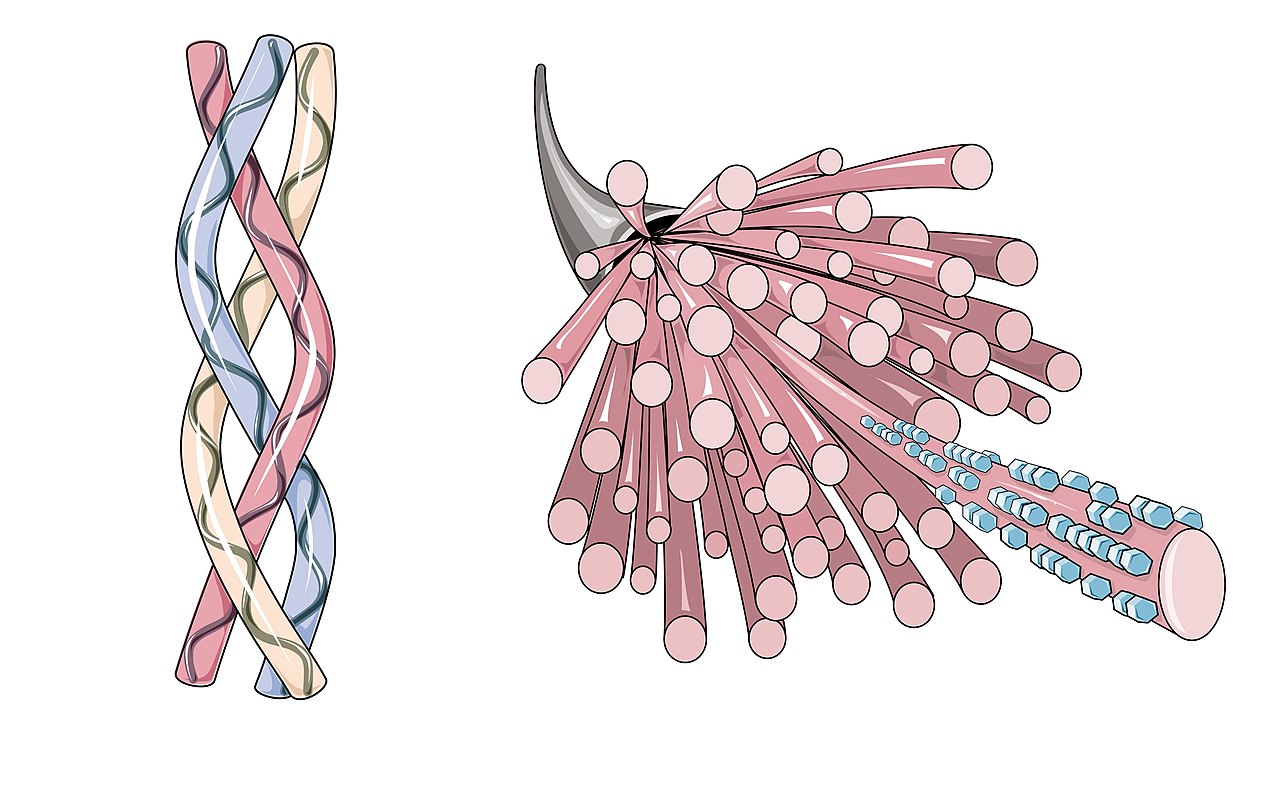


Structure and common types
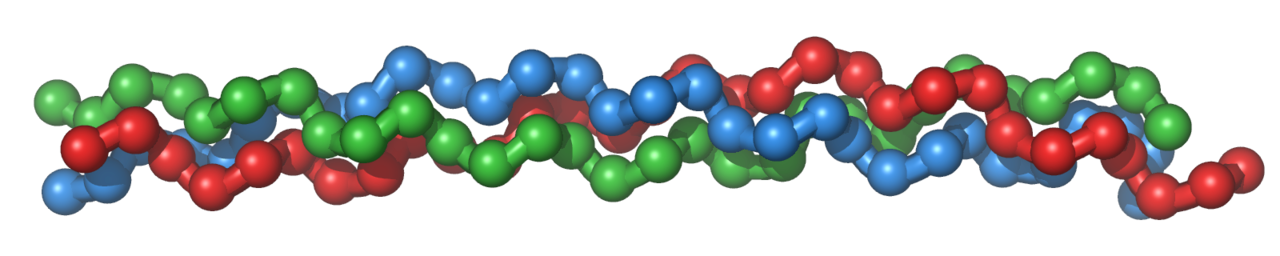
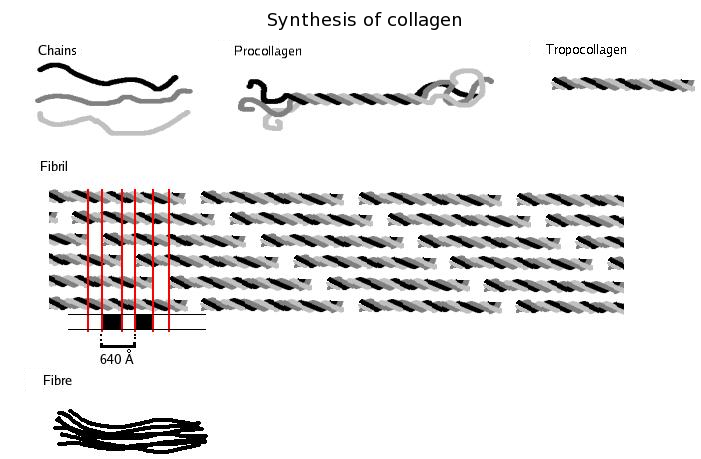
Individual collagen molecules consist of three polypeptide chains wound into a right‑handed triple helix. Repeating glycine‑X‑Y amino acid motifs, often with proline and hydroxyproline in the X and Y positions, stabilize the helix. Collagen molecules assemble into fibrils that are crosslinked to form fibers. Multiple genetically and structurally distinct types exist; for example, type I predominates in skin, bone and tendon, type II in cartilage, and type III in more elastic tissues. Other types specialize in basement membranes, reticular fibers or network formation.
Biosynthesis and maturation
Collagen is synthesized inside cells as procollagen, with signal peptides and propeptides that are removed after secretion. Post‑translational modifications such as proline hydroxylation and lysine glycosylation are important for helix stability and crosslink formation. Extracellular enzymes then cleave propeptides and catalyze covalent crosslinks that determine fibril strength and durability. Disturbances in these steps are associated with inherited connective tissue disorders.
Distribution and biological roles
Collagen fibers are concentrated in fibrous tissues such as tendon, ligament and skin, and are also abundant in the cornea, cartilage, bone, blood vessels, the digestive tract and intervertebral discs. Within muscle, collagen forms an extracellular network that contributes to passive tension and force transmission. Beyond mechanical support, collagen influences cell adhesion, migration and differentiation and plays a central role in wound healing and tissue remodeling.
Mechanical properties and changes with age
Properties of collagenous tissues depend on fiber orientation, crosslink density and the ratio of collagen types. With age and certain metabolic states, crosslinking patterns change, fibers become stiffer, and turnover slows, which can reduce elasticity and increase vulnerability to injury. These age‑related alterations are relevant for skin appearance, joint function and cardiovascular health.
Industrial processing and derivatives
Collagen can be extracted from animal tissues and processed into a variety of materials. Gelatin is produced by denaturing and partially hydrolyzing collagen; it forms gels and is widely used in food and pharmaceuticals. Further hydrolysis yields collagen peptides or hydrolyzed collagen, which are soluble and used in dietary supplements and functional foods. Processing methods affect molecular size, solubility, and functional properties important for different applications.
Uses in medicine, industry and research
- Medical: collagen is used as biomaterial for wound dressings, surgical hemostats, scaffolds for tissue engineering and certain implants where biodegradability and biocompatibility are required.
- Cosmetics and supplements: topical and ingestible products incorporate collagen or peptides aiming to support skin and connective tissue, though clinical outcomes vary by formulation and study.
- Food and industry: gelatin and collagen peptides serve as gelling agents, stabilizers, clarifiers and protein supplements in diverse products.
- Research and biotechnology: collagenous matrices are standard substrates for cell culture and biomechanics experiments, and recombinant or synthetic analogues are developed to overcome sourcing limitations.
Sources, ethical considerations and alternatives
Commercial collagen is most often derived from mammalian tissues such as bovine or porcine sources and from fish by‑products. Source choice raises considerations of disease risk, dietary restrictions and ethics, prompting interest in recombinant human collagen and synthetic polymers that mimic collagen function. Marine collagen differs in composition and melting behavior from terrestrial sources and is used where specific properties are desired.
Safety, efficacy and research directions
When used as a medical device or in supplements, product purity, processing and regulatory status influence safety and efficacy. Ongoing research focuses on improved synthetic scaffolds, recombinant production, better understanding of collagen turnover in aging and disease, and controlled modification of mechanical and biological properties for regenerative medicine. For summaries on protein families and applied materials, see general reviews on protein families and topic overviews in connective tissue biology.
Further reading and resources: general summaries and applied guides are available for connective tissue structure, biomaterials and food applications animal sources, connective tissue, tendon studies, ligament research, skin biology, corneal structure, cartilage, bone, vascular collagen, intervertebral discs, gelatin processing and hydrolyzed collagen.
Questions and answers
Q: What is collagen?
A: Collagen is a group of naturally occurring proteins found exclusively in animals, especially in the flesh and connective tissues of mammals.
Q: What is the main function of collagen?
A: The main function of collagen is to provide structural support to the body's connective tissue.
Q: Where is collagen mostly found in the body?
A: Collagen is mostly found in fibrous tissues such as tendon, ligament and skin, and is also abundant in cornea, cartilage, bone, blood vessels, the gut, and intervertebral discs.
Q: How much of the whole-body protein content does collagen make up?
A: Collagen makes up about 25% to 35% of the whole-body protein content.
Q: What is gelatin and how is it made?
A: Gelatin is collagen that has been irreversibly hydrolyzed, which means that it has been broken down into smaller pieces. It is commonly used in the food industry.
Q: Can collagen be found in muscle tissue?
A: Yes, collagen makes up 1% to 2% of muscle tissue, and accounts for 6% of the weight of strong, tendinous muscles.
Q: Can collagen be found in non-animal sources?
A: No, collagen is found exclusively in animals.
Related articles
Author
AlegsaOnline.com Collagen: structure, types, biological roles and common uses Leandro Alegsa
URL: https://en.alegsaonline.com/art/21556
Sources
- doi.org : 10.1093/icb/43.1.3
- doi.org : 10.1074/jbc.M110709200
- pubmed.ncbi.nlm.nih.gov : 11704682