
Elastin: the elastic protein of connective tissues
Elastin is a durable, highly elastic protein found in connective tissues that enables organs and vessels to stretch and recoil. It arises from tropoelastin, is cross-linked into fibers, and is vital for lungs, skin, and arteries.
Overview
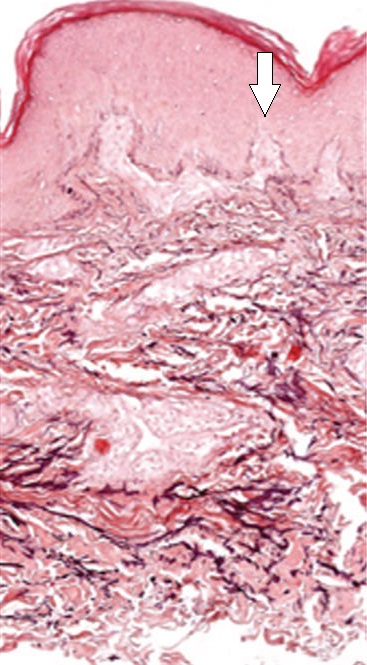
Elastin is an extracellular protein that gives certain tissues the ability to resume their original shape after stretching or contracting. It is a principal component of connective tissue and is classified as an elastic protein. In the body, elastin provides resilience and passive recoil: for example, it helps the skin to recover after deformation and allows large arteries to expand with each heartbeat and then return toward their resting diameter.
Image gallery
7 Images


Structure and molecular characteristics
Elastin is synthesized as a soluble precursor called tropoelastin. Tropoelastin molecules are secreted by cells, assembled on a scaffold of microfibrils, and covalently cross-linked to form insoluble elastic fibers. Unique amino acid cross-links—desmosine and isodesmosine—stabilize the network and give mature elastin its exceptional durability and elasticity. Because of this dense cross-linking, mature elastin is highly insoluble and turns over very slowly, often persisting for many years in adult tissues.
Distribution and functional roles
Elastin-rich fibers occur where reversible extension and energy storage are required. Principal sites include:
- Large blood vessels (notably the aorta and its major branches), where elastic recoil aids continuous blood flow during diastole;
- Lungs, where elastic recoil helps expiration and maintains alveolar architecture;
- Ligaments and the elastic components of joints, supporting flexible motion;
- Skin, the bladder, and elastic cartilage, where stretch and recovery are important.
Synthesis, assembly and maintenance
Elastin production begins with gene transcription and translation of tropoelastin. Extracellular enzymes such as lysyl oxidase mediate oxidative deamination of specific lysine residues, enabling formation of the characteristic cross-links. Fibrillin-rich microfibrils serve as a template that organizes tropoelastin molecules into mature fibers. Because mature elastin is largely insoluble and cells produce relatively little new elastin in adulthood, damage to elastic fibers accumulates over time.
Clinical significance and applied uses
Genetic and environmental factors that affect elastin produce recognizable conditions. Mutations or deletion of the human ELN gene (which encodes tropoelastin) are associated with certain vascular abnormalities. Loss or degradation of elastin is implicated in skin wrinkling, age-related arterial stiffening, emphysema (where proteases destroy alveolar elastic fibers), and some inherited connective tissue disorders. Elastin and elastin-derived materials are also under investigation in biomaterials and tissue engineering because their elastic and biocompatible properties suit applications such as vascular grafts and scaffolds.
Notable distinctions and facts
- Elastin differs from collagen: collagen provides tensile strength and resists stretching, whereas elastin allows reversible stretch and recoil.
- Elastin fibers are composite structures: an elastin core plus microfibrils built from other proteins such as fibrillin.
- Unique cross-links (desmosine/isodesmosine) can be measured as markers of elastin turnover in research settings.
Together, these properties make elastin a crucial molecular component for organs and tissues that must deform repeatedly and reliably, balancing flexibility with structural integrity.
Additional reading and resources: connective tissue overview, elastic protein properties, protein structure basics, skin biomechanics, arterial elasticity, lung mechanics, ligament structure, ELN gene information.
Related articles
Author
AlegsaOnline.com Elastin: the elastic protein of connective tissues Leandro Alegsa
URL: https://en.alegsaonline.com/art/30609
Sources
- doi.org : 10.1007/978-1-4684-9093-0_27
- pubmed.ncbi.nlm.nih.gov : 868643
- sciencedirect.com : "The elastin gene is disrupted by a translocation associated with supravalvular aortic stenosis"
- doi.org : 10.1016/0092-8674(93)90168-P