
Ethane: properties, production, uses and safety
Ethane (C2H6) is a simple alkane gas used chiefly as a petrochemical feedstock. This article summarizes its structure, occurrence, industrial uses, hazards and historical context.
Ethane is a saturated hydrocarbon with the molecular formula C2H6. It is one of the simplest alkanes and is classed as an organic chemical compound. The empirical formula is often written as C2H6 to emphasize its two carbon atoms bonded to six hydrogen atoms. Under normal atmospheric conditions ethane is a colorless and largely odorless gas; see safety notes for situations where odorants are added or detectable traces occur [details].
Image gallery
3 Images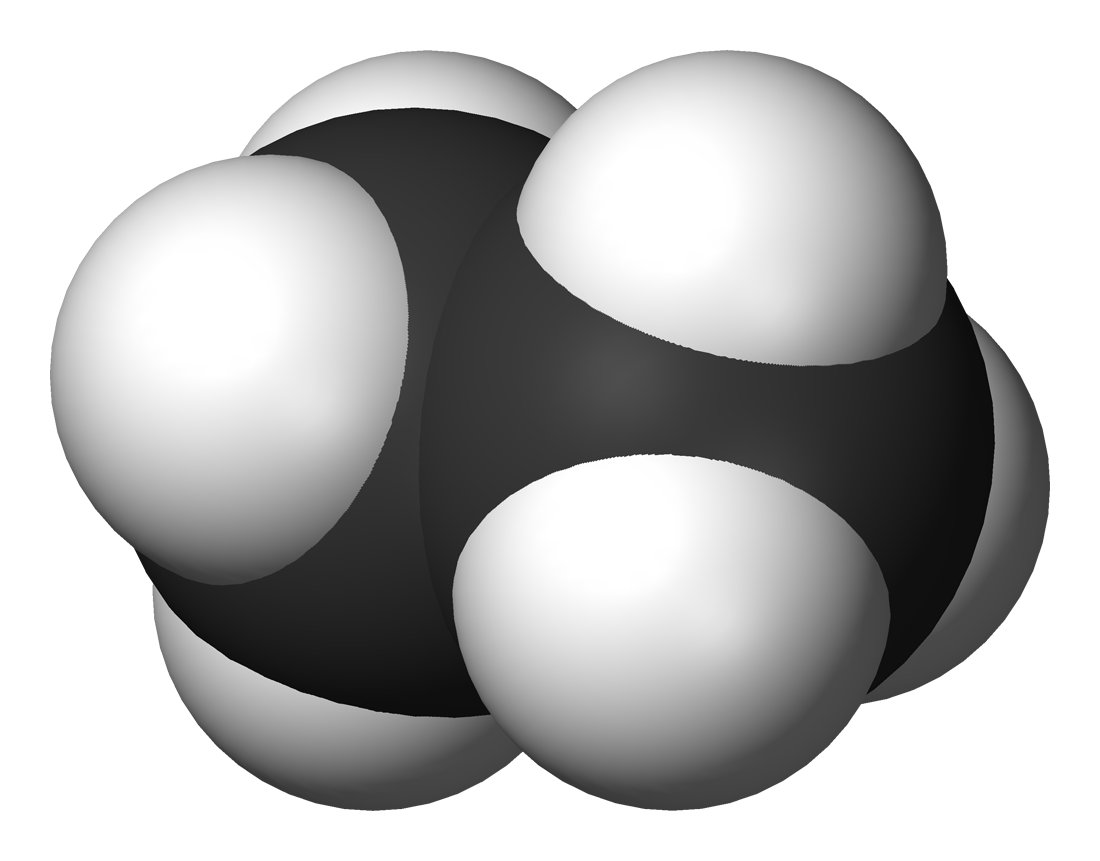


Structure and properties
Chemically, ethane is a saturated molecule with a single carbon–carbon sigma bond. Each carbon atom is tetrahedral and bonded to three hydrogen atoms and the other carbon, resulting in sp3 hybridization. Ethane has low boiling and melting points compared with common liquids and is normally handled as a gas at ambient temperature. It participates in typical alkane reactions: combustion, free-radical halogenation under light, and cracking under high temperature.
Occurrence and production
In nature ethane occurs with methane and other hydrocarbons in natural gas reservoirs and in the liquid mixtures recovered from gas processing. It is commonly recovered from natural gas streams [source] or appears as a byproduct of crude-oil refining and processing [refinery operations]. Industrial separation often uses cryogenic distillation of natural gas liquids to obtain commercial-grade ethane.
Uses
The principal industrial role of ethane is as a feedstock to produce ethylene, an unsaturated two-carbon building block used worldwide in plastics and chemicals. Ethylene is typically made by high-temperature steam cracking of ethane; the product ethylene itself is central to polymer production and commodity chemicals [ethylene]. Smaller-scale uses include use as a fuel in heat applications, research reagent and, where liquefied, as a refrigerant in low-temperature systems.
Hazards and environmental notes
Ethane is flammable and can form explosive mixtures with air; handle with precautions for ignition sources [flammability] and be aware of explosion risks in confined spaces [explosive mixtures]. It is a simple asphyxiant in high concentrations but has low direct chemical toxicity. Contact with liquefied ethane causes severe cold burns or frostbite [cryogenic hazard]. In the atmosphere ethane is reactive and participates in photochemical processes that can influence air quality.
Historically, ethane was recognized by 19th-century chemists studying hydrocarbons and gained industrial importance with the growth of the petrochemical industry in the 20th century. It is also found beyond Earth; for example, ethane and related hydrocarbons occur in the atmospheres and surfaces of some solar-system bodies, illustrating its broader significance in planetary chemistry.
- Key properties: molecular formula C2H6, saturated alkane, gaseous at room temperature.
- Major feedstock: converted to ethylene by cracking for plastics.
- Safety: flammable, can form explosive mixtures, liquid causes frostbite.
For technical data and handling guidance consult specialized chemical safety resources or industry literature [more] and processing references [refinery info].
Related articles
Author
AlegsaOnline.com Ethane: properties, production, uses and safety Leandro Alegsa
URL: https://en.alegsaonline.com/art/32368
Sources
- doi.org : 10.1039/9781849733069-FP001
- pubchem.ncbi.nlm.nih.gov : "Ethane – Compound Summary"