
Extended periodic table and the search for superheavy elements
Overview of efforts to extend the periodic table beyond known elements, how new elements are made and detected, theoretical limits, the island of stability, and scientific significance.
Overview
The phrase "extended periodic table" refers to hypothetical and synthesized chemical elements beyond those currently confirmed in the standard table. Researchers continue to create and study new, short-lived nuclei in laboratories to lengthen the chart of elements. The heaviest element confirmed so far is oganesson (element 118), but experimental campaigns aim to produce still heavier nuclei and to explore their properties.
Image gallery
1 Image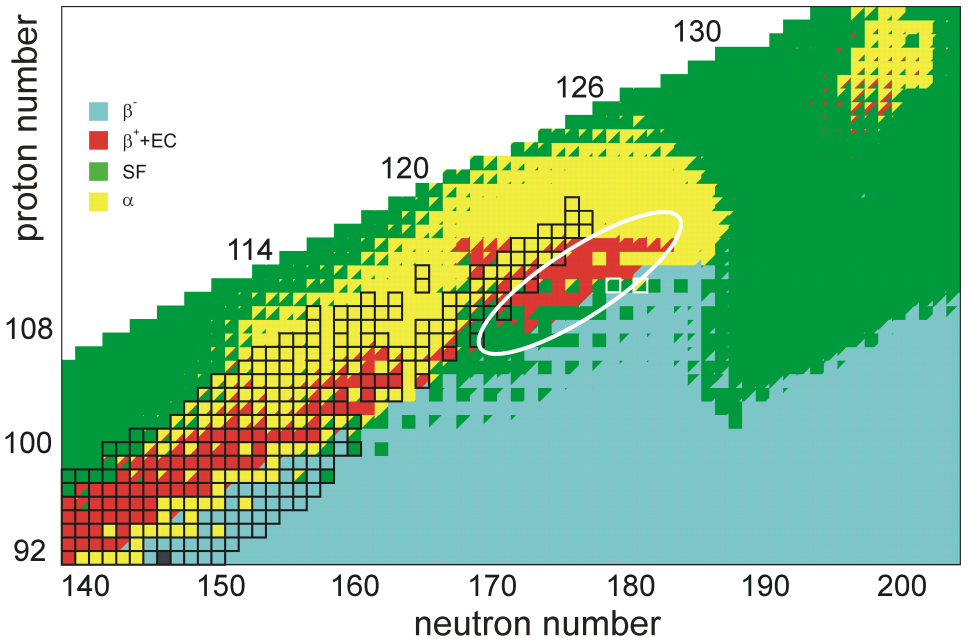
Synthesis and detection
Superheavy elements are generally produced by accelerating a beam of lighter nuclei and colliding it with a heavier target; successful fusion events create a compound nucleus that may decay into a new element. Laboratories use particle accelerators, separators and highly sensitive detectors to identify decay chains and characteristic radiation. Because creation rates are extremely low and half-lives often very short, confirming a new species requires careful repetition and analysis. For general public introductions to these efforts see new elements and the modern periodic table discussions.
Theoretical limits and the "island of stability"
Nuclear theory predicts two important regimes: a region where increasing proton number makes nuclei ever more unstable, and possible "islands of stability" where particular combinations of protons and neutrons confer longer lifetimes. Calculations also consider relativistic effects on inner electrons that alter chemical behavior for very high atomic numbers. Physicists have proposed various upper bounds for how far the periodic table can be extended, but the ultimate maximum atomic number remains uncertain; theoretical studies and predictions continue to refine possible limits and synthesis pathways. Discussions about whether there is a largest possible atomic number are active in the literature and summarized in accessible resources about the topic: see theoretical limits.
Properties and chemistry
When superheavy nuclei exist even for fractions of a second, they can reveal basic nuclear and electronic behavior. Chemical properties may differ from simple periodic trends because of strong relativistic shifts in electron energies; predictions suggest novel oxidation states and bonding for some superheavy elements. Practical chemistry of these atoms is limited by their fleeting existence, so much knowledge comes from decay patterns and a few rapid chemical separation experiments.
History, naming and notable facts
The search for elements beyond uranium (the transuranium elements) has driven nuclear and accelerator science for decades. Discoveries are vetted by international bodies, and new elements receive provisional names and later official names following agreed procedures. The field combines experimental skill, theoretical modeling and international collaboration.
Importance and challenges
Extending the periodic table advances understanding of nuclear forces, the limits of matter, and fundamental chemistry. It also drives the development of detection technologies and accelerator science. Major challenges include extremely low production rates, short lifetimes, and complex background signals. Although most superheavy elements have no practical applications due to their instability, their study enriches basic science and occasionally yields insights with broader technological or theoretical impact.
For readers seeking introductions or updates, authoritative summaries and research reports are available through specialized scientific outlets and institutional pages: for example, reviews on synthesis methods and theoretical models provide deeper technical context and evolving perspectives on how far the periodic table might one day extend. Further reading on element discovery, periodic table resources, and current predictions can guide interested readers.
Related articles
Author
AlegsaOnline.com Extended periodic table and the search for superheavy elements Leandro Alegsa
URL: https://en.alegsaonline.com/art/33008