
Evaporating dish
A shallow laboratory vessel used to evaporate solvents from solutions, concentrating solutes or recovering residues. Commonly ceramic or glass, it is designed for controlled heating and simple separation.
Overview
An evaporating dish is a shallow, open laboratory vessel used to remove a solvent from a solution so that the dissolved substance remains as a residue. It is commonly employed to evaporate aqueous solutions or organic solvent mixtures, turning the liquid phase into vapour while leaving solids behind. Typical tasks include concentrating solutions, isolating salts, and preparing samples for further analysis.
Image gallery
2 Images
Design and materials
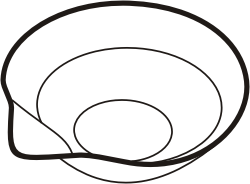
Evaporating dishes are shallow with a wide surface area to speed evaporation. They are made from heat-resistant materials such as glazed porcelain, borosilicate glass, or other ceramics that tolerate direct flame and thermal cycling. The rim may be slightly flared and some dishes have a small pouring spout to aid transfer of residues. Sizes range from small laboratory dishes to larger weighing-dish equivalents.
Common uses and technique
In practice, a solution is poured into the dish and heated gently on a hot plate, in a steam bath, or over a flame. For volatile or heat-sensitive substances, evaporation in a controlled water bath or under reduced pressure is preferred to avoid decomposition or loss. Typical uses include recovering crystallized salts, concentrating analytes for gravimetric analysis, and removing solvents prior to weighing or microscopy.
Precautions and alternatives
When using an evaporating dish beware of bumping, spattering, and loss of volatile analytes. Heating to complete dryness can sinter some residues to the dish and make removal difficult. For precise quantitative work, alternative apparatus such as a crucible, rotary evaporator, or evaporative concentrator may be more appropriate. Evaporating dishes are often cleaned with solvents or detergents and must be stored to avoid chipping.
History and distinctions
Evaporating dishes have been standard in chemical laboratories for centuries, evolving with improvements in ceramic glazing and laboratory glassware. They are distinct from crucibles (which are deeper and intended for melting at high temperatures), watch glasses (which are shallower and used mainly as lids or small evaporation surfaces), and beakers (which are taller and used for mixing or heating larger volumes).
Further information and resources
- Material and temperature guidance: selection of ceramics and glass
- Safety and technique notes: heating liquids safely
- Application examples and protocols: sample preparation and vapour-handling
Modern laboratories continue to use evaporating dishes for simple evaporation tasks because of their low cost and ease of use; choosing the proper material and heating method improves results and prolongs equipment life.
Related articles
Author
AlegsaOnline.com Evaporating dish Leandro Alegsa
URL: https://en.alegsaonline.com/art/32727
Sources
- en.oxforddictionaries.com : "evaporating dish - Definition of evaporating dish in English by Oxford Dictionaries"