
Ethylene (ethene): properties, production, and uses
Ethylene (ethene) is the simplest alkene: a high-volume industrial hydrocarbon used to make plastics, chemicals and as a plant hormone affecting ripening and growth.
Overview
Ethylene, also called ethene, is the simplest alkene and a fundamental organic building block. It is a colorless, flammable gas composed of two carbon atoms and four hydrogen atoms joined by a carbon–carbon double bond. Chemically it is classified as a chemical compound and more specifically as an alkene. The molecular formula is commonly written as C2H4 and the structural feature that defines it is the double bond between the two carbon atoms, which gives the molecule its characteristic reactivity.
Image gallery
10 Images





Structure and properties
Ethylene has trigonal planar geometry at each carbon owing to sp2 hybridization, and its double bond consists of a sigma bond and a pi bond. The pi bond is a region of higher electron density that makes ethylene more reactive than saturated hydrocarbons. As a gas at standard conditions it is odorless in pure form, though industrial streams often carry impurities that produce a sweet or sharp smell. It is a hydrocarbon (hydrocarbon) and behaves as a volatile organic compound in the atmosphere.
Production and industrial processing
Ethylene is produced on a massive scale and is the highest-volume organic chemical produced worldwide. Most industrial ethylene is generated by cracking larger hydrocarbons: thermal steam cracking of naphtha or ethane breaks carbon–carbon bonds to give lighter alkenes. Other methods include catalytic dehydrogenation of ethane and by-product streams from refinery operations. Once produced, ethylene is transported as a pressurized liquefied gas or in gaseous pipelines to downstream plants.
Major uses
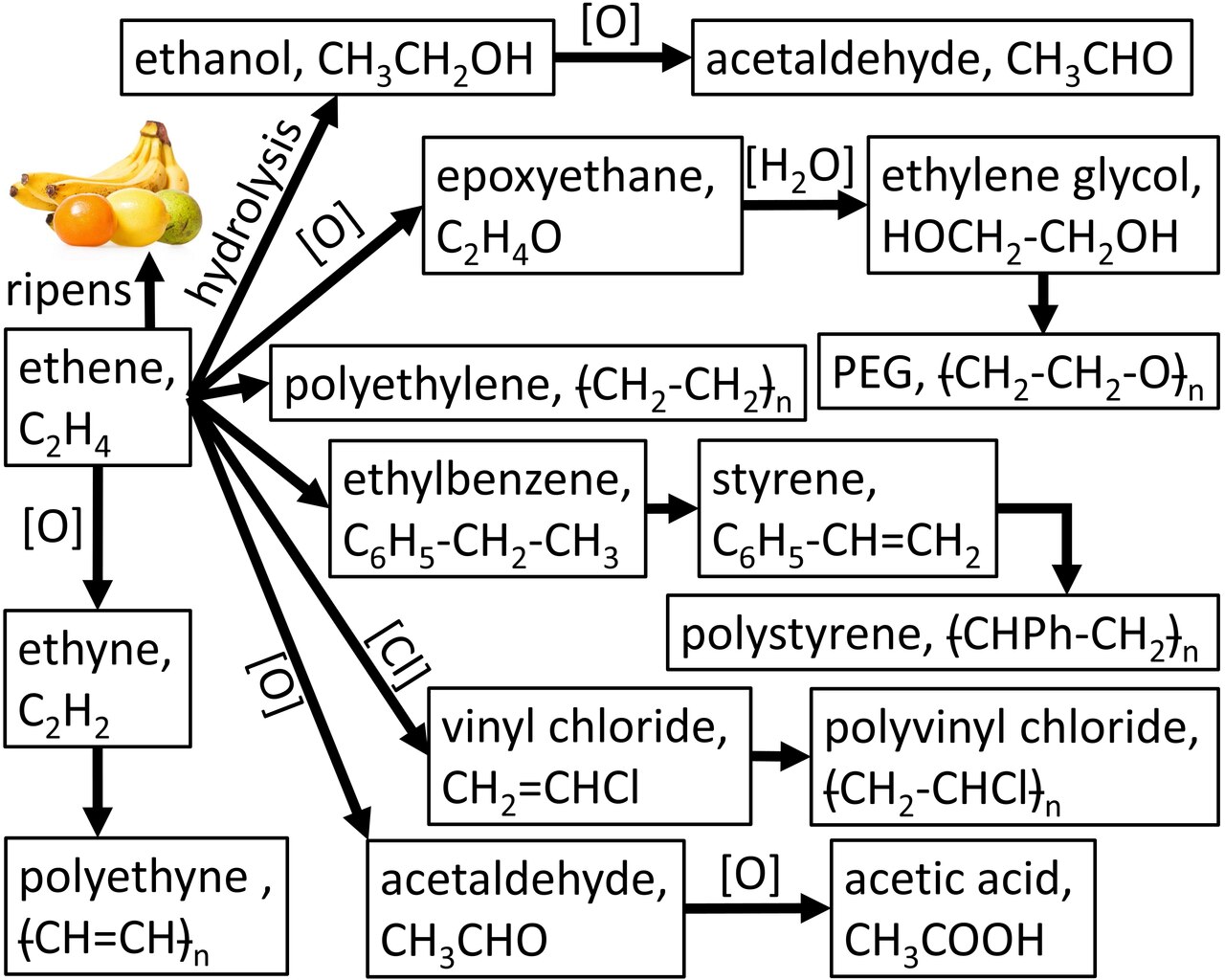
Ethylene is a precursor to a wide array of chemicals and materials. Its principal application is polymerization to form polyethylene, a diverse family of plastics produced using different catalysts and conditions. Other important chemical transformations include oxidation to ethylene oxide and then ethylene glycol, halogenation, and hydration to ethanol. The range of products derived from ethylene spans packaging, fibers, antifreeze, solvents and many intermediates used across the chemical industry.
- Polyethylene (LDPE, HDPE, LLDPE)
- Ethylene oxide and ethylene glycol
- Vinyl chloride and other intermediate chemicals
- Industrial feedstock for a broad range of organic synthesis
Biological role and applications
Ethylene also functions as a simple signaling molecule in plants. It acts as a plant hormone, influencing fruit ripening, flower wilting, leaf drop (abscission) and responses to stress. This biological role has practical implications: controlled ethylene exposure is used commercially to synchronize or accelerate ripening of fruits such as bananas and tomatoes in storage and distribution systems.
History, safety and notable facts
Historically, ethylene was once known as "olefiant gas" because of its oily reaction products with chlorine. Modern catalysis developments — including Ziegler–Natta and metallocene catalysts — greatly expanded the ability to polymerize ethylene into materials with tailored properties. Safety considerations are significant: ethylene is highly flammable and can form explosive mixtures with air, and as a volatile organic compound it participates in atmospheric chemistry that can affect air quality. For more detailed technical or safety information consult dedicated industrial sources and standards (safety guidance, regulatory summaries).
Questions and answers
Q: What is ethylene?
A: Ethylene is a chemical compound composed of two carbon atoms and four hydrogen atoms with a double bond, making it a hydrocarbon.
Q: What is the significance of ethylene in industry?
A: Ethylene is essential in industry due to its wide range of applications in the production of various chemicals.
Q: Can ethylene be used in biology?
A: Yes, ethylene can be used in biology as a hormone.
Q: How much ethylene is produced each year?
A: Since 2005, about 75 million tons of ethylene have been produced each year, making it the most produced chemical.
Q: What is the primary use of ethylene?
A: The primary use of ethylene is in the production of polyethylene.
Q: What kind of bond does ethylene have?
A: Ethylene has a double bond, which makes it a hydrocarbon.
Q: How many hydrogen atoms are in each ethylene molecule?
A: Each ethylene molecule contains four hydrogen atoms.
Related articles
Author
AlegsaOnline.com Ethylene (ethene): properties, production, and uses Leandro Alegsa
URL: https://en.alegsaonline.com/art/32400
Sources
- ncbi.nlm.nih.gov : PMID 12045274
- chem.yale.edu : "Hofmann's Proposal for Systematic Nomenclature of the Hydrocarbons"