
Eta Carinae — a massive luminous blue variable in the Carina Nebula
Eta Carinae is a highly luminous, massive binary system in the southern Carina Nebula, famous for its 19th‑century Great Eruption and the bipolar Homunculus Nebula it expelled.
Overview
Eta Carinae (η Car) is one of the most luminous and massive stellar systems known, located in the southern constellation Carina at a distance of roughly 7,500–8,000 light‑years from the Sun. It is embedded in the giant Carina Nebula and visually dominated by the bipolar Homunculus Nebula, a dense cloud of gas and dust formed in the system's dramatic 19th‑century outburst. Because of its brightness and unusual behaviour, Eta Carinae is a key object for studying extreme mass loss, stellar winds and late stages of the lives of the most massive stars.
Image gallery
10 Images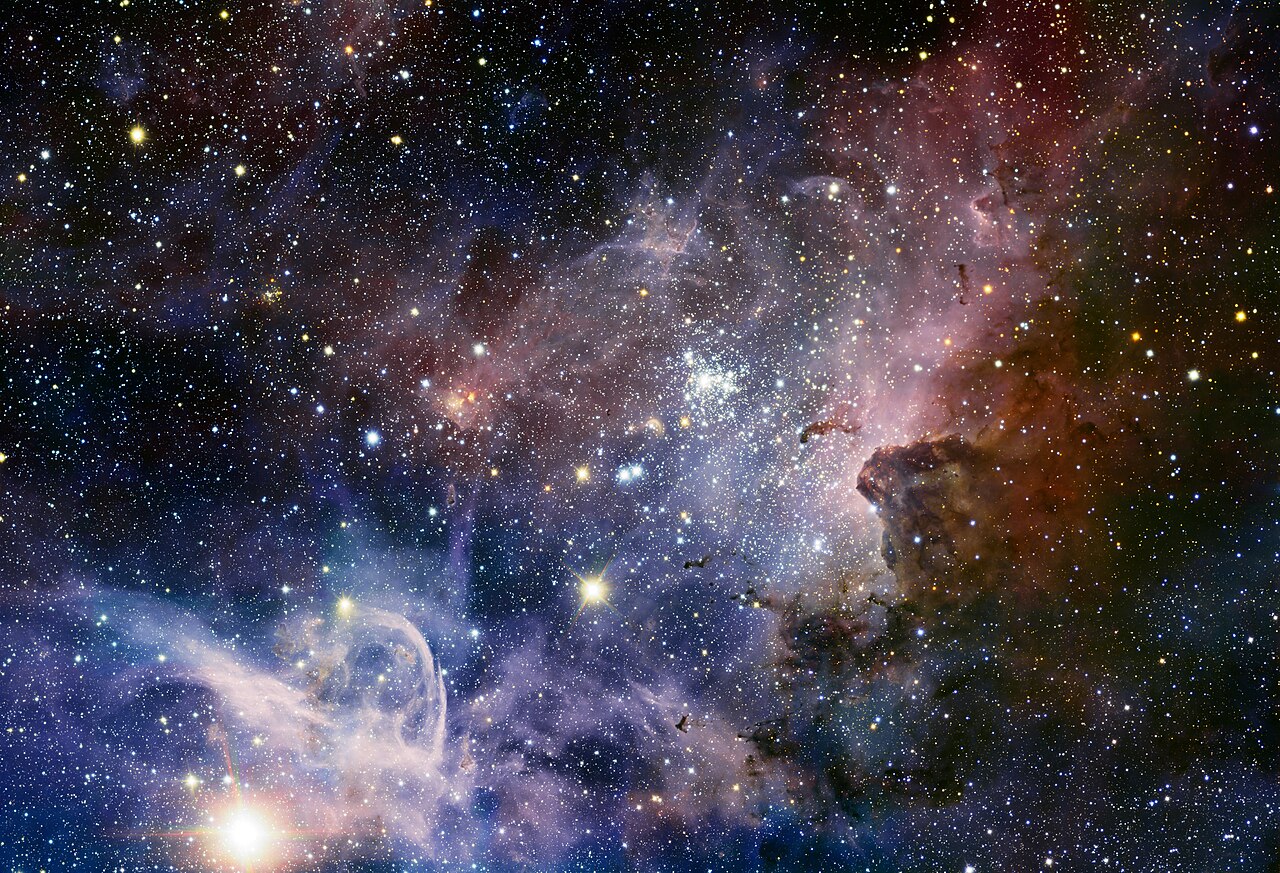



System components and physical characteristics
Eta Carinae is a multiple system dominated by a primary luminous blue variable (LBV)—a very hot, extremely bright and unstable supergiant that has shed a large fraction of its original mass. Most estimates place the primary's original mass on the order of a hundred solar masses, with tens of solar masses lost during eruptive episodes. A hot, massive companion star orbits the primary in a highly eccentric orbit with a period of about 5.5 years; the interaction of their winds produces strong, variable X‑ray emission and complex circumstellar structure.
- Primary: an LBV/hypergiant with extreme luminosity and episodic mass loss (star class).
- Companion: a hot supergiant in an eccentric 5.5‑year orbit that shapes the surrounding gas (companion).
- Environment: the Homunculus Nebula and the wider Carina Nebula provide a dense, dusty envelope that obscures the system at optical wavelengths (Homunculus, Carina Nebula).
- Luminosity: combined output exceeds millions of times that of the Sun (distance and luminosity estimates).
History and the Great Eruption
In the mid‑19th century Eta Carinae underwent the so‑called Great Eruption (peaking around 1843), temporarily becoming one of the brightest stars in the sky and ejecting a large mass of material that now forms the Homunculus. That outburst was not a final supernova but rather a violent, non‑terminal shedding of mass typical of LBV behaviour. The nebula's bipolar lobes and a dense equatorial skirt preserve information about the geometry and energetics of that event.
Observations, multiwavelength studies and scientific importance
Eta Carinae has been observed across the electromagnetic spectrum. Optical and infrared images resolve the Homunculus and trace dust, while ultraviolet, X‑ray and radio observations probe the hot collision zone between the stellar winds and the inner ejecta. High‑resolution spectroscopy reveals periodic changes tied to the orbital motion and to episodic mass ejections. These data make Eta Carinae a natural laboratory for studying massive‑star evolution, wind collisions, dust formation and the processes that precede core collapse.
Notable facts and future fate
The system's extreme mass and evolutionary state mean it is expected to end its life in a core‑collapse supernova or related explosive event sometime in the astronomically near future, though exactly when is uncertain. Its position in the southern sky makes it difficult or impossible to observe from much of the northern hemisphere—the object is effectively a southern‑hemisphere target (visibility limits). Because of its brightness variations and eruptions, Eta Car has been monitored by space telescopes and ground observatories and appears frequently in studies of the most massive stars (LBV behaviour, supernova progenitors).
Further reading and resources
- Constellation Carina — sky context and neighbours.
- Eta Carinae general overview — historic observations and basic facts.
- Star classification — luminous blue variables and hypergiants.
- Distance and luminosity studies — methods and ranges.
- Companion star — role in wind collisions and periodic behaviour.
- Homunculus Nebula — structure formed in the Great Eruption.
- Carina Nebula — the broader star‑forming region.
- Visibility — best viewing latitudes and seasons.
- LBV variability — classification and typical outbursts.
- Supernova expectations — end stages for very massive stars.
Questions and answers
Q: What is Eta Carinae?
A: Eta Carinae is a superbright hypergiant star system located in the constellation Carina, about 7,500 to 8,000 light-years from the Sun.
Q: Does Eta Carinae contain more than one star?
A: Yes, Eta Carinae contains at least two stars, the primary being a luminous blue variable (LBV) and a hot supergiant star in orbit around it.
Q: What is the mass of the primary star in Eta Carinae?
A: The primary star in Eta Carinae initially had around 150 solar masses, of which it has lost at least 30.
Q: What is the Homunculus nebula?
A: The Homunculus nebula is a thick red nebula surrounding Eta Carinae, formed by two stars. It is also part of the much larger Carina nebula.
Q: Is the companion star in Eta Carinae visible through optical telescopes?
A: No, the enormous thick red nebula surrounding Eta Carinae makes it impossible to see the companion optically.
Q: How luminous are Eta Carinae and the Homunculus nebula?
A: Eta Carinae and the Homunculus nebula have a combined luminosity of over five million times the Sun's.
Q: Is it expected for Eta Carinae to explode as a supernova in the future?
A: Yes, due to its mass and the stage of its life, it is expected for Eta Carinae to explode as a supernova in the future.
Related articles
Author
AlegsaOnline.com Eta Carinae — a massive luminous blue variable in the Carina Nebula Leandro Alegsa
URL: https://en.alegsaonline.com/art/32337
Sources
- bbc.co.uk : bbc.co.uk/news/science-environment-50765663
- sciencedirect.com : sciencedirect.com/science/article/pii/S1384107608000547
- adsabs.harvard.edu : adsabs.harvard.edu/abs/2004JAD....10....6F
- arxiv.org : arxiv.org/abs/astro-ph/0606174
- messier.seds.org : messier.seds.org/xtra/ngc/etacar.html