
Euporie (moon) — small retrograde satellite of Jupiter
Euporie is a tiny, retrograde irregular moon of Jupiter discovered in 2001. This article summarizes its discovery, orbit, physical traits, name origin, and relationship to the Ananke group of Jovian satellites.
Overview
Euporie (Jupiter XXXIV) is a small irregular moon that orbits Jupiter in a retrograde direction. First reported in 2001, it is only a few kilometers across and is one of the many minor satellites that circle the giant planet at large distances and with inclined, eccentric orbits. Because of its size and faintness it is observed only with large telescopes and studied mostly through its orbital motion rather than direct imaging.
Image gallery
2 Images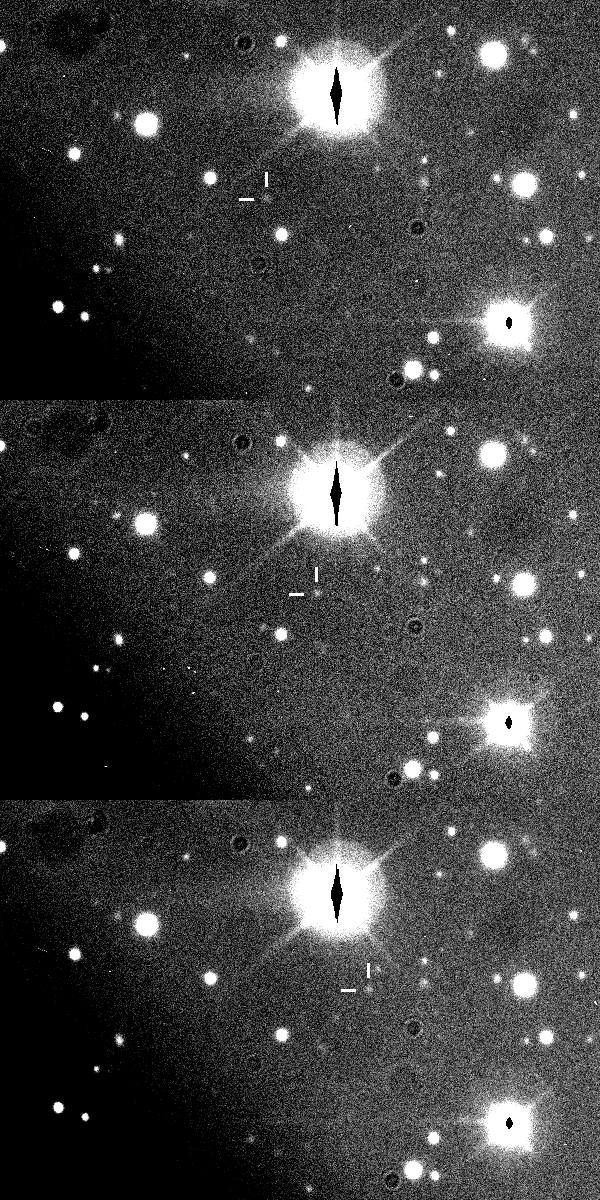

Discovery and naming
Euporie was discovered by a team led by Scott S. Sheppard and colleagues from the University of Hawaii and was given the provisional designation S/2001 J 10. The discovery team is often credited specifically by name in records; see work associated with Scott S. Sheppard for additional context. In 2003 the moon received the name Euporie, after a minor Greek goddess associated with abundance and one of the Horae. This naming follows the convention of assigning names from classical mythology that are linked to Zeus (the Greek counterpart of Jupiter) or to figures appropriate for retrograde Jovian moons; see references on Greek mythology, the Horae, and Zeus.
Orbit and physical characteristics
Euporie is a tiny, non-spherical body with an estimated diameter of about 2 kilometers. Its orbit is markedly inclined and eccentric compared with the regular, large moons of Jupiter. Key orbital parameters include:
- Average orbital distance: approximately 19,088,000 km from Jupiter
- Orbital period: about 538.78 days
- Inclination: roughly 145° to the ecliptic, indicating a retrograde orbit (ecliptic reference)
- Eccentricity: near 0.0960, meaning the orbit is modestly elliptical (eccentricity reference)
Group membership and origin
Euporie is usually associated with the Ananke group, a family of retrograde irregular satellites that share similar orbital parameters and are thought to have a common origin. Members of this group orbit at roughly similar distances and inclinations and are interpreted as fragments of a single progenitor object that was captured by Jupiter and later disrupted. Euporie lies near the inner edge of the range commonly cited for the Ananke group and, as with other small group members, is likely an elongated, irregular fragment rather than a spherical body (non-spherical).
Scientific importance and observation
Because Euporie is very small and faint, it contributes to studies of the population and dynamics of Jupiter’s irregular satellites rather than to detailed surface science. Tracking its motion helps refine models of Jupiter’s satellite capture processes, collisional history among captured bodies, and long-term orbital evolution under planetary perturbations. Continued observations with larger telescopes can improve orbital elements and help determine whether its color and reflectance match other Ananke-group members, a test of the common-origin hypothesis.
Notable facts and distinctions
Unlike Jupiter’s regular Galilean moons, which formed in a circumplanetary disk, Euporie belongs to the irregular class and moves on a retrograde, inclined path. Its discovery in the early 21st century reflects advances in digital imaging and survey techniques that have revealed dozens of small Jovian satellites. For more on the discovery team, orbital data, and mythological naming, consult sources linked above and dedicated catalogs of planetary satellites.
Related articles
Author
AlegsaOnline.com Euporie (moon) — small retrograde satellite of Jupiter Leandro Alegsa
URL: https://en.alegsaonline.com/art/32545
Sources
- cfa-www.harvard.edu : IAUC 7900: Satellites of Jupiter
- cfa-www.harvard.edu : MPEC 2002-J54: Eleven New Satellites of Jupiter
- cfa-www.harvard.edu : IAUC 8177: Satellites of Jupiter, Saturn, Uranus