
Eurydome (Jupiter moon)
Eurydome (Jupiter XXXII, S/2001 J 4) is a small, retrograde irregular moon of Jupiter discovered in 2001; it belongs to the Pasiphaë group and orbits at ~23.2 million km.
Overview
Eurydome—also recorded as Jupiter XXXII and provisionally designated S/2001 J 4—is a small irregular satellite of Jupiter. It was discovered in 2001 by a team from the University of Hawaii led by Scott S. Sheppard, and later given the name Eurydome in 2003. The moon is faint and only a few kilometres across, typical of the many minor outer satellites that orbit Jupiter at large distances.
Image gallery
3 Images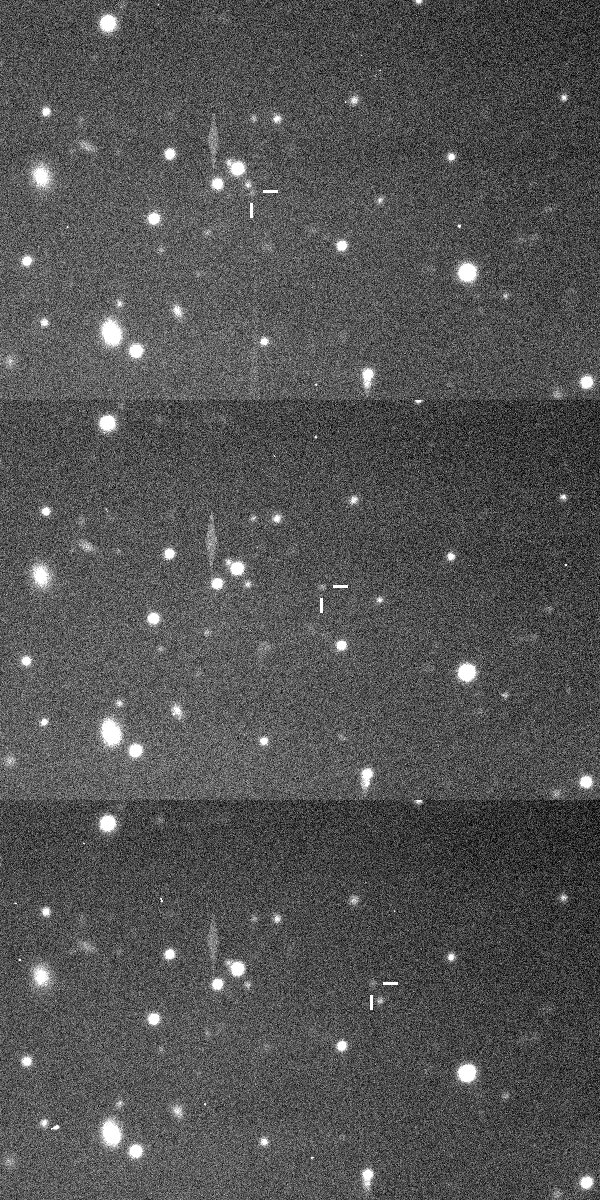


Physical characteristics
Eurydome is estimated to be about 3 kilometres in diameter. Like other small outer moons it is non-spherical and likely an irregularly shaped fragment rather than a rounded body. Its surface composition is not well characterized; observations are limited to broadband photometry and motion tracking, so composition, albedo and detailed geology remain largely unknown.
Orbit and dynamics
Eurydome follows a retrograde, highly inclined and eccentric orbit. Its average orbital distance from Jupiter is roughly 23,231,000 km and its orbital period is about 723.359 days. The inclination is close to 149° to the ecliptic (about 147° relative to Jupiter's equator), and the orbital eccentricity is approximately 0.3770. These parameters place it among Jupiter's irregular satellites, whose orbits are thought to be the result of past capture and collisional processes rather than formation in a regular circumplanetary disk.
Group membership and origin
Eurydome is classified as a member of the Pasiphaë group, a collection of retrograde irregular moons that share similar orbits. Members of the Pasiphaë group orbit at distances between roughly 22,800,000 and 24,100,000 km and have inclinations in the range of about 144.5° to 158.3°. The shared orbital parameters suggest a common origin, perhaps as fragments from the capture and subsequent disruption of a single progenitor body.
Discovery, naming, and observation
The discovery team from the University of Hawaii and astronomer Scott S. Sheppard identified Eurydome in 2001 using deep, wide-field imaging and follow-up astrometry. The moon was initially listed as S/2001 J 4 before receiving its official name in August 2003. The name comes from Greek mythology; Eurydome is sometimes cited as the mother of the Charites (the Graces) by Zeus, the Greek counterpart of Jupiter—this association is reflected in the naming convention linking Jovian satellites to figures related to Zeus/Jupiter (mythology, the Graces, Zeus/Jupiter).
Scientific importance and distinctions
Small irregular satellites such as Eurydome are valuable to planetary science because they provide clues about the processes of capture, collisional fragmentation, and the dynamical evolution of giant-planet satellite systems. Eurydome differs markedly from Jupiter's large regular moons (the Galilean satellites) in size, orbit, and origin: it is tiny, moves on a retrograde and highly inclined trajectory, and is almost certainly a captured and subsequently modified object. Continued tracking of objects like Eurydome refines our understanding of the Pasiphaë group's extent and history, and helps test models of satellite capture and family formation (Pasiphaë group).
Observation challenges and future study
Because Eurydome is small and faint, observations require large telescopes and multiple nights to confirm motion against background stars. Future work would aim to obtain spectra or better photometry to constrain its surface properties and possible relation to other group members. Such studies rely on coordinated surveys and follow-up astrometry by observatories and teams engaged in outer-satellite discovery and characterization (orbital reference, eccentricity data, shape note).
- Discovery record: University of Hawaii survey, lead Scott S. Sheppard
- Provisional designation: S/2001 J 4
- Group: Pasiphaë group
- Mythological name origin: Eurydome and related figures (Graces, Zeus/Jupiter)
For additional data and observational updates consult dedicated satellite catalogs and recent survey publications (designation records, survey teams, discoverer notes, orbital references, eccentricity references, naming sources, mythology, naming conventions, group classification, shape and physical notes).
Questions and answers
Q: What is Eurydome?
A: Eurydome is a moon of Jupiter.
Q: Who discovered Eurydome?
A: Eurydome was found by a team of astronomers from the University of Hawaii led by Scott S. Sheppard in 2001.
Q: What is the diameter of Eurydome?
A: Eurydome has a diameter of about 3 kilometres.
Q: What is the average distance of Eurydome from Jupiter?
A: Eurydome orbits Jupiter at an average distance of 23,231,000 km.
Q: How long does it take for Eurydome to orbit Jupiter?
A: Eurydome completes one orbit around Jupiter in 723.359 days.
Q: Why was Eurydome named after Eurydome in Greek mythology?
A: Eurydome was named after Eurydome in Greek mythology, who is sometimes described as the mother of the Graces by Zeus (Jupiter).
Q: What group does Eurydome belong to?
A: Eurydome belongs to the Pasiphaë group, which consists of non-spherical retrograde moons that orbit Jupiter at distances ranging between 22,800,000 and 24,100,000 km, and with inclinations ranging between 144.5° and 158.3°.
Related articles
Author
AlegsaOnline.com Eurydome (Jupiter moon) Leandro Alegsa
URL: https://en.alegsaonline.com/art/32664
Sources
- cfa-www.harvard.edu : IAUC 7900: Satellites of Jupiter
- cfa-www.harvard.edu : MPEC 2002-J54: Eleven New Satellites of Jupiter · webcitation.org
- cfa-www.harvard.edu : IAUC 8177: Satellites of Jupiter, Saturn, Uranus