
Exosphere (outermost layer of a planetary atmosphere)
The exosphere is the outermost, extremely rarified layer of a planet's atmosphere where particles move ballistically and may escape into space; composition and extent vary with solar activity.
Overview
The exosphere is the highest region of a planet's atmosphere, a transition zone between the bound atmosphere and interplanetary space. In this region the gas is so tenuous that individual atoms and molecules travel long distances without colliding with one another. Because particles follow ballistic trajectories and can reach escape velocity, the exosphere is the layer most directly connected to atmospheric loss and to the space environment surrounding a planet.
Image gallery
6 Images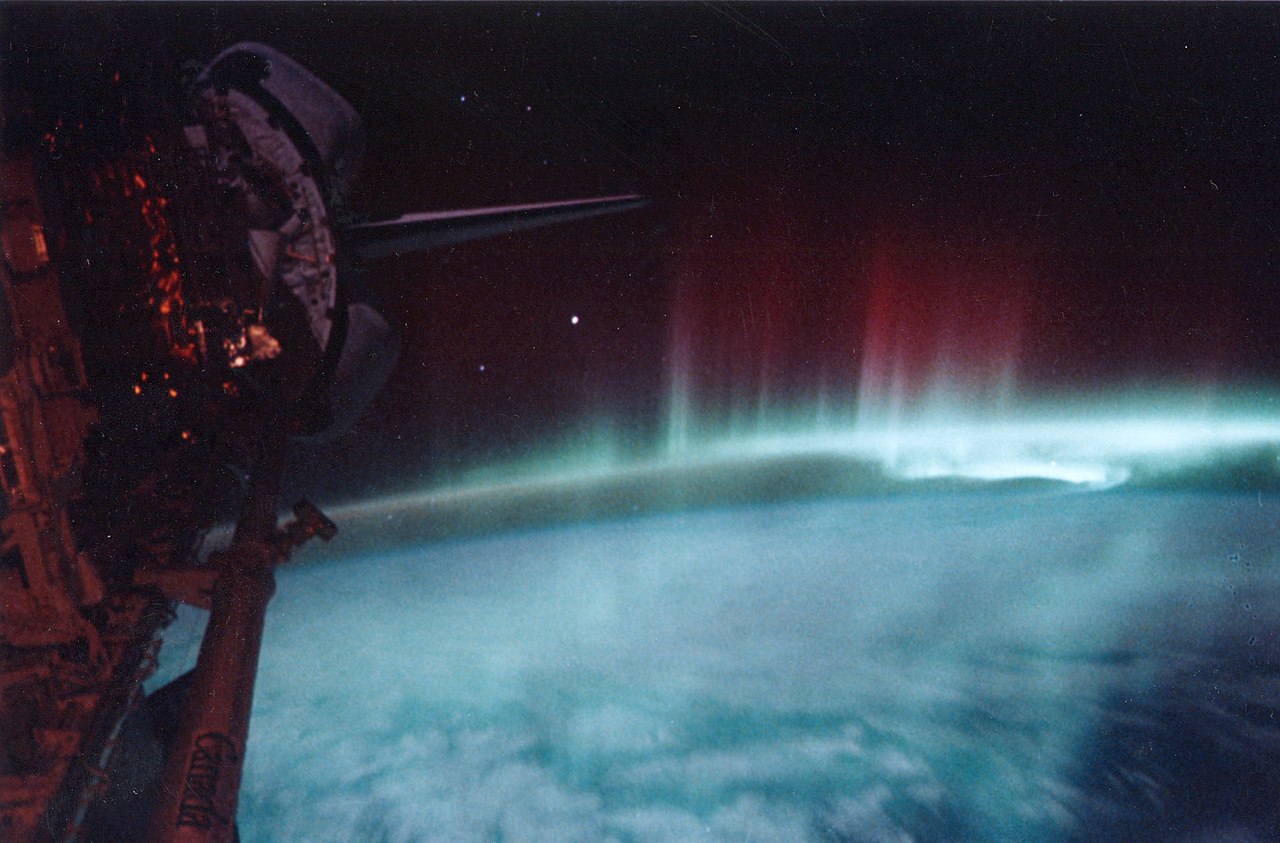




Characteristics and composition
The exosphere contains the lightest gases in greatest abundance at high altitudes. On Earth and similar planets the dominant constituents at high altitudes include hydrogen and helium, while heavier species such as carbon dioxide and atomic oxygen are concentrated closer to the layer's base. Temperature in the exosphere is often described in terms of particle kinetic energy and can be very high; however, the extremely low density means the total heat content is small and conventional notions of temperature must be applied with care.
The lower boundary of the exosphere is called the exobase or the thermopause and typically lies several hundred kilometres above a planetary surface (for Earth this is often on the order of a few hundred kilometres, varying with solar activity). Above the exobase collisions are rare and particles follow nearly collisionless paths. There is no sharply defined upper boundary: the exosphere gradually thins and merges into the background of the solar wind and interplanetary medium.
Formation, escape processes, and dynamics
The exosphere forms where atmospheric density becomes too low for frequent collisions to sustain a local thermodynamic equilibrium. Several processes supply and remove particles in this region. Thermal escape (Jeans escape) allows the fastest atoms and molecules to overcome gravity, while non-thermal mechanisms — including photochemical reactions, sputtering by energetic particles, and impact vaporisation from micrometeoroids — can eject neutrals and ions into space. Solar ultraviolet radiation and the solar wind strongly influence these processes, causing the extent and composition of the exosphere to vary with solar activity.
- Jeans escape: slow, thermal loss of light atoms that achieve escape velocity.
- Photochemical and non-thermal loss: energetic reactions and collisions that accelerate particles.
- Magnetospheric coupling: charged particles are affected by magnetic fields and may be guided or trapped, altering the effective loss rates.
Exospheres of other worlds
Not all exospheres are like Earth's. Airless or nearly airless bodies such as the Moon and Mercury have extremely tenuous exospheres composed of atoms and molecules released by surface sputtering, thermal desorption, and micrometeoroid impacts. These populations are so sparse that they are often described simply as surface-bounded exospheres. By contrast, giant planets have very extended exospheres that blend into their magnetospheres and the surrounding plasma environment.
Practical importance and observations
The exosphere matters for several practical and scientific reasons: it is the region where satellites in high orbits operate, it affects drag on spacecraft at very high altitudes, and it is the gateway for long-term atmospheric loss. Observations come from in situ instruments (mass spectrometers and particle detectors on spacecraft), remote sensing of emission and absorption signatures, and theoretical modelling. Spacecraft measurements and ground-based observations together reveal how the exosphere responds to seasonal changes, solar flux, and geomagnetic activity.
Distinctions and notable facts
The exosphere is distinct from the thermosphere, which lies below the exobase and where collisions are still frequent enough to define a local temperature. It is also distinct from the magnetosphere, which is dominated by magnetic and plasma processes rather than neutral gas dynamics. Understanding the exosphere helps scientists trace how atmospheres evolve over geologic time, why some worlds retain thick atmospheres while others do not, and how planetary environments interact with the space surrounding them.
For further technical details and measurements, consult mission reports and dedicated atmospheric studies that combine particle data and remote sensing to characterise exospheric structure and variability.
Related articles
Author
AlegsaOnline.com Exosphere (outermost layer of a planetary atmosphere) Leandro Alegsa
URL: https://en.alegsaonline.com/art/32959