
Hypergiant (luminosity class 0): enormous, unstable stars
Extremely luminous, massive stars that lose mass rapidly and live only a few million years. Overview of classification, structure, examples (Stephenson 2-18, NML Cygni, UY Scuti), formation and significance.
A hypergiant is an exceptionally massive and luminous star formally associated with luminosity class 0. These objects stand above ordinary supergiants in size and brightness and exhibit signs of extreme instability and strong mass loss. The term is applied by observers and catalogers to stars whose spectra and atmospheres show expanded outer layers, emission lines, or other indicators of intense wind-driven shedding of material. For general context see star classification resources.
Image gallery
9 Images





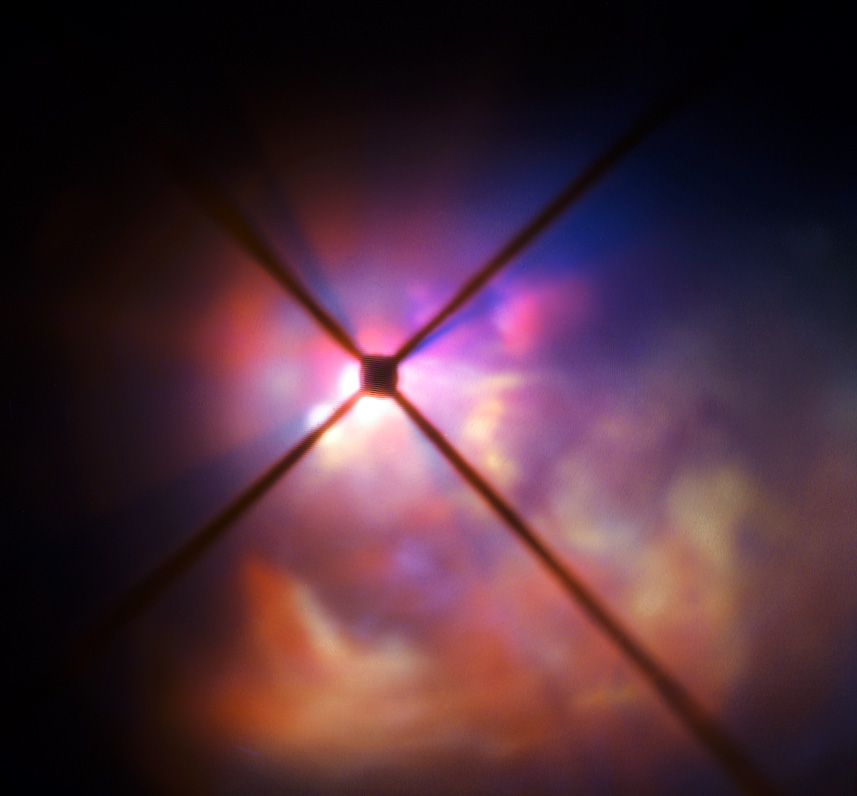
Defining traits and structure
Hypergiants are identified by a combination of high luminosity, large radius, broad or peculiar spectral lines, and evidence of significant outflow. They may be blue and hot (luminous blue hypergiants) or red and cool (red hypergiants), and many show episodic eruptions or variable brightness. Their outer envelopes are often convective and extended, and radiation pressure contributes to instability. Observers refer to catalogs and studies when assigning the class; discussions of precise criteria can be found through specialist pages such as classification discussions and reviews like mass-loss studies and luminosity analyses.
Formation, evolution and lifespan
Hypergiants form from the most massive stellar progenitors. Their cores burn fuel at a prodigious rate, so despite their size they have short lifetimes measured in millions rather than billions of years. As they evolve they can pass through phases characterized by heavy winds, eruptions, or pulsations that peel away layers of the star. Some evolve from hot blue stages into cool red hypergiants or vice versa, depending on initial mass and composition. Their rapid evolution and extreme mass loss make them important contributors to the chemical enrichment of their surroundings; for broader background see cosmic context.
Notable examples and measurements
A few well-studied stars often cited as hypergiants include Stephenson 2-18, NML Cygni, and UY Scuti. Estimates place Stephenson 2-18 among the largest known, with a radius on the order of thousands of solar radii, and NML Cygni is another very large red evolved star. Published radius estimates vary and are continually refined with better distance and modeling; for large-star comparisons consult resources such as size catalogs, observational papers, and individual object pages like NML Cygni notes or UY Scuti summaries. Readers should treat specific numeric values as estimates rather than fixed constants.
Scientific importance and observational challenges
Hypergiants are rare and often heavily obscured by dust or located in crowded regions, which complicates distance and size determinations. They are astrophysically important because their winds and eruptions influence star-forming regions and later supernova behavior. Observations in multiple wavelengths, long-term monitoring, and spectral modeling are all used to study their unstable atmospheres. For instrumentation and observational techniques see additional summaries such as observing large stars.
Key distinctions and open questions
- Distinction from supergiants: hypergiants show more extreme mass loss and spectral signs of instability than typical supergiants.
- Classification ambiguity: astronomers continue to refine quantitative criteria for the class; see expert discussions at classification resources and working definitions.
- Uncertainties: distances, radii, and evolutionary fate remain areas of active research; updated results appear in targeted studies and catalog updates such as luminosity surveys and review articles.
Questions and answers
Q: What is a hypergiant star?
A: A hypergiant star is a star with an enormous mass and luminosity, showing signs of a very high rate of mass loss.
Q: How are hypergiants different from supergiants?
A: Hypergiants are usually larger than supergiants and are the largest stars in the universe.
Q: What is the largest hypergiant star known?
A: The hypergiant with the largest known diameter is Stephenson 2-18, which is about 2,150 times wider than the Sun.
Q: What is NML Cygni?
A: NML Cygni is another large hypergiant star that is about 1,650 times wider than the Sun.
Q: What is UY Scuti?
A: UY Scuti is a pulsating red hypergiant star that is probably larger than any other star with a radius of about 1,700 times the Sun.
Q: Why do hypergiants have a short lifespan?
A: Hypergiants have a short lifespan because of their size, even a few million years, whereas the Sun has a lifespan of around 10 billion years.
Q: Are hypergiants easy to find?
A: No, hypergiants are very hard to find.
Related articles
Author
AlegsaOnline.com Hypergiant (luminosity class 0): enormous, unstable stars Leandro Alegsa
URL: https://en.alegsaonline.com/art/46158
Sources
- space.com : "What Is the Biggest Star?"
- books.google.com : Investigating the circumstellar environments of the cool hypergiants
- arxiv.org : 0801.2519
- ui.adsabs.harvard.edu : 2008IAUS..250...71O
- doi.org : 10.1017/S1743921308020358
- arxiv.org : astro-ph/0409573
- ui.adsabs.harvard.edu : 2004ApJ...616..525O
- doi.org : 10.1086/424910
- arxiv.org : astro-ph/0606174
- ui.adsabs.harvard.edu : 2006ApJ...645L..45S
- doi.org : 10.1086/506523