
Eros — Greek god of love and desire
Eros is a figure in Greek mythology associated with love, sexual desire, and procreative force. His myths, symbols and later cultural legacy span ancient poetry, philosophy, art and modern language.
Eros is a central figure in ancient Greek religion and literature commonly identified with sexual love, desire and attraction. Classical sources treat him variously as a primordial force and as an anthropomorphic deity who intervenes in human affairs. As a personification of erotic power he appears across myths, poetry and visual art, and his name is the root of modern terms such as "erotic" and "eroticism". Many modern descriptions also contrast his impulsive, passionate nature with other Greek concepts of affection.
Image gallery
10 Images





Origins and genealogy
Early cosmological accounts present Eros as an elemental principle. In Hesiod's account in Theogony he arises in the earliest generations after Chaos, a force involved in bringing order and fertility to the cosmos; this is emphasized in ancient poetic cosmogony (Hesiod). By contrast, later mythography and cultic tradition often portray Eros as a younger, more personal god: the son of Aphrodite and sometimes of Ares or another consort. These divergent genealogies reflect different ways the Greeks understood love—both as a metaphysical principle and as an active deity in social life.
Myths and literature
The best-known narrative featuring Eros is the tale of Psyche, which survives most fully in the Latin novel by Apuleius but draws on Greek oral traditions. In that story, Eros both causes and resolves human trials: his arrows induce passion, yet his relationship with Psyche also becomes a parable about trust, trials and divine favor. Eros also appears indirectly in many other works—poetry, drama and philosophical texts. Philosophers such as Plato discussed Eros as a motivating principle of desire and creativity, distinguishing different kinds of love in ethical and metaphysical contexts.
Attributes and symbolism
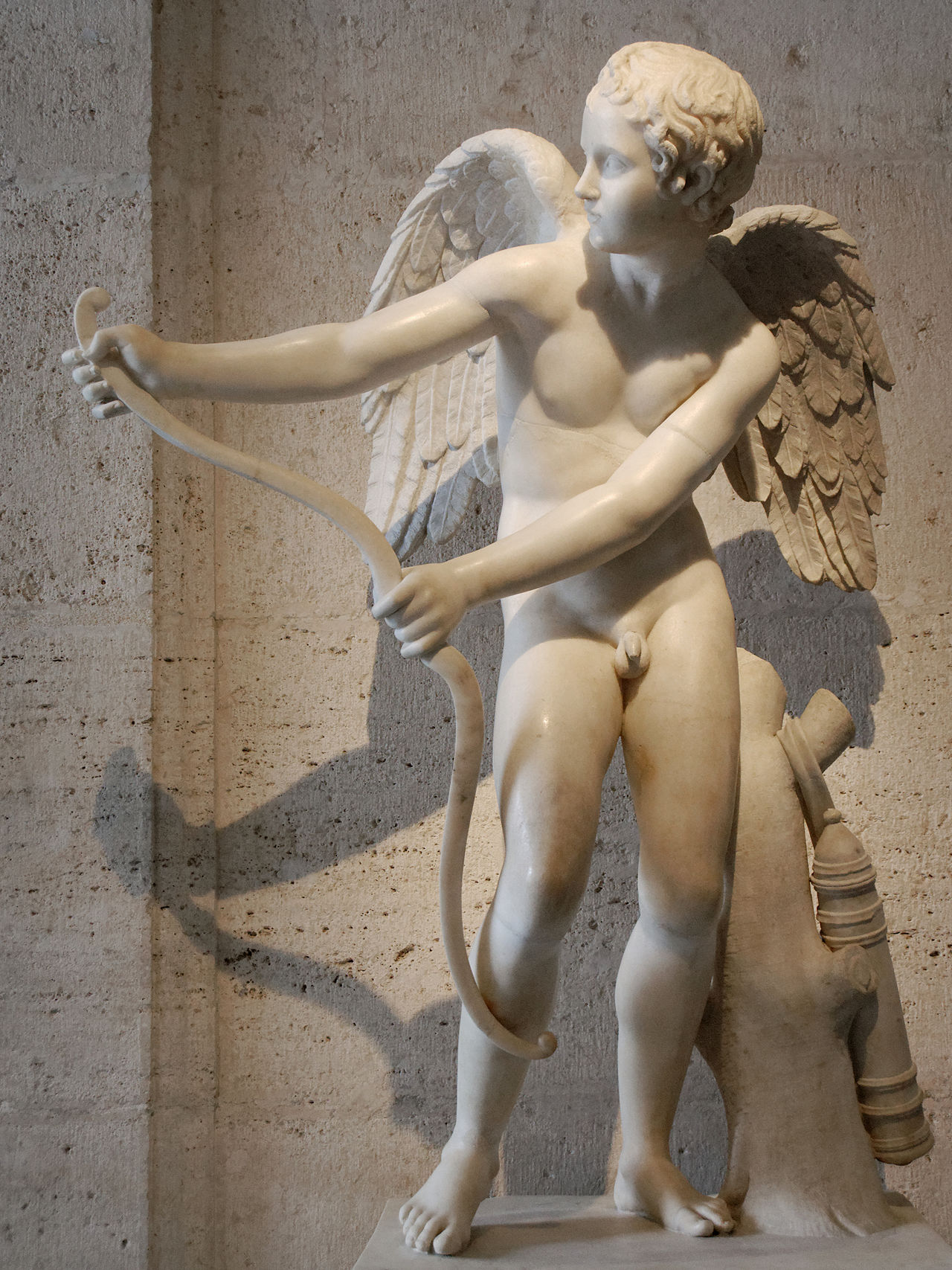
In art and myth Eros is commonly associated with the bow and arrows, instruments that make mortals and gods fall in or out of love. Tradition describes golden arrows that inflame desire and leaden arrows that dull affection or provoke aversion. He is frequently depicted as a winged youth or child—sometimes mischievous, sometimes benevolent—reflecting the sudden and unpredictable character of attraction. In Roman art and literature his counterpart is Cupid, who shares many attributes and stories with the Greek figure.
Iconography, cult and notable distinctions
Eros appears in a wide range of media from vase-paintings to Roman frescoes, and later Renaissance and modern works. Popular images vary: some emphasize erotic playfulness, others the deeper, creative power of desire. A famous London monument often called "Eros" actually represents Anteros; it stands in Piccadilly Circus and is commonly misidentified by visitors. Eros should be distinguished from other Greek concepts of love such as philia (friendship) and agape (broader benevolence): he personifies sexual and passionate attraction rather than social or familial bonds.
Legacy and language
The figure of Eros has left a lasting imprint on Western thought and language. The adjective "erotic" and the noun "eroticism" derive from his name and denote matters related to sexual desire and sensuality. Literary and artistic traditions have repeatedly returned to Eros to explore desire's moral, social and psychological dimensions. While rooted in ancient religion, his image has been adapted by philosophy, psychoanalysis, visual art and popular culture as an emblem of both peril and creative energy.
Quick reference
- Love: Eros is closely associated with romantic and sexual love.
- Lust: aspects of physical desire often fall within his domain.
- Sex: Eros is linked to procreative and erotic impulses.
- Greek mythology: his stories are part of the Hellenic mythic corpus.
Related articles
Author
AlegsaOnline.com Eros — Greek god of love and desire Leandro Alegsa
URL: https://en.alegsaonline.com/art/32041