
Excalibur — the legendary sword of King Arthur
Excalibur is the legendary sword associated with King Arthur in British tradition; a symbol of sovereignty, martial power, and mythic justice with varied medieval origins and modern adaptations.
Excalibur is the name given to a famous sword in the body of stories surrounding King Arthur. In legend it functions both as a weapon and as a mark of rightful rule: possession or receipt of the sword often validates Arthur's kingship and ties him to supernatural or divine authority. The sword appears in many versions of the Arthurian cycle and has become a widely used symbol in literature, film, and popular culture.
Image gallery
9 Images




Characteristics and symbolism
Accounts differ about Excalibur's appearance and powers. Some narratives describe it as an ornate, magical blade that shines, never dulls, and gives its bearer victory in battle; other tellings emphasize its role as an emblem of sovereignty rather than a repository of explicit magical abilities. The weapon is commonly associated with themes of legitimacy, sacred kingship, and the close link between king and land. Returning the sword to the water at a ruler's death reinforces the idea that authority is loaned by supernatural forces.
Origins and medieval sources
Medieval writers contributed different names and backstories. The Latin historian Geoffrey of Monmouth used a form related to Caliburnus, which later evolved into the familiar name. Earlier Celtic sources may have influenced the motif: Welsh tradition contains a cognate name, and other continental tales feature swords with comparable roles. Major medieval prose cycles and romances — including the Vulgate Cycle and Sir Thomas Malory's Le Morte d'Arthur — present variant accounts that shaped later interpretations.
Narrative variants: stone, lake, and returning the sword
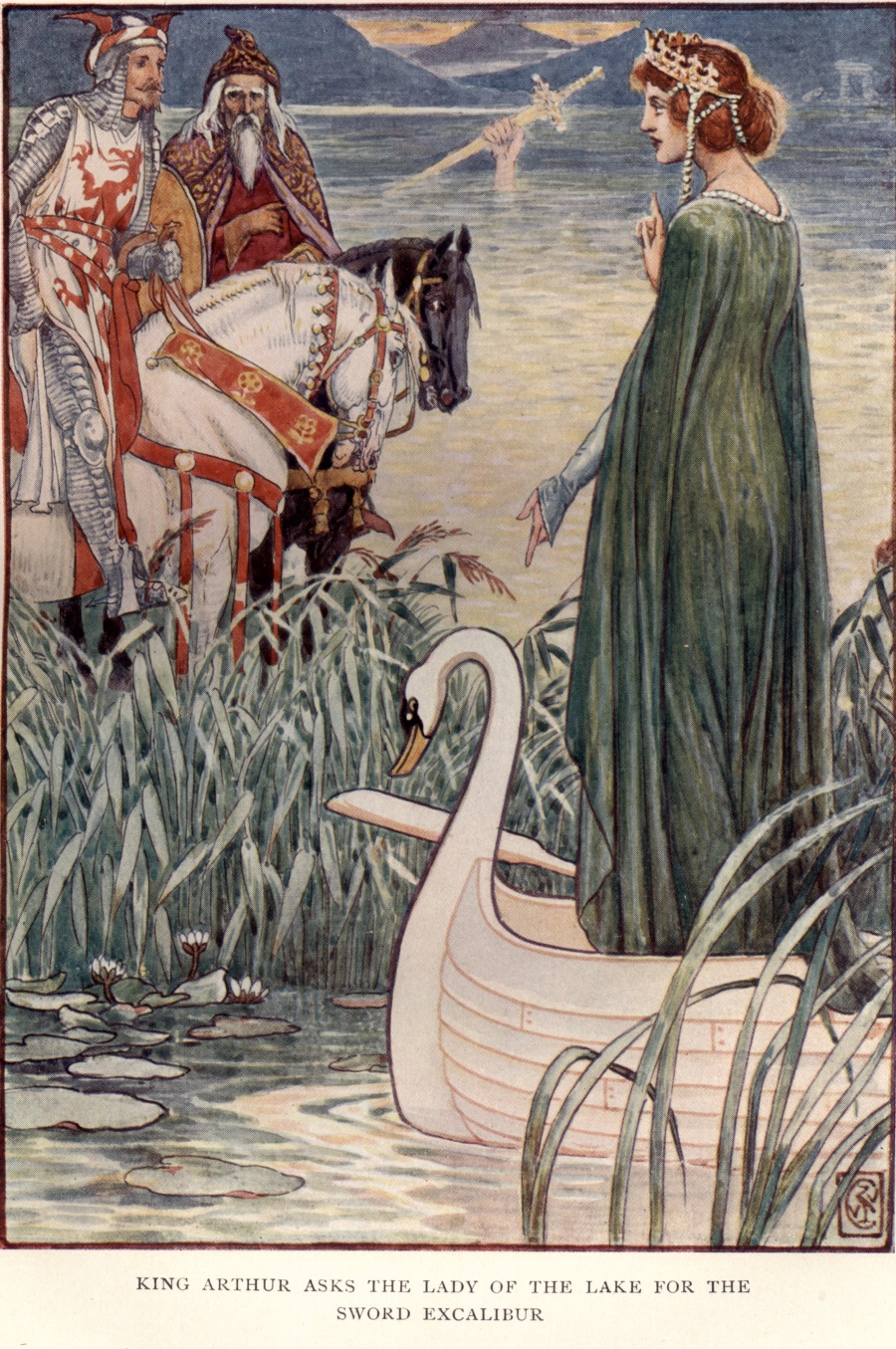
Two recurring motifs appear across versions. In one, the king is identified by pulling a sword from an anvil or stone, an act that proves his divine right to rule. In another tradition, Arthur receives the sword from a mystical maiden of the lake (often called the Lady of the Lake or by individual names), who later reclaims it by taking Excalibur back into the water when Arthur is dying. Some retellings treat these as separate swords or merge them into a single weapon; the texts do not agree uniformly, and later authors freely adapted the material.
Major texts and cultural influence
- Geoffrey of Monmouth's historical-legendary accounts introduced early forms of the name and helped popularize the tale.
- Medieval romances and cycles developed distinct narrative threads that modern readers know as Arthurian legend.
- Modern literature and cinema — from Victorian retellings to 20th-century novels (for example, the works of T. H. White) and films like John Boorman's adaptation — have sustained and transformed the image of Excalibur.
The sword's name and image have been adopted beyond literature: it appears in art, music, military nomenclature, and as a metaphor in politics and business, underscoring its lasting symbolic power.
Distinctions and notable facts
Scholars emphasize caution about treating any single medieval detail as definitive. Whether Excalibur and the sword in the stone are identical is a matter of literary tradition rather than historical fact; different manuscripts and authors resolve the question in different ways. Attempts to link the legend to archaeological finds or real rulers are speculative. For introductions and further reading on the topic see general treatments of Arthurian myth and folklore: Excalibur overview, accounts of mythological motifs, regional histories of Great Britain, and biographical summaries of King Arthur.
As a cultural object, Excalibur endures because it combines the practical drama of heroism with enduring questions about where authority comes from and how leaders are recognized and held accountable. Its flexibility across contexts — sacred gift, test of right, or tragic loss — helps explain why storytellers continue to reinterpret the sword for new audiences.
Questions and answers
Q: What is Excalibur?
A: Excalibur is a legendary sword in the mythology of Great Britain.
Q: Who was Excalibur owned by?
A: Excalibur was owned by King Arthur.
Q: In what ways has Excalibur become widespread in popular culture?
A: Excalibur and its name are widely used in fiction and films.
Q: What is Excalibur a symbol of?
A: Excalibur is a symbol of divine kingship and great power.
Q: Why is Excalibur so famous?
A: Excalibur is famous because of its association with King Arthur and its status as a symbol of great power and divine kingship.
Q: Is Excalibur a real sword?
A: No, Excalibur is a legendary sword from mythology and is not a real object.
Q: What role does Excalibur play in popular culture?
A: Excalibur is often used as a plot device or key symbol in popular culture, representing great power and the ability to overcome difficult challenges.
Related articles
Author
AlegsaOnline.com Excalibur — the legendary sword of King Arthur Leandro Alegsa
URL: https://en.alegsaonline.com/art/32874