
Epistasis: genetic interactions between loci
Epistasis describes how alleles at one genetic locus can modify or mask the effects of alleles at another locus, affecting phenotype, genetic architecture, and evolutionary dynamics.
Epistasis is the phenomenon in which the effect of an allele at one genetic locus depends on alleles present at one or more other loci. The word was coined by William Bateson in the early 20th century to name cases where one 'factor' overrides or modifies the action of another. Epistasis contrasts with simple independent action of genes: rather than each locus contributing an effect that sums without interaction, epistatic relationships produce outcomes that cannot be predicted by examining loci in isolation.
Epistasis is closely related to classical genetics and to the work of Gregor Mendel. Mendel's controlled crosses and Mendel's experiments on the sweet pea established basic rules of segregation and independent assortment, but later geneticists noticed many cases where one pair of factors alters the appearance produced by another. Modern readers generally use the term gene and phenotype to describe the same relationships Bateson observed: a mutation at one locus can mask, enhance or modify the phenotypic expression produced by alleles at a different chromosome or locus.
Image gallery
4 Images


Types and classical examples
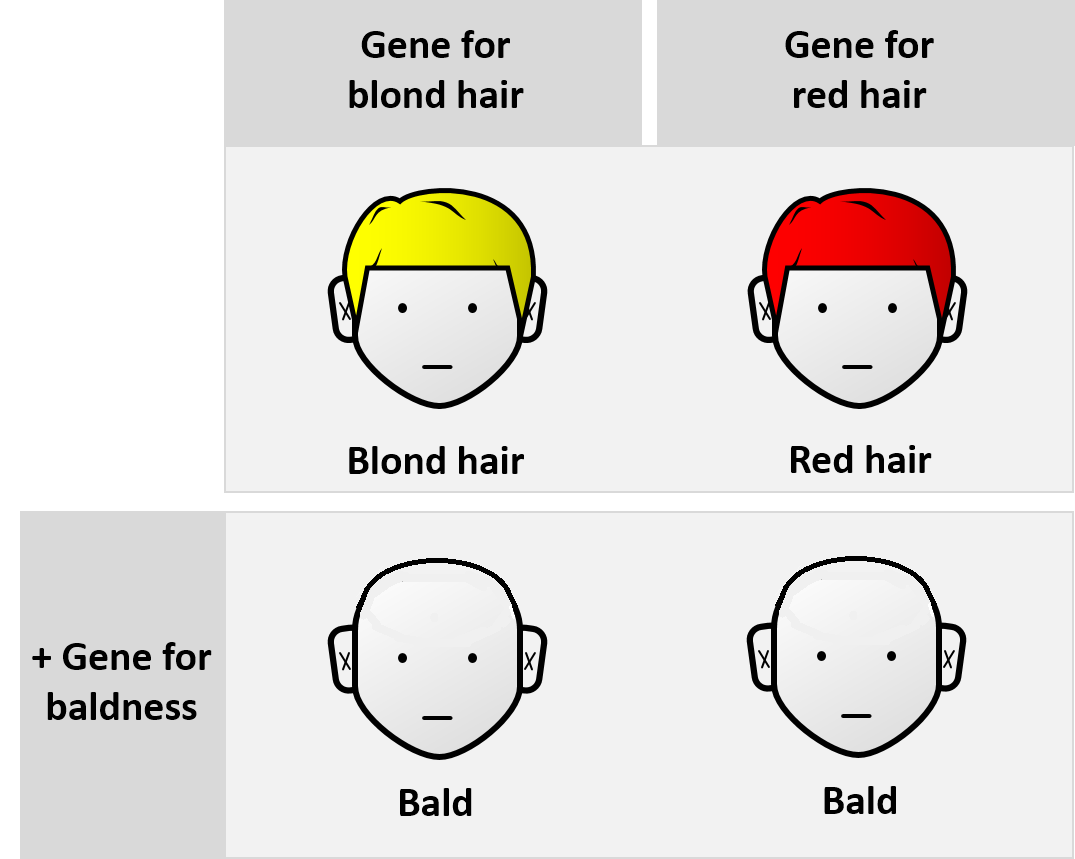
Geneticists recognize several patterns of epistasis. In recessive epistasis one recessive allele at one locus masks alleles at another; in dominant epistasis a dominant allele masks effects elsewhere. Duplicate genes can produce redundancy so that mutation of one locus has no visible effect unless the other is also altered. Famous textbook examples include pigmentation pathways, such as coat color in dogs and mice, where one gene controls pigment production and another controls pigment deposition. When one locus prevents pigment formation entirely, it makes the state of pigmentation genes irrelevant, a clear epistatic relationship.
Biological versus statistical epistasis
Two complementary meanings of epistasis are commonly used. Biological (molecular) epistasis refers to mechanistic interactions among gene products or biochemical steps—how proteins and pathways influence one another. Statistical epistasis describes departures from additivity detected in genetic experiments or association studies: it is the interaction term in a model that cannot be explained by single-locus effects alone. A molecular interaction will often produce statistical epistasis, but complex networks, environmental effects, and allele frequencies all shape whether interactions are detectable in population data.
Importance, detection and implications
Epistasis matters for breeding, disease genetics and evolution. It can obscure the mapping of trait-causing loci, complicate prediction of hybrid performance (heterosis), and influence how populations respond to selection. Detecting epistasis requires experiments or statistical models that include interaction terms, such as controlled crosses, quantitative trait locus (QTL) mapping, or genome-wide association studies that look for pairs or higher-order combinations of loci. Model organisms—fruit flies, mice, yeast and plants—have provided many instructive examples where controlled crosses reveal epistatic architectures.
- Practical consequence: epistasis can make phenotype prediction from genotype more difficult than single-gene models imply.
- Evolutionary consequence: epistasis contributes to rugged fitness landscapes and can promote or hinder adaptation depending on genetic context.
- Research note: quantitative geneticists separate additive variance from epistatic (interaction) variance when partitioning trait heritability.
Understanding epistasis requires combining classical genetic crosses, molecular biology of pathways, and modern statistical genetics. For readers seeking historical context and foundational experiments, sources linked in the text offer entry points to the original work and later developments in quantitative genetics and evolutionary theory.
Questions and answers
Q: What is epistasis?
A: Epistasis is the interaction between genes at different loci.
Q: Who invented the term 'epistasis'?
A: William Bateson invented the term 'epistasis' in 1909.
Q: What did Gregor Mendel's experiments on sweet pea involve?
A: Gregor Mendel's experiments on sweet pea involved choosing seven traits, such as round vs wrinkled peas, and tall vs short plants, and finding pairs of 'factors' (genes) which controlled their appearance (phenotype).
Q: Did the pairs of factors in Gregor Mendel's experiments affect each other?
A: No, one pair of factors never affected the other pairs in Gregor Mendel's experiments.
Q: Does the action of one gene affect another gene in epistasis?
A: Yes, the action of one gene does affect another gene, even one on a different chromosome in epistasis.
Q: What does the term 'epistasis' denote?
A: In general, the term 'epistasis' denotes any departure from independence of the effects of different genetic loci.
Q: What was the original meaning of epistasis?
A: The original meaning of epistasis was quite narrow. For instance, a gene for no wings in Drosophila will obviously mask genes for any other aspect of the wings.
Related articles
Author
AlegsaOnline.com Epistasis: genetic interactions between loci Leandro Alegsa
URL: https://en.alegsaonline.com/art/31745