
William Bateson (1861–1926): champion of Mendelian genetics
British biologist who coined the term "genetics" and championed Mendelian inheritance, helping to turn Mendel's ideas into an organized scientific discipline.
William Bateson (8 August 1861 – 8 February 1926) was a British biologist born in Yorkshire. Trained and active at Cambridge as a Fellow of St John's College, he worked across comparative anatomy and breeding experiments before becoming a leading advocate for the study of heredity. Often described as a zoologist in his early career, he combined observational skills with an interest in practical breeding (zoologist).
Image gallery
2 Images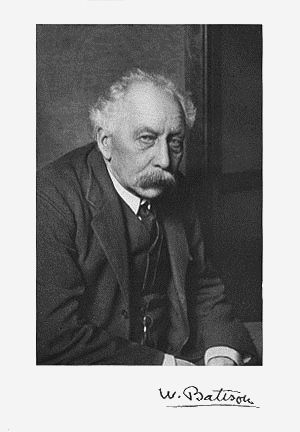

Overview and key contribution
Bateson is best known for introducing and popularizing the word genetics to denote the scientific study of inheritance and variation. He played a central role in promoting the significance of Gregor Mendel's work on pea hybrids and Mendelian laws after those results were brought to wider attention by scientists such as Hugo de Vries and Carl Correns. Bateson emphasized discrete units of inheritance and argued that Mendel's principles offered an explanatory framework for many patterns of trait transmission, relating them to classical concerns about heredity.
Research, collaborations and debates
Through breeding experiments and careful collection of data, Bateson helped demonstrate Mendelian ratios in a variety of organisms and highlighted exceptions that led to deeper concepts about dominance, linkage and dominance interactions. He collaborated with other geneticists of his time and famously worked with younger colleagues to develop methods and vocabulary that made Mendelian ideas accessible to biologists and breeders. His public and scholarly debates with biometricians illustrated a key intellectual shift in biology from continuous statistical approaches to a focus on distinct hereditary factors. He also published accessible summaries and critiques to defend Mendelian interpretations.
Writings and terminology
Bateson published several influential works that collected data and argued for a Mendelian approach to inheritance. His early writings gathered case studies of variation in plant and animal breeding; later books and essays sought to systematize Mendelian principles for scientists and agriculturalists. In promoting a new scientific vocabulary he helped to standardize terms that would become foundational for 20th‑century genetics.
Legacy and historical importance
Bateson's energetic advocacy helped establish genetics as a distinct discipline within biology. By translating Mendel's rediscovered results into a broader research program and institutional presence, he influenced the direction of research on heredity, development and evolution. His role as a teacher, organizer and communicator ensured that Mendelian ideas became central to biological thought and practical breeding. He remains a pivotal figure in the history of genetics and the early professionalization of the subject linked to Mendel and the rediscoverers such as Gregor Mendel.
Selected topics and resources
- Early experiments in inheritance and variation; practical breeding observations.
- Promotion and definition of 'genetics' as a scientific field.
- Interactions and debates with biometricians and other contemporary scientists.
- Historical accounts of Mendel's rediscovery by Hugo de Vries and Carl Correns.
- Biographical and scientific summaries available from archival and historical sources (regional records, institutional histories).
For general readers the story of Bateson connects the rediscovery of Mendel's experiments with the establishment of a new scientific identity—genetics—shaping both theory and practice in biology during the early 20th century.
Questions and answers
Q: Who was William Bateson?
A: William Bateson was a British zoologist and a Fellow of St. John's College, Cambridge University.
Q: What is Bateson's contribution to genetics?
A: Bateson is credited as the first person to use the term genetics to describe the study of heredity.
Q: Whose ideas did Bateson popularize in the field of genetics?
A: Bateson popularized the ideas of Gregor Mendel, after their rediscovery in 1900 by Hugo de Vries and Carl Correns.
Q: When was Bateson born and when did he pass away?
A: Bateson was born on August 8, 1861, and passed away on February 8, 1926.
Q: Was Bateson affiliated with any educational institution?
A: Yes, Bateson was a Fellow of St. John's College, Cambridge University.
Q: What field of study did Bateson specialize in?
A: Bateson specialized in the field of zoology.
Q: What makes Bateson's contribution to genetics significant?
A: Bateson's contribution to genetics is significant because he was the first to establish the term genetics and popularized the ideas of Mendel after their rediscovery in 1900.
Related articles
Author
AlegsaOnline.com William Bateson (1861–1926): champion of Mendelian genetics Leandro Alegsa
URL: https://en.alegsaonline.com/art/108190
Sources
- doi.org : 10.1017/S0007087400024201
- pubmed.ncbi.nlm.nih.gov : 11612343
- doi.org : 10.1080/00033798300200111
- pubmed.ncbi.nlm.nih.gov : 11615930