
Elliptical orbit
A closed orbital path in the shape of an ellipse followed by planets, moons, and many spacecraft; characterized by eccentricity between 0 and 1 and governed by Kepler's laws and Newtonian gravity.
Overview
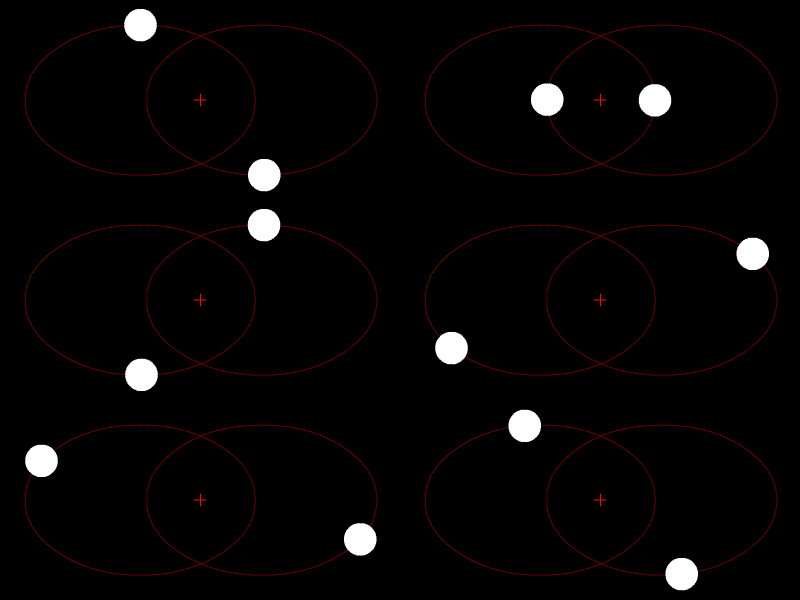
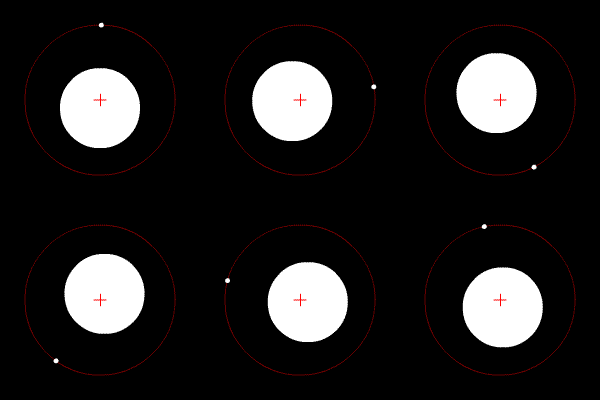
In astronomy, an elliptical orbit is a bound path traced by one body around another when their relative motion describes an ellipse. The central mass lies at one of the ellipse's two foci, not at its center. Elliptical orbits occur when orbital eccentricity has a value greater than 0 but less than 1; the special case e = 0 is a circular orbit. The term applies to natural objects such as a planet, star, or moon and to human-made satellites and interplanetary spacecraft.
Image gallery
8 Images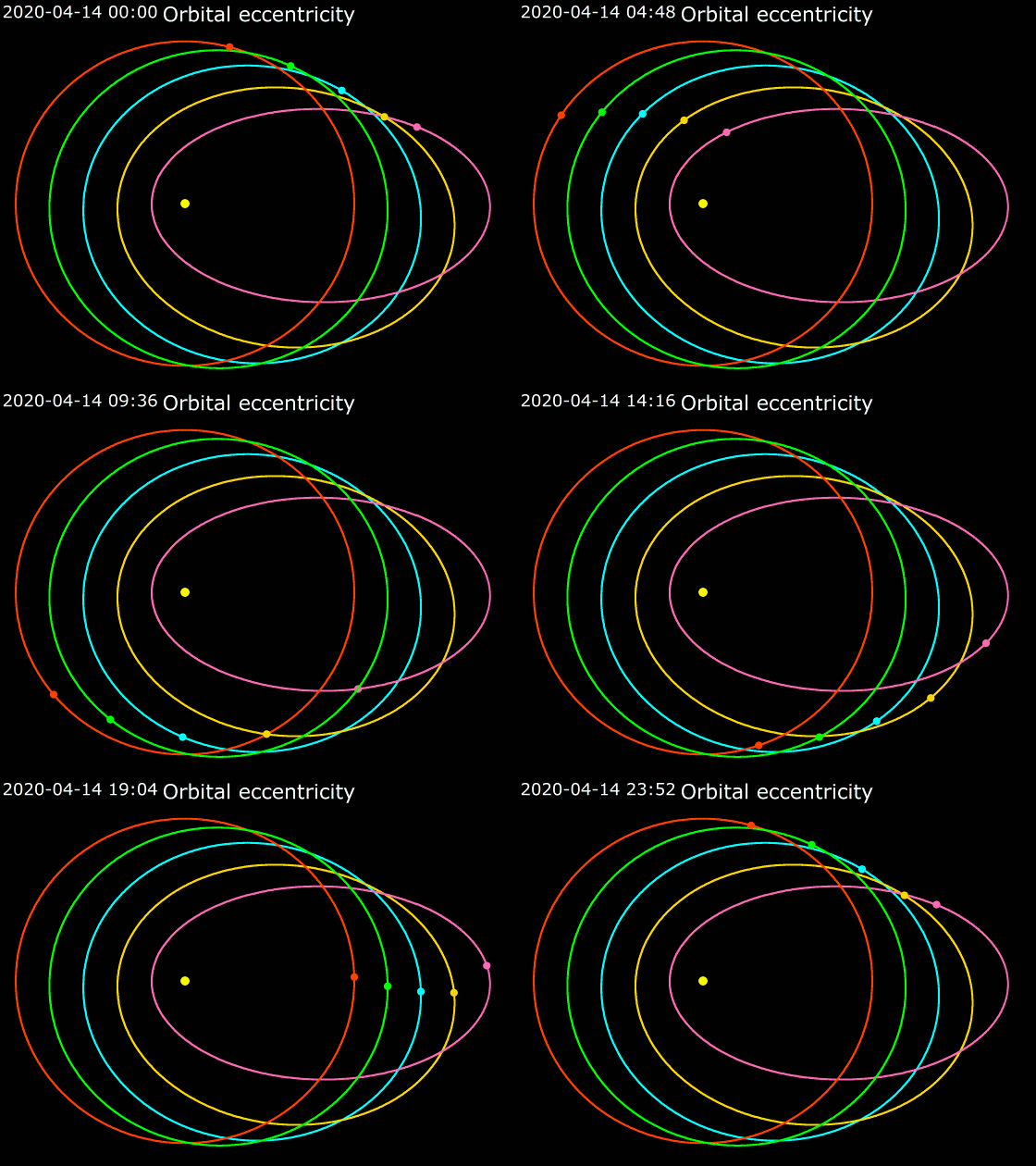




Key characteristics
- Geometry: defined by the semi-major axis (average size) and eccentricity (shape).
- Foci: the attracting mass (for example, the Sun) is at one focus; distances at closest and farthest approach are periapsis and apoapsis (perihelion/aphelion for solar orbits).
- Variable speed: orbital speed increases near periapsis and decreases near apoapsis due to conservation of angular momentum.
- Bound energy: elliptical orbits correspond to negative specific orbital energy in Newtonian gravity.
Laws and dynamics
Elliptical motion is described by Kepler's laws: orbits are ellipses with the central body at a focus (Kepler's first law); a line joining the bodies sweeps equal areas in equal times (Kepler's second law), explaining the varying speed; and the square of the orbital period scales with the cube of the semi-major axis (Kepler's third law), linking orbit size to period. These empirical laws follow from Newton's law of gravitation and conservation principles, which are used in celestial mechanics and spaceflight trajectory design.
History and examples
Johannes Kepler formulated the elliptical model in the early 17th century from precise observations collected by Tycho Brahe. Since then, elliptical orbits have been recognized in the motions of the planets around the Sun, the Moon around the Earth, and many comets and asteroids. Space missions routinely use elliptical transfer orbits and elliptical parking orbits when changing altitude or performing planetary encounters.
Distinctions and related trajectories
Conic-section trajectories include more than ellipses: a perfect circle is a special ellipse, while open paths arise when eccentricity is ≥ 1. A parabolic trajectory (e = 1) and a hyperbolic trajectory (e > 1) describe unbound flybys or escape trajectories. Recognizing which conic section applies is essential for predicting whether an object remains gravitationally bound or will escape the system.
Importance and applications
Understanding elliptical orbits is central to predicting planetary motion, planning spacecraft transfers, and calculating satellite coverage. Orbital elements such as eccentricity, inclination, and the argument of periapsis provide a compact description of an orbit's shape and orientation and are widely used in mission design, astronomy databases, and educational resources.
For general reference on related topics see orbit, eccentricity, and entries about circular orbit and other conic trajectories in celestial mechanics. Further reading and databases are available through standard astronomy resources and mission documentation (astronomy guides and technical archives).
Related articles
Author
AlegsaOnline.com Elliptical orbit Leandro Alegsa
URL: https://en.alegsaonline.com/art/30964