
Epsilon Eridani: nearby K-type star with planets and debris
Epsilon Eridani is a nearby K2 main-sequence star in Eridanus, visible to the naked eye. It hosts at least one confirmed planet, a complex debris system, and shows youthful magnetic activity and a strong stellar wind.
Overview
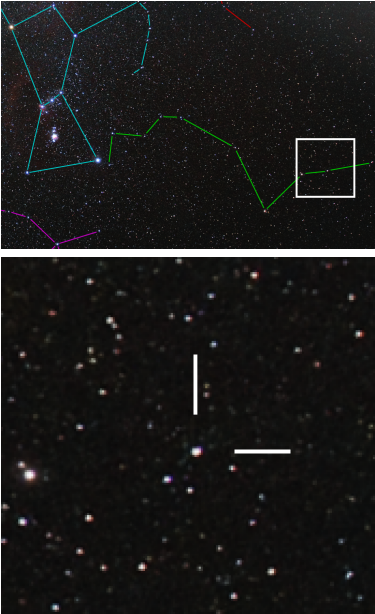
Epsilon Eridani (ε Eri) is a nearby main-sequence star in the southern constellation Eridanus, located just south of the celestial equator and visible from much of Earth. At an apparent magnitude of about 3.73 and a distance of roughly 10.5 light years, it is among the closest stars that can be seen without optical aid. Its proximity and relative brightness have made it a frequent target of observational programs and popular discussion about nearby planetary systems.
Physical characteristics
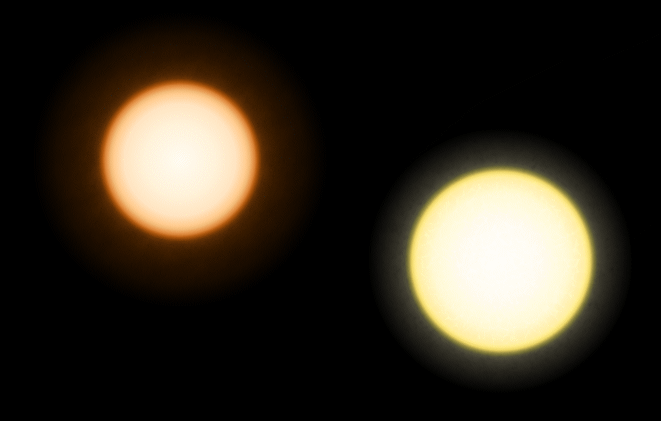
Epsilon Eridani is classified as a K2-type dwarf, which denotes a star cooler and smaller than the Sun that produces an orange hue. It fuses hydrogen at its core like other main-sequence stars, and its surface temperature is near 5,000 K. Compared with the Sun, Epsilon Eridani is less massive and has a lower abundance of elements heavier than helium. Astronomical studies indicate it is considerably younger than the Sun — generally estimated at under a billion years — and retains a more vigorous magnetic activity. Observations show a relatively rapid equatorial rotation (about 11.2 days) and a stellar wind stronger than the modern solar wind.
Planetary system and circumstellar material
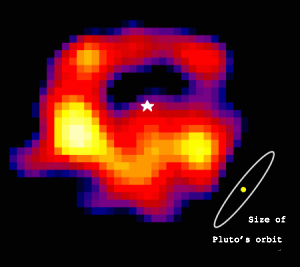
The star hosts at least one confirmed giant planet, commonly designated Epsilon Eridani b, announced around 2000. This planet orbits the star with a period of roughly seven years at a distance comparable to a few astronomical units. In addition to the confirmed planet, the system contains multiple belts of small bodies and dust: a warm inner belt near a few astronomical units and a colder, broader belt at tens of astronomical units, together with an extended outer debris disk. The structure of these belts and gaps has led astronomers to propose one or more additional planets that shepherd and shape the debris, though not all such companions have been confirmed. The debris disk resembles a young analogue of the Solar System’s Kuiper Belt and is interpreted as a population of leftover planetesimals and collisional dust from the system’s formation.
Motion, neighbors and future encounters
Epsilon Eridani’s space motion has prompted suggestions that it may belong to a loose kinematic group of stars that share a common origin. Its nearest known stellar neighbor, the binary called Luyten 726-8, is predicted to make a relatively close approach in astronomical terms in tens of thousands of years. Such encounters alter only the farthest reaches of stellar debris disks and have negligible influence on life-bearing planets at typical orbital distances, but they are interesting for long-term dynamical studies.
Image gallery
8 Images


Importance, observation and cultural references
The combination of proximity, youth and circumstellar material makes Epsilon Eridani important for studies of planetary formation and early stellar evolution. Because of these attributes it has been a target for searches for extraterrestrial signals and has a prominent place in science fiction and interstellar travel proposals. Its relative accessibility to telescopes and space missions means it continues to be monitored across many wavelengths to refine knowledge of its planets, dust belts and magnetic behavior.
Key facts
- Spectral type: K2 (orange dwarf).
- Distance from Earth: about 10.5 light years.
- Apparent magnitude: ~3.73 (visible to the unaided eye under good conditions).
- Rotation period: ~11.2 days at the equator; more magnetically active than the Sun.
- Known planet: Epsilon Eridani b — orbital period ~7 years, semimajor axis of a few AU.
- Debris architecture: inner and outer belts plus an extended disk of planetesimals and dust.
Selected links and further reading
- Eridanus constellation reference
- Celestial equator context
- Distance measurements and parallax data
- Nearby stars visible to the naked eye
- Star systems and multiplicity
- Stellar magnetic activity studies
- Stellar winds and mass loss
- Stellar metallicity and composition
- Main-sequence stellar classification
- Nuclear fusion in stars
- Hydrogen fusion processes
- Effective temperature scales
- Stellar color and spectral type
- Astronomical unit and orbital dimensions
- Asteroid belts and small-body populations
- Debris disks around nearby stars
- Planetesimals and planetary formation
- Ursa Major moving group and stellar kinematics
- Open clusters and common origins
- Luyten 726-8 and nearby stellar encounters
- Epsilon Eridani in science fiction
- Proposals for interstellar visits and exploration
Note: Many properties of Epsilon Eridani and its planetary companions have been refined by successive observations. While some features, such as the existence of dust belts and at least one planet, are well established, the presence and parameters of additional planets and finer details of the debris structure remain under active investigation.
Questions and answers
Q: What is Epsilon Eridani?
A: Epsilon Eridani (ε Eri, ε Eridani) is a star in the southern constellation Eridanus, just south of the celestial equator. It can be seen from most of Earth's surface.
Q: How far away is Epsilon Eridani?
A: Epsilon Eridani is 10.5 light years (ly) away from Earth.
Q: What is the apparent magnitude of Epsilon Eridani?
A: The apparent magnitude of Epsilon Eridani is 3.73.
Q: Is there a planet orbiting around Epsilon Eridani?
A: Yes, there is a planet orbiting around Epsilon Eridani called Epsilon Eridani b which was announced in 2000 and orbits in about 7 years at about 3.4 astronomical units (AU) away from its star.
Q: Is there any evidence for other planets or objects in the system?
A: Yes, there are two belts of rocky asteroids - one at about 3 AU and a second at about 20 AU - as well as an extensive outer debris disk of remnant planetesimals left over from the system's formation which may suggest that another hypothetical planet exists called Epsilon Eridani c which maintains their structure.
Q: Does it have any relation to other stars or clusters?
A: Yes, it may be part of Ursa Major Moving Group which suggests they share a common origin in an open star cluster and will have a close encounter with Luyten 726-8 binary star system in 31,500 years when they will be separated by 0.93 ly apart.
Q: Has it been used for SETI searches or interstellar travel stories? A:Yes, it has been used for SETI searches and appears in science fiction stories as suggested destination for interstellar travel
Related articles
Author
AlegsaOnline.com Epsilon Eridani: nearby K-type star with planets and debris Leandro Alegsa
URL: https://en.alegsaonline.com/art/31792
Sources
- iopscience.iop.org : iopscience.iop.org/article/10.1086/317319
- cfa.harvard.edu : cfa.harvard.edu
- iopscience.iop.org : iopscience.iop.org/article/10.1088/0004-637X/690/2/1522
- arxiv.org : arxiv.org/abs/1004.1557