
Epimetheus — co-orbital moon of Saturn
Epimetheus is a small, irregular, icy moon of Saturn that shares an orbital path with Janus. Discovered in 1966 and clarified by Voyager 1 in 1980, it performs a rare horseshoe orbital exchange.
Overview
Epimetheus is a small, irregular natural satellite of Saturn notable for its unusual orbital relationship with the nearby moon Janus. Both bodies orbit at nearly the same distance from Saturn and periodically swap orbital positions instead of colliding. This co-orbital configuration and regular exchange of angular momentum make Epimetheus a classic case study in celestial mechanics.
Image gallery
10 Images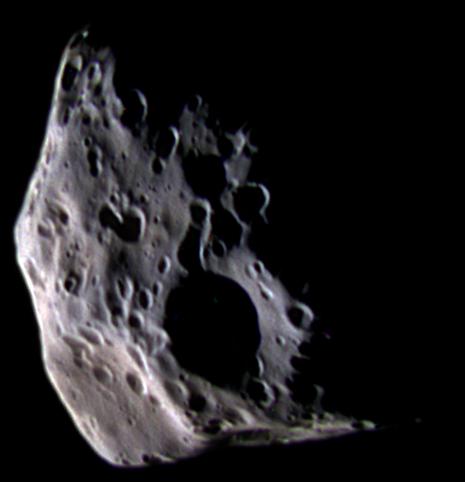


Discovery and naming
The object now known as Epimetheus was first reported from ground-based observations in 1966. Because Janus follows an almost identical orbit, early observations could not reliably distinguish whether there were one or two objects. The ambiguity persisted until close-up imagery from the Voyager 1 spacecraft in 1980 confirmed that two distinct moons share the orbital zone. The name Epimetheus comes from Greek mythology; Epimetheus was the brother of Prometheus.
Physical characteristics
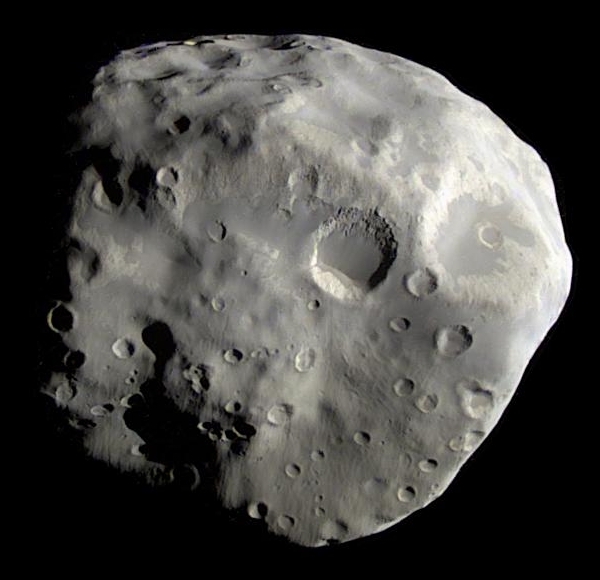
Epimetheus is irregular in shape and relatively small — only tens of kilometres across — with a heavily cratered, ancient surface. Spectral and imaging data indicate a composition dominated by water ice mixed with darker, rockier material. Its low bulk density and surface appearance suggest a porous, rubble-pile or fractured interior rather than a solid, fully compact body.
Orbit and dynamical behaviour
The most remarkable feature of Epimetheus is its co-orbital interaction with Janus. The two moons perform a periodic orbital exchange: the inner moon, moving slightly faster, gains energy and moves outward while the outer moon loses energy and moves inward. This process repeats on a timescale of a few years and produces a horseshoe-shaped path when viewed in a rotating reference frame. Mutual gravitational perturbations keep the two bodies from approaching dangerously close.
Exploration and observations
After the Voyager 1 confirmation, the Cassini–Huygens mission in the 2000s provided more detailed images and measurements of Epimetheus, improving knowledge of its shape, rotation state, and surface geology. Cassini observations helped map crater distributions and surface brightness variations, and informed models of its interior porosity and composition.
Scientific significance
- Epimetheus and Janus are among the best-known examples of natural co-orbital satellites and illustrate stable, long-term gravitational interactions in a multi-body system.
- Study of Epimetheus contributes to understanding the formation and evolution of small icy moons, the processes that produce cratered surfaces, and how small satellites interact with planetary ring material and resonances.
- Because of its accessibility to spacecraft and clear dynamical signature, Epimetheus remains an important target for research into orbital dynamics and small-body geology.
Research on Epimetheus continues through analysis of existing spacecraft data and ground-based observations. Its coexistence with Janus and the regular exchange of orbits remain a striking natural example of how gravity can produce stable but unusual configurations in planetary systems.
Related articles
Author
AlegsaOnline.com Epimetheus — co-orbital moon of Saturn Leandro Alegsa
URL: https://en.alegsaonline.com/art/31724