
Elongation (astronomy): angle, observation, and significance
Elongation is the apparent angular separation between the Sun and another celestial body as seen from Earth. It governs when planets are visible and reaches characteristic maxima for inner planets.
Elongation is the apparent angular separation between the Sun and another celestial body as observed from Earth. In practical terms it tells an observer how far east or west a planet or other object appears relative to the Sun on the sky. The term is used in planetary astronomy and navigation to describe geometry that controls when a body is visible in morning or evening twilight. For a general definition see astronomical term, and for the central objects involved consult the entries for the Sun, a planet, and Earth.
Image gallery
4 Images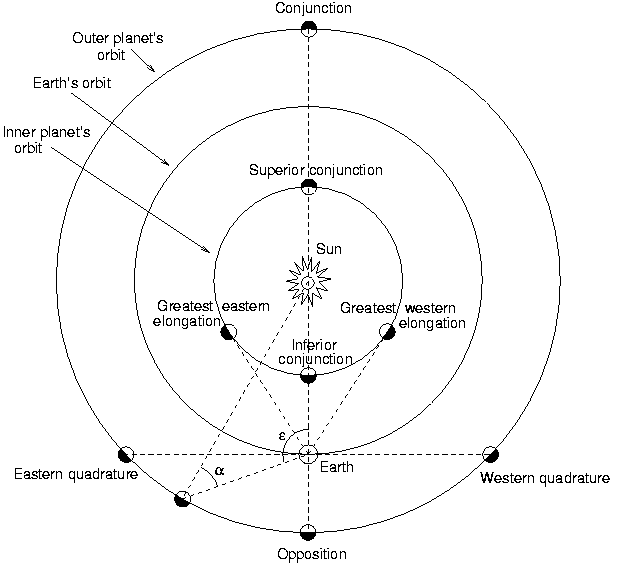


Geometry and meaning
Elongation is measured as the angle at Earth between lines drawn to the Sun and to the other object. If the object lies east of the Sun it has eastern elongation and will set after the Sun, making it an evening object. If it lies west of the Sun it has western elongation and will rise before the Sun, making it visible in the morning. The Moon, planets, asteroids and some comets all have elongations that change continually as they orbit.
Inferior and superior planets
Planets inside Earth’s orbit (Mercury and Venus) are called inferior planets. Their elongation never reaches 180°, because they remain close to the Sun in the sky. Each has a greatest elongation — the largest apparent angular separation possible from our vantage point. For Mercury the greatest elongation varies roughly between about 18° and 28°, while for Venus it is typically near 45°–47°. These ranges arise because planetary orbits are elliptical and because the relative positions of the three bodies change. For more on observational times: sunset and sunrise mark useful reference points.
Observational importance
Greatest elongation is important for amateur astronomers: an inferior planet near its greatest eastern elongation is best seen after dusk; near greatest western elongation it is highest in the sky before dawn. Superior planets (those outside Earth’s orbit) can reach elongations up to 180° and include opposition, when they are opposite the Sun and visible all night. Observing elongation helps plan photography, timing for occultations, and conjunction predictions. Historical records of elongations also aided early measurements of planetary orbits.
Calculation and notable facts
Computing elongation requires the orbital elements of the bodies and basic spherical trigonometry or modern ephemeris software. The apparent value fluctuates due to orbital eccentricity and inclination. Mercury’s rapid orbital motion produces frequent changes in its elongation — see Mercury for examples — while Venus moves more slowly and is thus visible in pleasant long evening or morning apparitions. Astronomers and navigators still reference elongation when describing when and where an object will appear relative to the Sun.
- Key point: elongation is an observer-centered angle, not a physical distance.
- Greatest elongation determines the best observing windows for inferior planets.
- Superior planets can be at any elongation up to 180°, including opposition.
Related articles
Author
AlegsaOnline.com Elongation (astronomy): angle, observation, and significance Leandro Alegsa
URL: https://en.alegsaonline.com/art/31019