
Enceladus — Saturn’s bright, icy moon with active plumes
Enceladus is a small, highly reflective moon of Saturn known for its subsurface ocean, south-pole geysers that feed the E ring, and active geology revealed by spacecraft observations.
Enceladus is one of Saturn’s most remarkable moons. Roughly 500 km across, it is among the smaller major satellites of the planet but stands out because its surface is almost entirely water ice and is exceptionally bright. The moon orbits within Saturn’s diffuse E ring, to which it is now known to contribute material via powerful jets and sprays of ice and vapor.
Image gallery
10 Images



Physical characteristics
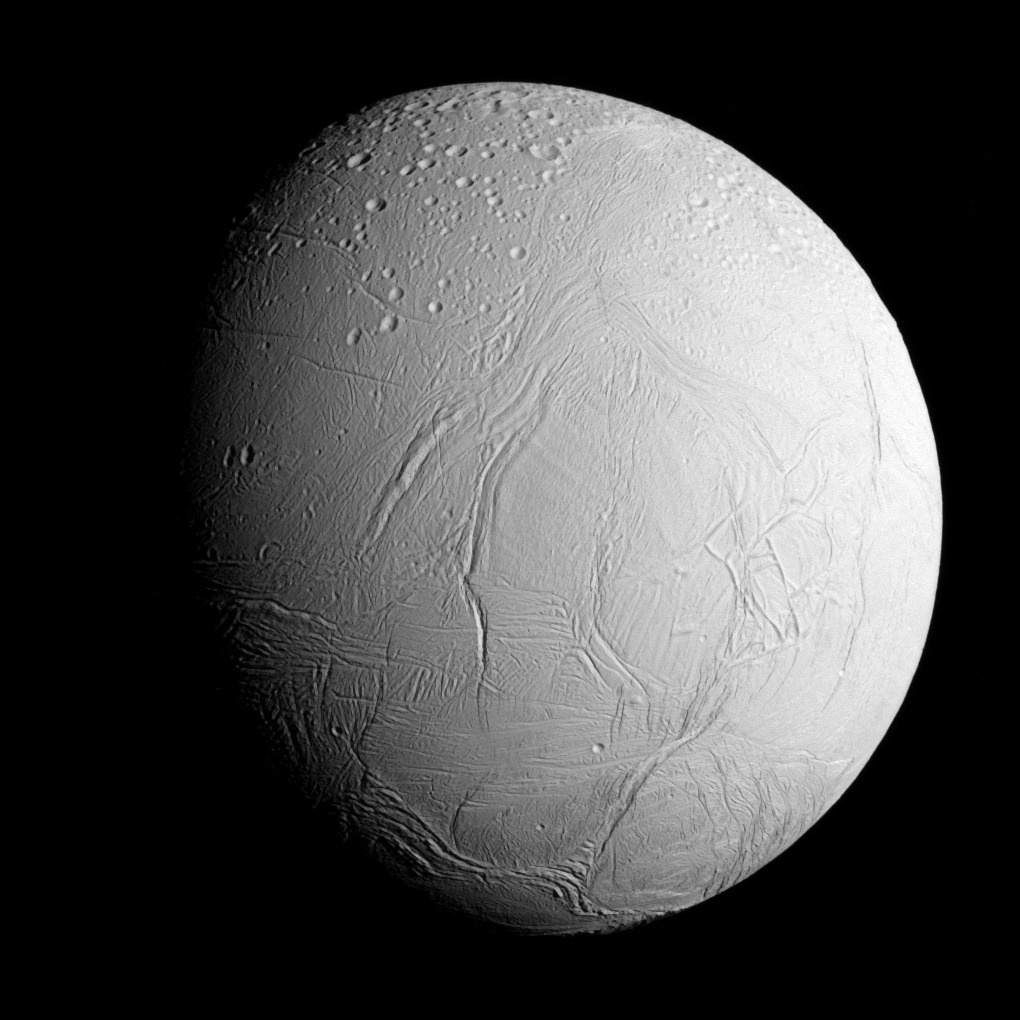
Enceladus has a low bulk density, indicating a composition dominated by water ice with some rock and metal in its interior. Its surface reflects an unusually large fraction of incoming light, making it one of the most reflective bodies in the Solar System; this high reflectivity helps explain its conspicuous appearance despite its small size. Surface terrain ranges from heavily cratered regions to relatively smooth plains and long fractures, with concentrated activity near the south pole.
Discovery and exploration
Enceladus was discovered by the astronomer William Herschel in 1789. Modern understanding of the moon advanced dramatically after visits by spacecraft, most notably the Cassini mission managed by NASA. Cassini performed multiple close flybys and remote-sensing observations that revealed active plumes, unusual surface geology, and signs of a subsurface reservoir of liquid water.
Geology, plumes and the subsurface ocean
A defining feature of Enceladus is its south-pole region, where long tectonic fractures—often called "tiger stripes"—serve as sources for continuous, collimated jets. These fissures vent water and other substances into space. The ejected material includes water vapor, fine ice grains and volatile compounds, and some salts and organic-bearing particles. These emissions are collectively described as cryovolcanism or cryovolcanoes.
Measurements and models derived from spacecraft data indicate that a global or regional subsurface liquid water layer lies beneath the icy crust, with evidence especially strong near the south pole. Some studies estimate an ocean tens of kilometers beneath the surface in places and a localized liquid layer perhaps on the order of about 10 km thick in the active southern region. The plumes themselves are dominated by water vapor and entrained ice grains, and they carry other volatile species and salts outward into space.
Relationship to Saturn’s E ring and environment
Material from Enceladus’ plumes escapes into orbit and supplies a large fraction of the particles in Saturn’s E ring. The continuous injection of ice grains replenishes the ring and links the moon’s activity directly to Saturn’s magnetospheric and ring environment. Observations show that plume output and local ring particle density vary with orbital position, suggesting interactions among tidal stresses, internal heating, and surface venting.
Importance and scientific interest
- Potential habitability: The combination of liquid water, chemical ingredients in plume material, and internal heat make Enceladus a prime target in the search for environments that could support microbial life.
- Planetary processes: Enceladus provides a nearby example of cryovolcanism, tidal heating, and the coupling between a moon and a planetary ring.
- Sample access: Plume material ejected into space offers a way to sample subsurface chemistry without drilling—an appealing prospect for future missions.
For additional context about Enceladus’ orbital setting and observational history, see resources on the moon’s location in the E ring, its ice-dominated composition described in studies of water ice, and published summaries of its high reflectivity and albedo in planetary science reviews that discuss how it reflects light and appears under sunlight (sunlight). Basic mission and research overviews are available through agency and research organization portals that summarize Cassini-era discoveries and ongoing analyses (NASA and related scientific archives).
Enceladus today remains a focus for follow-up exploration and study. Its active plumes, subsurface water, and dynamic interaction with Saturn’s ring system make it an important natural laboratory for understanding icy worlds and assessing their potential for habitability.
Related articles
Author
AlegsaOnline.com Enceladus — Saturn’s bright, icy moon with active plumes Leandro Alegsa
URL: https://en.alegsaonline.com/art/31329
Sources
- universetoday.com : "Enceladus"
- saturn.jpl.nasa.gov : "NASA: Jet Propulsion Laboratory: Cassini Soltice Mission: About Saturn & Its Moons: Saturn's Moons: Enceladus"
- solarsystem.nasa.gov : "NASA: Solar System Exploration: Planets: Saturn: Moons: Enceladus"