
Dolly (sheep): first mammal cloned from an adult somatic cell
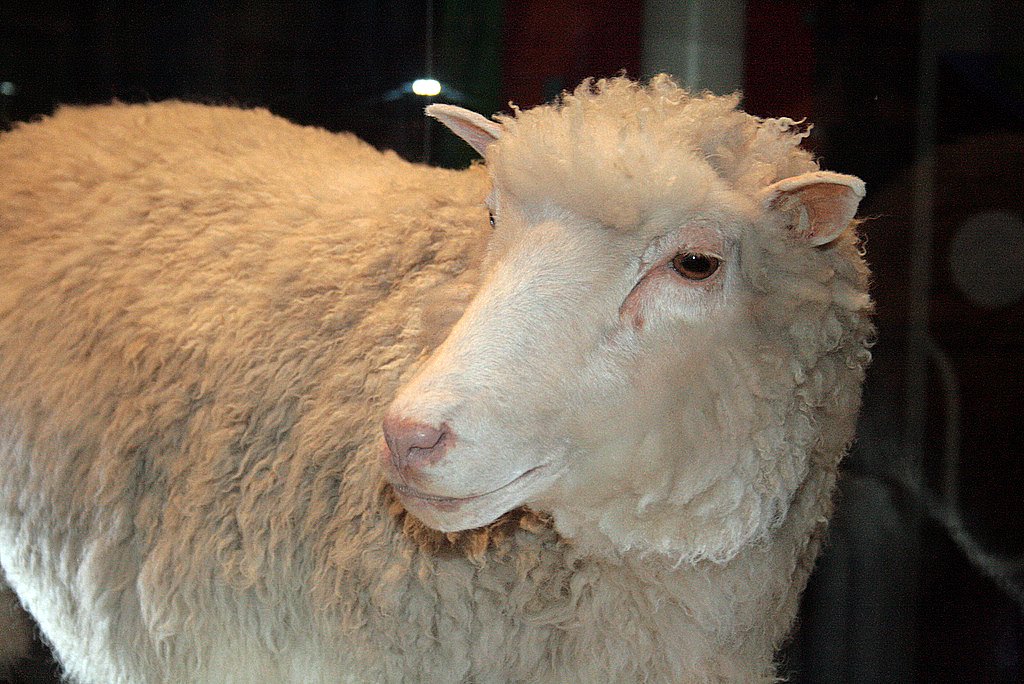
Dolly (1996–2003) was the first mammal cloned from an adult somatic cell. Her birth advanced developmental biology, raised ethical debate, and influenced cloning and stem‑cell research worldwide.
Overview
Dolly was a Finn Dorset sheep born on 5 July 1996 and publicly announced in 1997 as the first mammal cloned from an adult somatic cell. The experiment demonstrated that a differentiated cell taken from an adult animal could be reprogrammed to generate an entire organism. The work was carried out at the Roslin Institute in Scotland and changed how scientists understood cellular specialization and developmental potential. Her creation required many attempts and a low overall success rate, illustrating technical limits that remain important in cloning research.
Image gallery
3 Images

What was cloned and how
Dolly was produced by somatic cell nuclear transfer (SCNT), a laboratory technique in which the nucleus of a donor somatic cell is inserted into an enucleated egg cell. In Dolly’s case the donor was a cultured cell from a mammary gland, and the procedure proved that an ordinary body cell could supply the full genetic complement for a new individual. A somatic cell is any non‑reproductive cell of the body; its nucleus contains the DNA that was transferred into the egg. The Roslin team reported that the project involved hundreds of attempts (often cited as 277) before producing a successful pregnancy and live birth.
Steps of somatic cell nuclear transfer
- Remove the nucleus from an unfertilized egg cell (enucleation).
- Isolate the nucleus from a donor somatic cell.
- Insert the donor nucleus into the enucleated egg.
- Stimulate the reconstructed egg to begin dividing and culture to early embryo stages.
- Transfer embryos to a surrogate female for gestation.
Significance and scientific impact
Dolly provided direct experimental evidence that differentiated adult cells retain an intact genome and can be reprogrammed to an embryonic state. This finding influenced research into cellular reprogramming, cloning technologies, and stem cells, and it helped motivate the later development of induced pluripotent stem cells (iPSCs). Dolly’s birth also intensified public and policy debates about reproductive cloning, bioethics, and applications such as livestock breeding and conservation.
Health, lifespan and controversies
Dolly lived at the Roslin Institute and was bred with a Welsh Mountain ram, producing six lambs named Bonnie, Rosie, Lucy, Sally, Darcy and Cotton. Her life span (she died on 14 February 2003) and medical problems—she was euthanized following a progressive lung disease and arthritis—led to discussion about whether cloned animals display higher rates of abnormalities or premature aging. Early reports suggested some clones showed health issues more often than naturally conceived animals, but subsequent research has shown mixed results and emphasized that outcomes vary with species, techniques and husbandry.
Legacy and notable facts
Dolly’s case remained an educational landmark: she is widely cited when explaining cellular differentiation, cloning methods and the ethics of biotechnology. Her creation demonstrated technical feasibility while also highlighting low efficiency and biological challenges inherent to cloning. The experiment prompted international conversations about regulation and responsible research and has had lasting influence on both basic science and public understanding.
For further reading on cloning methods and Dolly’s scientific context see resources at the Roslin Institute and reviews of somatic cell nuclear transfer and stem cell reprogramming (first mammal to be cloned, adult somatic cell).
Related articles
Author
AlegsaOnline.com Dolly (sheep): first mammal cloned from an adult somatic cell Leandro Alegsa
URL: https://en.alegsaonline.com/art/28237
Sources
- doi.org : 10.1126/science.288.5472.1775
- pubmed.ncbi.nlm.nih.gov : 10877698
- ui.adsabs.harvard.edu : 1997Natur.385..810W
- doi.org : 10.1038/385810a0
- pubmed.ncbi.nlm.nih.gov : 9039911