
Donkey (Equus africanus asinus): description, history, uses, and hybrids
Donkey (Equus africanus asinus): a domestic equid used for transport and work. Overview of appearance, behavior, domestication, human uses, hybrids with horses, breeds, and conservation issues.
The donkey, also called the ass (scientific name Equus africanus asinus), is a hoofed mammal often kept by people for transport and labor. As an animal classified among other even-toed ungulates, the donkey is closely related to horses and zebras and is placed in the family Equidae. The wild ancestor is the African wild ass; the domestic form has been shaped by centuries of human use and selective breeding. This article summarizes key features, human associations, and notable biological facts.
Image gallery
10 Images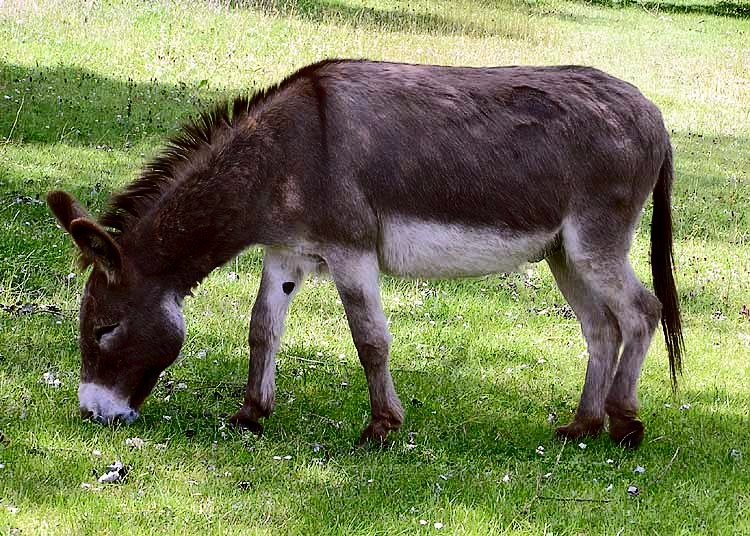


Physical characteristics and behavior
Donkeys are typically smaller and more rugged than most breeds of horse, with a compact body, long ears, and a short, upright mane. Coat color varies from gray and brown to black or white-marked patterns. Donkeys are adapted to arid and semi-arid environments and often display hardy digestive and metabolic traits that let them subsist on sparse forage. They are social but can form stable bonds in small groups; their vocalization—commonly called braying—is a distinctive behavior used to communicate over long distances.
Domestication and historical role
The domesticated donkey has been part of human societies for thousands of years. Archaeological and historical evidence indicates donkeys were used as working animals for at least 5,000 years, where their endurance and sure-footedness were prized for carrying loads and pulling light vehicles. The domesticated animal is properly referred to as a domesticated ass and appears in ancient records across Africa, Asia, and later Europe. Their relationship with people influenced settlement patterns, trade routes, and small-scale agriculture.
Common uses and cultural importance
Donkeys remain valuable in many regions because of their versatility and low maintenance requirements. Typical uses include:
- Pack and cargo transport across difficult terrain.
- Agricultural labor such as plowing a field or hauling harvested crops.
- Pulling carts and light carriages; historically they have been used for pulling a carriage in towns and villages.
- Companion and guard animals for flocks, and in some places they are kept for milk or as a source of income from tourism.
Donkeys are often preferred where fuel, roads, or mechanized vehicles are limited because they are economical to keep and can work under conditions that challenge machinery.
Reproduction, hybrids, and terminology
Donkeys reproduce like other equids. When donkeys and horses interbreed they can produce hybrid offspring. The general phenomenon of cross-species breeding in this group is called a hybrid cross. The offspring of a female horse and a male donkey is known as a mule, while the cross in the opposite direction (female donkey with male horse) produces a hinny. Mules are more common than hinnies and are valued for combining the strength and size of horses with the endurance and temperament of donkeys. Most equine hybrids are sterile, which affects breeding and long-term population dynamics.
Breeds, conservation, and notable facts
There are many regional donkey types and breeds, some recognized for distinct size or coat qualities. In the wild, several wild ass species and subspecies exist in different parts of Africa and Asia; conservation concerns vary by population. Donkeys are sometimes overlooked in conservation planning even though their wild relatives may face habitat loss and hunting pressure. Notable facts include the donkey's reputation for sure-footedness, resistance to harsh climates, and long-standing place in human culture as a symbol of humility and endurance.
For further reading on classification, behavior, and cultural history see sources linked here: mammal overview, family information at Equidae, the domestication process described at domesticated resources, practical uses and working animal studies at working animal references, and technical notes on hybrids and horses at horse and hybrid discussions. Additional materials: female and male reproductive biology and hybrid examples such as the mule.
Questions and answers
Q: What is a donkey?
A: A donkey is a mammal in the Equidae family that has been domesticated and used as a working animal for at least 5000 years.
Q: What is the wild ancestor of the donkey?
A: The wild ancestor of the donkey is the African wild ass, E. africanus.
Q: Are there other wild asses in different parts of the world?
A: Yes, there are a number of other wild asses in different parts of the world.
Q: What is the correct name for the domesticated donkey?
A: The correct name for the domesticated donkey is a "donkey."
Q: Can donkeys have hybrid children with horses?
A: Yes, donkeys can have hybrid children with horses.
Q: What is the child of a female horse and a male donkey called?
A: The child of a female horse and a male donkey is called a "mule."
Q: Which hybrid, mules or hinnies, is more common and has been used for transportation?
A: Mules are more common and have been used for transportation.
Related articles
Author
AlegsaOnline.com Donkey (Equus africanus asinus): description, history, uses, and hybrids Leandro Alegsa
URL: https://en.alegsaonline.com/art/28461
Sources
- species.wikimedia.org : Equus asinus
- commons.wikimedia.org : Equus asinus
- donkeys.com : "American Donkey & Mule Society Donkey facts"
- lovelongears.com : "All About DONKEYS!"