
Delta Cephei: a fundamental Cepheid variable and distance calibrator
Overview of Delta Cephei, a nearby classical Cepheid in Cepheus: its variability, physical properties, discovery, role as a distance calibrator, mass loss and surrounding nebula, and its binary nature.
Delta Cephei (δ Cep) is a prominent classical Cepheid variable located in the northern constellation of Cepheus. At an estimated distance of about 887 light‑years, its visible brightness is slightly dimmed by interstellar gas and dust by roughly 0.23 magnitudes. Because of its relative proximity and well‑measured parallax, Delta Cephei serves as a key reference object for calibrating astronomical distance measurements.
Image gallery
5 Images

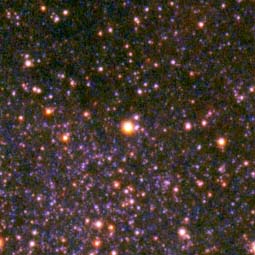


Basic characteristics
Delta Cephei is identified as a binary star system and is classified as a classical (Type I) Cepheid variable. Cepheids are pulsating supergiant stars whose luminosity varies in a periodic manner as their outer layers expand and contract. Delta Cephei emits order‑of‑magnitude greater energy than the Sun—about 2,000 times the solar luminosity—producing strong outflows and a dynamic stellar atmosphere. Its pulsations drive shocks and mass loss, and the expelled material interacts with the surrounding medium.
Variability and the period–luminosity relation
Cepheid variables like Delta Cephei are important because their pulsation period correlates with intrinsic brightness, a relationship first quantified by Henrietta Leavitt and used extensively in modern astronomy. Delta Cephei’s well determined distance (helped by measurements from space missions such as the Hubble Space Telescope and Hipparcos) makes it a "fundamental distance calibrator" for the period–luminosity (Leavitt) law. Precise parallaxes and cluster membership assessments refine its absolute magnitude and reduce systematic uncertainties when scaling distances to other galaxies.
Discovery and historical role
Delta Cephei’s variability was discovered in 1784 by John Goodricke, making it the second Cepheid recognized after Eta Aquilae. Over the centuries it has been observed repeatedly across the electromagnetic spectrum, contributing data that helped establish Cepheids as standard candles. Because the star is in or near a small star cluster and close enough for accurate parallax work (astrometric methods), Delta Cephei has been central to calibrating extragalactic distance scales and testing models of stellar pulsation and evolution.
Mass loss, nebula and environment
Delta Cephei is losing mass through a combination of a strong stellar wind and pulsation-driven ejections. Observational estimates place the mass‑loss rate on the order of 1.0 × 10⁻⁶ solar masses per year (with substantial uncertainty), with the outflow reaching speeds near 350 km s−1. Material shed by the star has accumulated in a circumstellar nebula roughly one parsec across and contains an observed reservoir of neutral hydrogen on the order of 0.07–0.21 solar masses. Where this wind meets the surrounding interstellar medium, a bow shock and related structures are formed, providing a laboratory for studying wind–medium interactions and the late stages of massive star evolution.
Binary nature and notable facts
Although primarily celebrated for its pulsations, Delta Cephei is also a multiple system: its binarity has been revealed through spectroscopic and astrometric studies and affects detailed interpretations of its light and motion. Its status as one of the nearest classical Cepheids (Polaris is closer but retains its own distance uncertainties) means Delta Cephei remains a focus of observational campaigns, theoretical modeling and calibration efforts that underpin the cosmic distance ladder.
Further reading and resources
- Delta Cephei: binary star information
- Cepheus constellation overview
- Mythology: Cepheus the King
- Cepheid variable class
- Associated star cluster studies
- Hubble Space Telescope observations
- Hipparcos astrometry
- Parallax measurement techniques
- Stellar luminosity and emission
- Stellar winds and mass loss
- Parsec: unit of distance
- Neutral hydrogen observations
- Interstellar medium interactions
Delta Cephei continues to be observed across wavelengths to refine its properties and to ensure that the period–luminosity relation remains a reliable tool for measuring distances from nearby star clusters to distant galaxies.
Questions and answers
Q: What is Delta Cephei?
A: Delta Cephei (δ Cep, δ Cephei) is a binary star system about 887 light-years away in the northern constellation of Cepheus, the King.
Q: Who discovered Delta Cephei?
A: Delta Cephei was discovered by John Goodricke in 1784.
Q: How far away is Delta Cephei?
A: Delta Cephei is located approximately 887 light-years away from Earth.
Q: What makes Delta Cephei important?
A: The distance to Delta Cephei is extremely well known due to its proximity to a star cluster and precise Hubble Space Telescope/Hipparcos parallaxes which give an accurate result. As a result, it is known as a "fundamental distance calibrator", or absolute candle.
Q: What type of variable star is Delta Cephei?
A:Delta Cephiei is classified as a classical, or type I, cephied variable star.
Q: How much luminosity does Delta Cepei emit compared to the Sun's luminosity?
A:Delta Cepei emits around 2,000 times more luminosity than the Sun's luminosity.
Q: How much mass does the expelled gas from delta cephie contain?
A:The expelled gas from delta cephie contains between 0.07 - 0.21 solar masses of neutral hydrogen
Related articles
Author
AlegsaOnline.com Delta Cephei: a fundamental Cepheid variable and distance calibrator Leandro Alegsa
URL: https://en.alegsaonline.com/art/26438
Sources
- adsabs.harvard.edu : Astrometry with the Hubble Space Telescope: a parallax of the fundamental distance calibrator δ Cephei
- iopscience.iop.org : iopscience.iop.org/article/10.1086/342014
- adsabs.harvard.edu : A Hipparchus census of the nearby OB associations
- iopscience.iop.org : iopscience.iop.org/article/10.1086/300682
- adsabs.harvard.edu : New evidence supporting cluster membership for the keystone calibrator Delta Cephei
- iopscience.iop.org : iopscience.iop.org/article/10.1088/0004-637X/744/1/53
- iopscience.iop.org : iopscience.iop.org/article/10.1086/588650
- adsabs.harvard.edu : adsabs.harvard.edu/abs/2010AAS...21642601R