
Hipparcos: ESA's Space Astrometry Mission and Star Catalogue
Hipparcos was the European Space Agency's pioneering space astrometry mission, producing a high-precision catalogue of about 118,000 stars and a larger Tycho catalogue, and transforming stellar distance measurements.
Hipparcos was a space observatory devoted to astrometry — the precise measurement of positions, parallaxes and proper motions of stars. Operated by the European Space Agency, Hipparcos is often described as the first dedicated space astrometry satellite. It produced a high-precision catalogue of roughly 118,000 stars and an accompanying, larger survey that extended the reach of accurate positional astronomy.
Image gallery
6 Images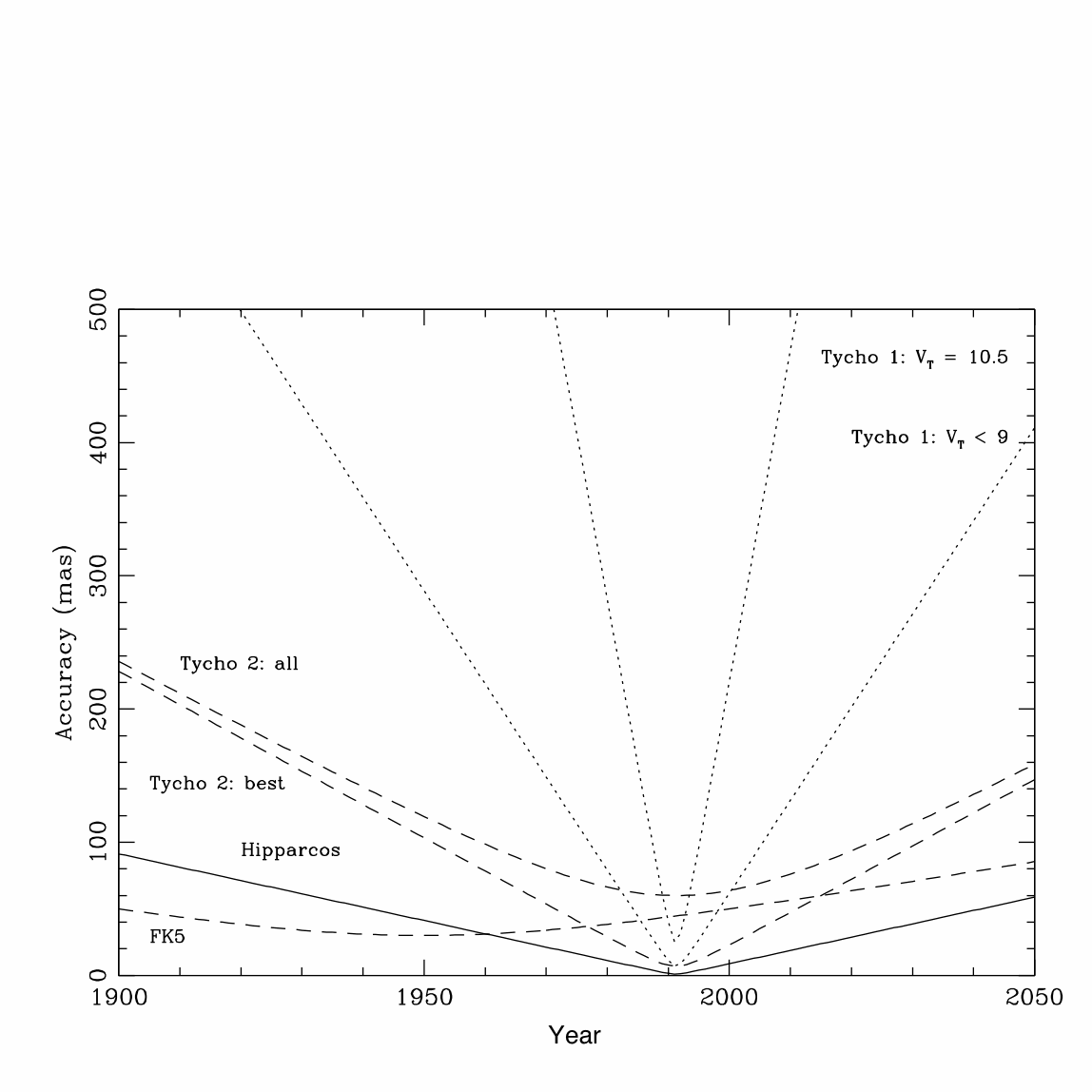


Mission and timeline
The spacecraft was developed under the direction of the European Space Agency (ESA) and was launched in 1989. Data collection continued into the early 1990s. Despite early challenges during launch and orbit insertion, the mission successfully measured stellar parallaxes and proper motions with a level of precision that had not been attainable from the ground.
Instruments and accuracy
Hipparcos used a carefully calibrated, double-field telescope and a scanning law that allowed it to observe each target from multiple angles over the mission lifetime. This systematic approach yielded parallax and position measurements at the milliarcsecond level for its primary catalogue, dramatically improving distance estimates for nearby stars and tightening constraints on stellar luminosities and motions.
Data products and uses
The mission produced two main catalogues: the high-precision Hipparcos Catalogue (the core sample) and the Tycho Catalogue, which contained far more stars at somewhat lower precision. These datasets have been used to:
- Refine distances to nearby stars and star clusters, improving calibration of the cosmic distance scale.
- Study stellar evolution by providing accurate absolute magnitudes and motions.
- Map the structure and kinematics of the Milky Way in greater detail.
- Support follow-up work in fields such as exoplanet detection, variable-star research, and Galactic dynamics.
Legacy and notable facts
Hipparcos was named after the ancient Greek astronomer Hipparchus, who made early star catalogues and worked on celestial coordinates. The mission set a new standard for positional astronomy from space and served as a technological and scientific precursor to later astrometry missions. Over the years its catalogues have been reprocessed and refined, and they remain a fundamental resource in astrophysics, often used in combination with more recent surveys for improved models of stellar and Galactic properties.
Because of its pioneering role and the quality of its measurements, Hipparcos transformed several areas of astronomy by replacing many uncertain ground-based distances with reliable space-based values, and by establishing techniques and expectations later expanded by subsequent missions.
Questions and answers
Q: What is Hipparcos?
A: Hipparcos is a satellite that was used to make the Hipparcos catalog of 118,000 stars with unprecedented precision.
Q: When was Hipparcos launched?
A: Hipparcos was launched in 1989 by the European Space Agency (ESA)
Q: What is the meaning of Hipparcos?
A: Hipparcos is an acronym for HIgh Precision PARallax COllecting Satellite.
Q: Who was the ancient Greek astronomer after which Hipparcos was named?
A: Hipparcos was named after the ancient Greek astronomer Hipparchus.
Q: How many stars were cataloged by Hipparcos?
A: Hipparcos cataloged 118,000 stars with unprecedented precision.
Q: When did Hipparcos stop operating?
A: Hipparcos stopped operating in 1983.
Q: What was the purpose of launching Hipparcos?
A: The purpose of launching Hipparcos was to create a catalog of stars with unprecedented precision.
Related articles
Author
AlegsaOnline.com Hipparcos: ESA's Space Astrometry Mission and Star Catalogue Leandro Alegsa
URL: https://en.alegsaonline.com/art/44329