
Delta IV (Evolved Expendable Launch Vehicle)
American family of expendable launch vehicles used for government and commercial satellites; available in Medium, Medium+ and Heavy configurations; launched from Cape Canaveral and Vandenberg.
Overview
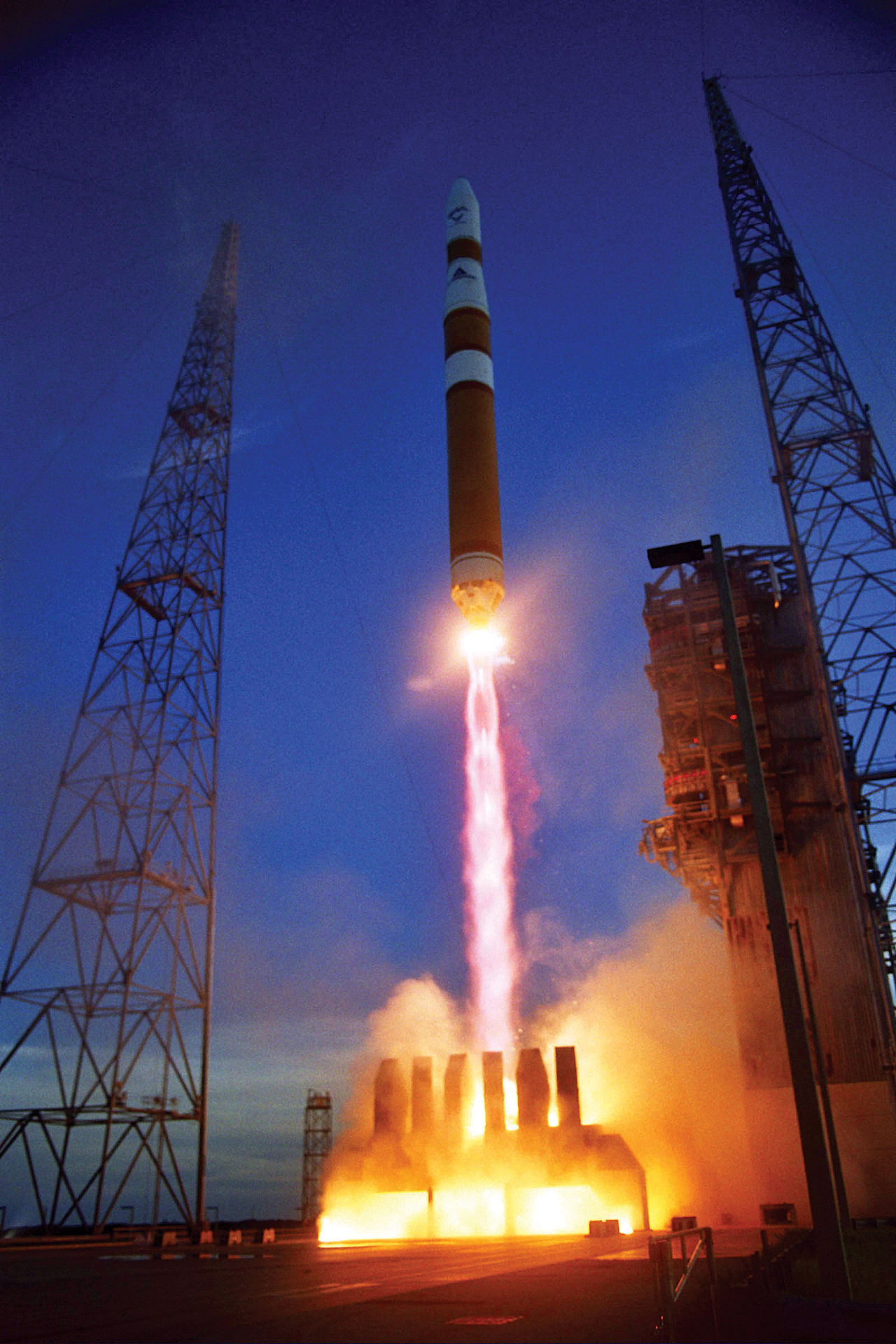
The Delta IV is an American expendable rocket family developed to place payloads into space. Built as part of the Evolved Expendable Launch Vehicle (EELV) program, the Delta IV entered service in the early 2000s and was later produced and operated by a national launch provider. It is intended to lift a wide range of payloads into different orbits around the Earth, relying on cryogenic liquid propellants and modular components.
Image gallery
10 Images




Design and variants
The Delta IV family is organized around a standardized core stage often called the common booster core (CBC). Variants were created by changing the number of cores, the size of the payload fairing, and the use of strap-on boosters. Major configurations include:
- Medium – a single core sized for moderate payloads.
- Medium+ – versions that add solid or additional booster elements and larger fairings to serve heavier satellites and higher orbits.
- Heavy – combines three common cores to produce high lift capability for the largest payloads.
Propulsion and stages
The first stage of Delta IV variants uses a powerful hydrogen/oxygen engine cluster designed for high thrust at liftoff and efficient performance in vacuum. The upper stage employs a smaller, high-efficiency cryogenic engine optimized for orbital insertion. This combination allows the family to carry payloads to low Earth orbit (LEO), geostationary transfer orbit (GTO) and other destinations by adjusting staging and configuration.
Launch sites and missions
Delta IV vehicles have been launched from major U.S. facilities, including Cape Canaveral Air Force Station in Florida and Vandenberg Air Force Base on the U.S. west coast. Missions have ranged from putting communications and Earth-observation satellites into service to carrying sensitive national-security payloads into orbiting regimes at widely varying altitudes.
Uses, history and legacy
Delta IV has served government, military and commercial customers, valued for its flexibility and lift capacity. Over time the family influenced subsequent launch vehicle design by emphasizing modular cores and cryogenic propulsion. As newer rockets entered service, some Delta IV variants were retired and flights concentrated on the most capable Heavy versions for the largest, most demanding missions. The Delta IV remains notable for its role in national access to space and for demonstrating modular, high-performance cryogenic stages.
Notable facts
- Delta IV Heavy is among the most powerful operational U.S. expendable launch vehicles when used.
- The family showcases modular engineering: similar core stages can be combined to scale performance.
- Its operational record includes a mix of routine commercial launches and high-priority government missions.
Questions and answers
Q: What is the Delta IV rocket used for?
A: The Delta IV rocket is used for launching satellites.
Q: How many different types of Delta IV are there?
A: There are three different types of Delta IV rockets: Medium, Medium+, and Heavy.
Q: What are the different types of Delta IV used for?
A: The different types of Delta IV are used for launching different types of satellites orbiting at different altitudes above the Earth.
Q: Where does the Delta IV rocket launch from in Florida?
A: The Delta IV rocket launches from Cape Canaveral Air Force Station in Florida.
Q: Where does the Delta IV rocket launch from in California?
A: The Delta IV rocket launches from Vandenberg Air Force Base in California.
Q: Is the Delta IV rocket used only for launching a specific type of satellite?
A: No, the Delta IV rocket is used for launching different types of satellites.
Q: How many different altitudes above the Earth can the Delta IV rocket launch satellites to?
A: The Delta IV rocket can launch satellites to many different altitudes above the Earth.
Related articles
Author
AlegsaOnline.com Delta IV (Evolved Expendable Launch Vehicle) Leandro Alegsa
URL: https://en.alegsaonline.com/art/26445
Sources
- ulalaunch.com : "Delta IV - United Launch Alliance"
- spaceflightnow.com : "Mission Status Center"