
Damn Small Linux (DSL): a tiny Live Linux for legacy x86 PCs
Damn Small Linux (DSL) is a minimal 50 MB live Linux distribution for older x86 hardware, designed to fit on tiny media, run from RAM, and serve as a portable rescue or lightweight desktop system.
Damn Small Linux (often abbreviated DSL) is a very small Linux distribution created to provide a functional graphical desktop and basic utilities within an exceptionally small footprint. Built around the idea that a usable system could fit into roughly 50 MB, DSL was distributed as a Live CD image and later adapted to boot from USB sticks, memory cards and other small storage media. Its design focused on supporting older x86 personal computers with limited processor power and memory, allowing them to run graphical applications and basic network services.
Image gallery
3 Images

Characteristics and design
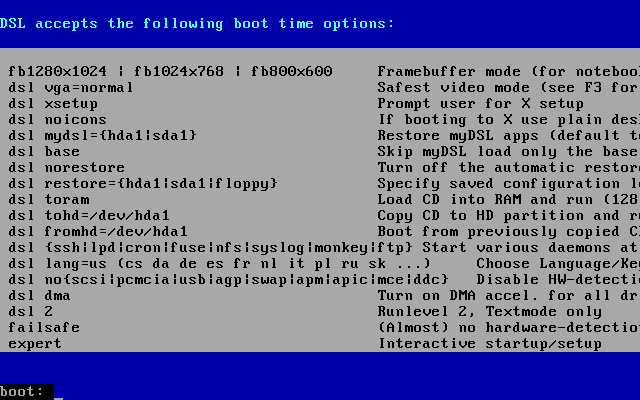
DSL emphasizes extreme efficiency: a compact kernel, lightweight windowing tools and a curated set of small applications make it possible to offer web browsing, text editing, file management and basic networking in a very small image. The distribution supported several boot modes, including a live session from removable media, a frugal install that keeps most files compressed on a small partition, and options to run entirely in RAM for improved responsiveness on capable machines. Modularity was a practical aspect of the project, allowing additional functionality to be added at runtime without inflating the base image.
Because of its size and low resource requirements, DSL could be used on business-card CDs, early USB flash drives, CompactFlash cards and other small-capacity devices. It was often used as a demonstration of minimalism and as a portable toolkit for system recovery tasks. The emphasis on tiny, efficient programs and careful configuration made DSL a useful reference for developers interested in optimization and embedded uses of Linux.
History and influence
DSL emerged in the early 2000s from an experiment in how much useful software could be packed into a 50 MB image. Its novelty and practical utility attracted attention from hobbyists, educators and administrators who needed a compact rescue environment. Over time it influenced other minimal and live distributions and helped popularize concepts such as frugal installs and running a complete system from removable media. Activity around the original project changed over the years; while its pace slowed as newer hardware and larger distributions became commonplace, its approach remains an instructive example of resource‑aware system design.
Typical uses and considerations
- Reviving or repurposing very old x86 computers for demonstration, testing or simple desktop tasks.
- Providing a portable rescue environment for data recovery, partitioning, password reset and basic repairs.
- Serving educational purposes to show how software selection and configuration affect footprint and performance.
- Acting as a starting point for embedded or specialized systems where storage and memory are constrained.
Users should keep in mind that DSL reflects the software choices and security practices of its active period; for connected or security‑sensitive tasks on modern networks, more recently maintained distributions are generally recommended. Nevertheless, DSL remains useful for offline recovery work, archival exploration of compact distributions, and learning about lightweight Linux setups.
Further information
- Official project page
- Download and ISO images
- Quick start and installation notes
- Hardware compatibility and requirements
- Documentation and how‑to guides
- Community forum and support
- Frequently asked questions
- Release announcements
- Source code and development resources
- Package repository and add‑ons
- Legacy archives and mirrors
- Related projects and comparisons
Questions and answers
Q: What is Damn Small Linux?
A: Damn Small Linux or DSL is a free operating system designed for the x86 family of personal computers.
Q: What kind of hardware was DSL designed to run on?
A: DSL was designed to run on older PC hardware, such as machines with 486/early Pentium processors and very little memory.
Q: What is the size of DSL?
A: DSL is a Live CD with a size of 50 MB.
Q: What was the experiment that led to the creation of DSL?
A: The creators of DSL started with an experiment to see how much software could fit in 50 MB.
Q: What did the experiment eventually produce?
A: The experiment with DSL eventually became a full-fledged Linux distribution.
Q: On what kind of storage media can DSL be installed?
A: DSL can be installed on various storage media with small capacities, such as bootable business cards, USB flash drives, various memory cards, and Zip drives.
Q: Is DSL available for free?
A: Yes, DSL is a free operating system for personal computers.
Related articles
Author
AlegsaOnline.com Damn Small Linux (DSL): a tiny Live Linux for legacy x86 PCs Leandro Alegsa
URL: https://en.alegsaonline.com/art/25280
Sources
- distrowatch.com : DistroWatch.com: Damn Small Linux
- unetbootin.sourceforge.net : unetbootin.sourceforge.net/