
Zip drive
Removable magnetic disk storage introduced by Iomega in 1994. Used 100 MB, 250 MB and 750 MB cartridges and offered internal and external interfaces for backups and file transport.
Overview
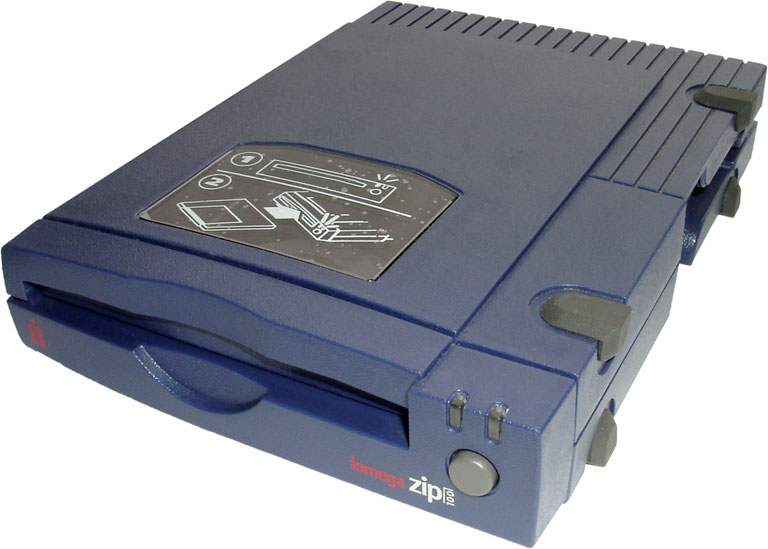
The Zip drive is a removable magnetic-disk storage system introduced by Iomega in late 1994 as a higher-capacity alternative to the common 3.5" floppy. It used cartridge-style disks that offered tens to hundreds of megabytes of storage and was marketed for personal and small-business backups, file transfer and archiving. The drive saw wide adoption in the mid-to-late 1990s before optical media, flash storage and inexpensive hard drives became dominant. For manufacturer information see Iomega.
Image gallery
9 Images


History and market position
The Zip format filled a market need for portable media that was both higher capacity and more durable than the standard 1.44 MB floppy. Early Zip drives were popular because they provided an easy, removable medium for larger project files and backups. Over the next decade the format competed with recordable CD, later DVD, and emerging solid-state options for removable storage. Historical product documentation and reviews provide additional context in contemporary sources such as product sheets and reviews.
Media and capacities
Zip cartridges were offered in several capacities during the product line's life. The original media stored 100 megabytes; later cartridges increased capacity to 250 MB and then 750 MB. Drives are generally backwards compatible in the sense that a drive rated for a higher-capacity cartridge can read lower-capacity media, but a lower-capacity drive cannot accept higher-capacity cartridges. Performance differences between drives and media generations are noted in technical references and manufacturer specifications.
Interfaces and form factors
Manufacturers produced both internal and external Zip drives. Internal models used common computer interfaces of the era such as IDE and SCSI. External models were offered with native SCSI connections and adapters for parallel port and USB, allowing connection to a wide range of desktop and laptop computers. Typical interface information can be found in interface guides and product listings: SCSI, parallel port adapters and USB variants.
Physical characteristics and compatibility
Physically, Zip cartridges resemble an oversized 3.5" floppy: they are thicker and have a similar rectangular outline but are not interchangeable. A standard 3.5" floppy (commonly described as 3.5" or about 9 cm wide) uses a different internal media and recording format, so inserting one into a Zip drive is incompatible despite occasional reports of fit; for comparisons see resources on 3.5-inch floppy dimensions and size comparisons. General information on floppy technology remains useful background reading on floppy disk technology.
Uses, software and operation
Zip cartridges were principally used for backing up documents, transporting large files between machines, and short-term archival storage. Drives were often bundled with backup utilities and driver software to integrate with operating systems of the day. Users appreciated the convenience and relative robustness of the cartridges compared with loose floppy disks, especially for multi-megabyte transfers.
Reliability, limitations and decline
Like many mechanical removable formats, Zip drives had occasional reports of mechanical failure and media-related problems, which, combined with falling costs of alternatives, contributed to declining use. The arrival of affordable CD-R and later DVD-R media, along with the small size and increasing capacity of flash drives, reduced the appeal of Zip cartridges and led to their gradual phase-out in consumer markets during the 2000s.
Legacy and preservation
Today the Zip drive is remembered as a transitional storage technology that bridged the gap between low-capacity floppy disks and later optical and solid-state media. Some collectors, archivists and hobbyists retain Zip drives and cartridges for data recovery, historical study and preservation of digital content created during the format's period of use. Technical manuals, archival guides and manufacturer documentation remain useful for those seeking to read legacy Zip media; see manufacturer and archival references such as Iomega documentation and contemporary product and interface notes.
- Capacities: 100 MB, 250 MB, 750 MB cartridges were the main offerings.
- Interfaces: internal (IDE, SCSI) and external (SCSI, parallel, USB).
- Use cases: backups, file transfer, short-term archives.
- Legacy: an important transitional removable format before widespread CD/DVD and flash storage adoption.
Questions and answers
Q: What is a Zip drive?
A: A Zip drive is a data storage device.
Q: When was the Zip drive introduced?
A: The Zip drive was introduced in late 1994, by the company Iomega.
Q: What capacities of disks did the Zip drive originally support?
A: The Zip drive originally only supported 100 MB disks.
Q: What higher capacity disks do later versions of the Zip drive support?
A: Later versions of the Zip drive support 250 MB and 750 MB disks.
Q: What kind of drives are able to handle all lower capacity media?
A: Generally, higher capacity Zip drives are able to handle all lower capacity media.
Q: What are the different ways Zip drives can transmit data to the computer?
A: Zip drives can transmit data to the computer through internal drives with IDE and SCSI interfaces, and external drives using SCSI, parallel port, or USB interfaces.
Q: Are Zip disks interchangeable with regular floppy disks?
A: Although Zip disks have a similar appearance to regular floppy disks and can fit into the same slot, they are not interchangeable.
Related articles
Author
AlegsaOnline.com Zip drive Leandro Alegsa
URL: https://en.alegsaonline.com/art/110645