
Darwin (operating system)
Darwin is Apple’s open-source Unix-like operating system kernel and userland foundation that forms the core of macOS and other Apple platforms, combining Mach, BSD and Apple-specific subsystems.
Darwin is the open-source, Unix-like foundation underlying Apple’s desktop and mobile platforms. It provides the core kernel, basic command-line utilities and low-level services used by macOS and other Apple systems. The project takes its name from the naturalist Charles Darwin and is released by Apple Inc. under a mix of permissive and Apple-specific licenses.
Image gallery
2 Images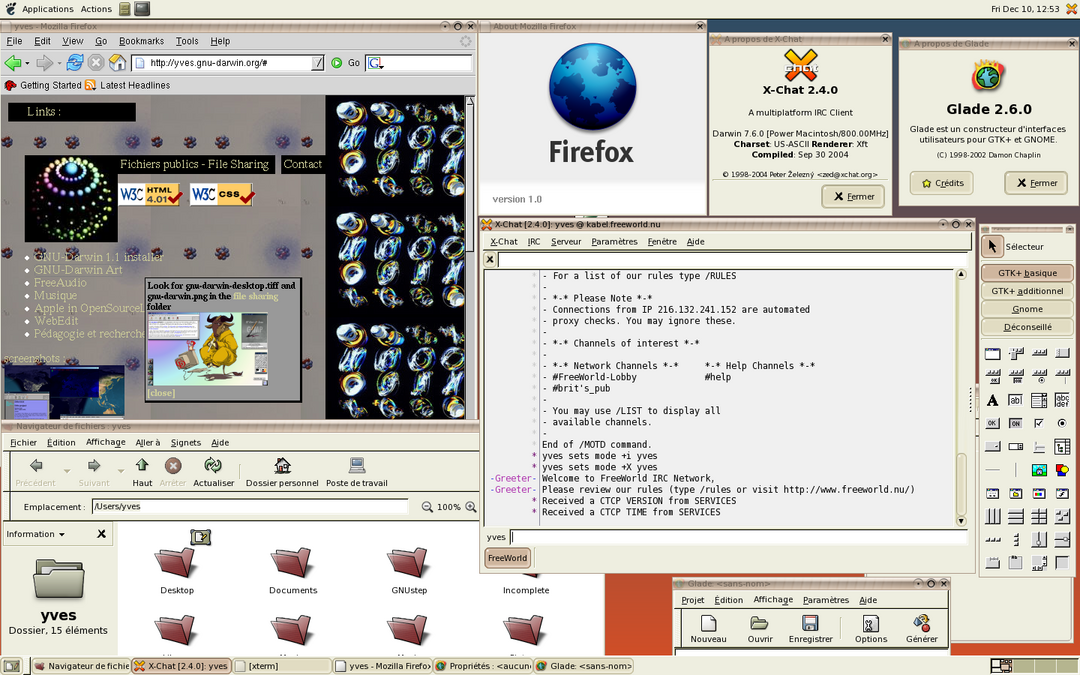

Core components
At its heart Darwin includes the XNU kernel, a hybrid design that combines ideas from the Mach microkernel with components derived from BSD. The distribution also contains a BSD-derived userland that implements standard Unix utilities and POSIX interfaces. Key subsystems commonly associated with Darwin are:
- XNU kernel: manages processes, memory and low-level scheduling.
- IOKit and device support: driver framework for hardware interaction.
- Launch and system services: launchd and other daemons that start and supervise system processes.
History and licensing
Apple made large parts of its system source available to the public as an open source release to encourage community inspection and to provide a transparent base for its commercial systems. The code combines BSD-derived software and Apple-written components and is distributed under licenses such as the Apple Public Source License and permissive BSD-style terms.
Uses, limits and community projects
Darwin serves as the backbone of macOS and influences other Apple platforms. By itself it lacks many of the proprietary graphical frameworks, libraries and drivers that make full macOS applications run, so a raw Darwin installation cannot execute most commercial macOS apps. Enthusiast and research efforts have produced community spins and experiments that build on Darwin’s open components to explore alternative desktop or server uses.
Notable distinctions
Darwin is a distinct example of a commercial vendor releasing a substantial operating-system core as open source. It blends traditional Unix compatibility with Apple-specific technologies and is often compared to other Unix-like cores such as Linux and the various BSDs. For further technical references and source repositories consult vendor and community resources Unix-oriented and developer pages about the project or platform-specific documentation from Apple and community mirrors that track development, including overviews of how it relates to Apple’s desktop OS.

Architecture, functional description and system requirements
The source code base of Darwin goes back to 4.4BSD-Lite, which was ‑cleaned of the last remaining original SystemV source lines after the dispute over rights to the UNIX code that ended in 1994.‑ It is available under a free license, the APSL. At the same time, Darwin is a descendant of the NeXT-developed operating system NeXTStep, which was renamed OPENSTEP in 1996 and was still based on 4.3BSD. Apple bought NeXT towards the end of 1996 and further developed the purchased system into Rhapsody. The BSD base system was ported from 4.3BSD to 4.4BSD Lite source code and the kernel from Mach 2.5 to Mach 3. With the release of Mac OS X Developer Preview 1, this kernel was first known as XNU and released as part of the Darwin source code. However, Mach 3 is not fully implemented, but supplemented by parts of the FreeBSD kernel to a hybrid kernel, so that it combines the advantages of a monolithic kernel with the advantages of a microkernel. Parts of the Mach implementation from MkLinux, in which Apple was also involved, were reused.
Darwin runs in different versions on PowerPC processors, x86 processors and on ARM processors. While all applications for Darwin also run on Mac OS X, applications tailored for Mac OS X/OS X/macOS do not necessarily work on Darwin. The mobile operating systems iOS for the iPhone, iPadOS for the iPad, tvOS for the Apple TV, and watchOS for the Apple Watch are also based on Darwin, but the user does not have access to the file system or the command line. This restriction can be lifted in some cases by a jailbreak.
Licensing and marketing
Darwin is published under the Apple Public Source License in source code, which is recognized as a free software license by the Free Software Foundation as of version 2.0. The mascot of Darwin is Hexley, the platypus.
Darwin is the open source core of Apple's proprietary Mac OS X or Rhapsody-based operating systems. Binary releases of Darwin were available from Apple until Darwin 8.0, on which Mac OS X Tiger, version 10.4 from 2004, is based.
Related articles
Author
AlegsaOnline.com Darwin (operating system) Leandro Alegsa
URL: https://en.alegsaonline.com/art/25588