
Dance Dance Revolution
Dance Dance Revolution (DDR) is a Konami music-rhythm video game series where players step on a floor pad to match on-screen arrows in time with music, spanning arcades, consoles, and a competitive community.
Overview
Dance Dance Revolution (often abbreviated DDR) is a music-rhythm video game series created by Konami in which players physically step on directional panels to match scrolling arrows on a screen. The series is known in some regions as Dancing Stage. Gameplay requires timing, coordination and rhythm as arrows correspond to beats in songs; when performed correctly, the player's on-screen score increases and a life gauge is maintained.
Image gallery
10 Images


Gameplay and hardware
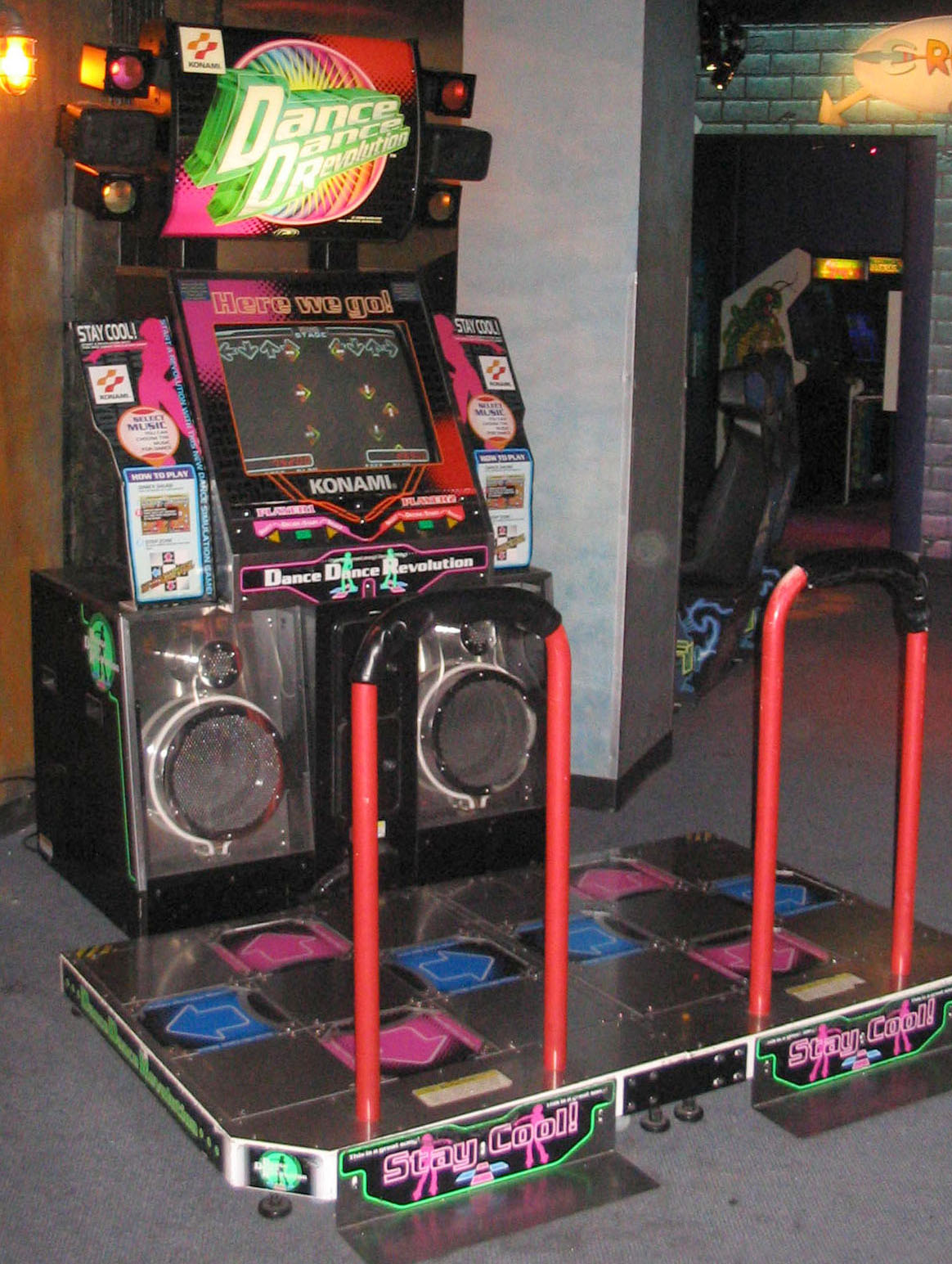
Typical play uses a large floor pad or mat divided into directional panels (up, down, left, right) that detect the player's steps. Arcade installations use sturdier metal platforms, while home versions often ship with softer rubber mats. The visual interface shows arrows that scroll toward a stationary target zone; players step on the corresponding pad when the arrow reaches that zone. Performance is judged by timing windows (e.g., Perfect, Great, Good, Miss) and a life or performance meter that rises with successful inputs and falls with mistakes.
Modes, difficulty and scoring
DDR offers multiple difficulty settings to suit new and experienced players. Early releases used labels such as light, standard and heavy; later titles expanded these to beginner, basic, difficult, expert and challenge. Some versions add specialized modes like workout, nonstop, or practice. Scores translate into letter grades and performance tiers; common notations across the community include grades like E through A and extended rankings such as AA or AAA for top play. A combo counter, accuracy judgments and special modifiers (speed changes, arrow mirrors) further affect scoring.
History and development
The first DDR arcade machines appeared in the late 1990s and quickly became popular for blending physical activity with gaming. Konami developed the series for both arcades and home consoles, releasing numerous sequels and regional variants. Music selections mix licensed pop songs, electronic tracks and original in-house compositions produced for the series. Over time, hardware and software changes introduced newer step chart types, multiplayer modes and online features on console editions.
Cultural impact and uses
DDR helped popularize rhythm games and inspired other motion-based titles. It has been used for entertainment, exercise and informal social competition. Arcades often serve as community hubs for players who exchange techniques, charts and high scores. The series' influence extends into fitness classes, academic studies on physical gaming, and fan events; community sites and forums maintain guides, song lists and tutorials (game information, community resources).
Variations, competitive play and notable facts
Variants of DDR include regional branding and spin-offs with altered song lists or control schemes. Competitive play focuses on accuracy, stamina and mastery of difficult step charts; tournaments and online events test players across song sets and modes. Notable elements that distinguish DDR from many rhythm titles are its full-body movement, the use of a physical platform, and a broad library that mixes licensed hits with original Bemani compositions. For updates, historical timelines and official announcements consult the developer and recognized fan archives (developer pages, fan archives).
- Common platforms: Arcade cabinets, home consoles, PC and mobile adaptations.
- Typical scoring elements: Timing judgments, combo counts, life/energy gauge, letter or tier grades.
- Community activities: Tournaments, chart editing, fitness challenges and online leaderboards.
Dance Dance Revolution remains a recognizable entry in the history of rhythm games because it merged physical motion with music-based timing mechanics and cultivated a lasting player community across arcades and home systems.
Questions and answers
Q: What is Dance Dance Revolution?
A: Dance Dance Revolution (or Dancing Stage in Europe) is a series of video games made by Konami in which players step on arrows on a large pad or mat to match the arrows on screen. The arrows are in time with the music, so it looks like the players are dancing.
Q: How does the game work?
A: There is a bar at the top of the screen that gets smaller if players make mistakes and grows if they don't. The game ends if too many mistakes are made. Players can choose between three levels - light, standard, and heavy - with light being easy and heavy being hard. On some newer versions there is also beginner mode (very easy) and challenge mode (very hard). Players are graded based on their performance using letters from E to AAA depending on how well they played the song.
Q: What levels are available?
A: On DDR SuperNOVA and later versions, there are five levels available - beginner, basic, difficult, expert, and challenge. Light is easy and heavy is hard for earlier versions of DDR.
Q: How do players get graded?
A: Players get graded by their performance in letters from lowest to highest (E, D, C, B, A , AA , AAA) based on how well they played the song. The better a player does on a song ,the higher their grade will be .
Q: Is there variety in terms of music?
A: Yes! There is a large variety of music available for play within this game series .
Related articles
Author
AlegsaOnline.com Dance Dance Revolution Leandro Alegsa
URL: https://en.alegsaonline.com/art/25331