
Corona (solar and stellar outer atmosphere)
The corona is the tenuous, extremely hot outer atmosphere of the Sun and other stars. This article explains its structure, temperature paradox, observable features, methods of study, and its role in space weather.
The corona is the outermost layer of a star's atmosphere, an extended region of hot ionized gas or plasma that surrounds the visible surface of a star such as the Sun. The name derives from the Latin word for "crown" and traces back to the Greek term korōnē. When conditions align, the solar corona becomes visible to the naked eye as a white, pearly halo during a total solar eclipse, and it can also be studied using instruments such as a coronagraph.
Image gallery
10 Images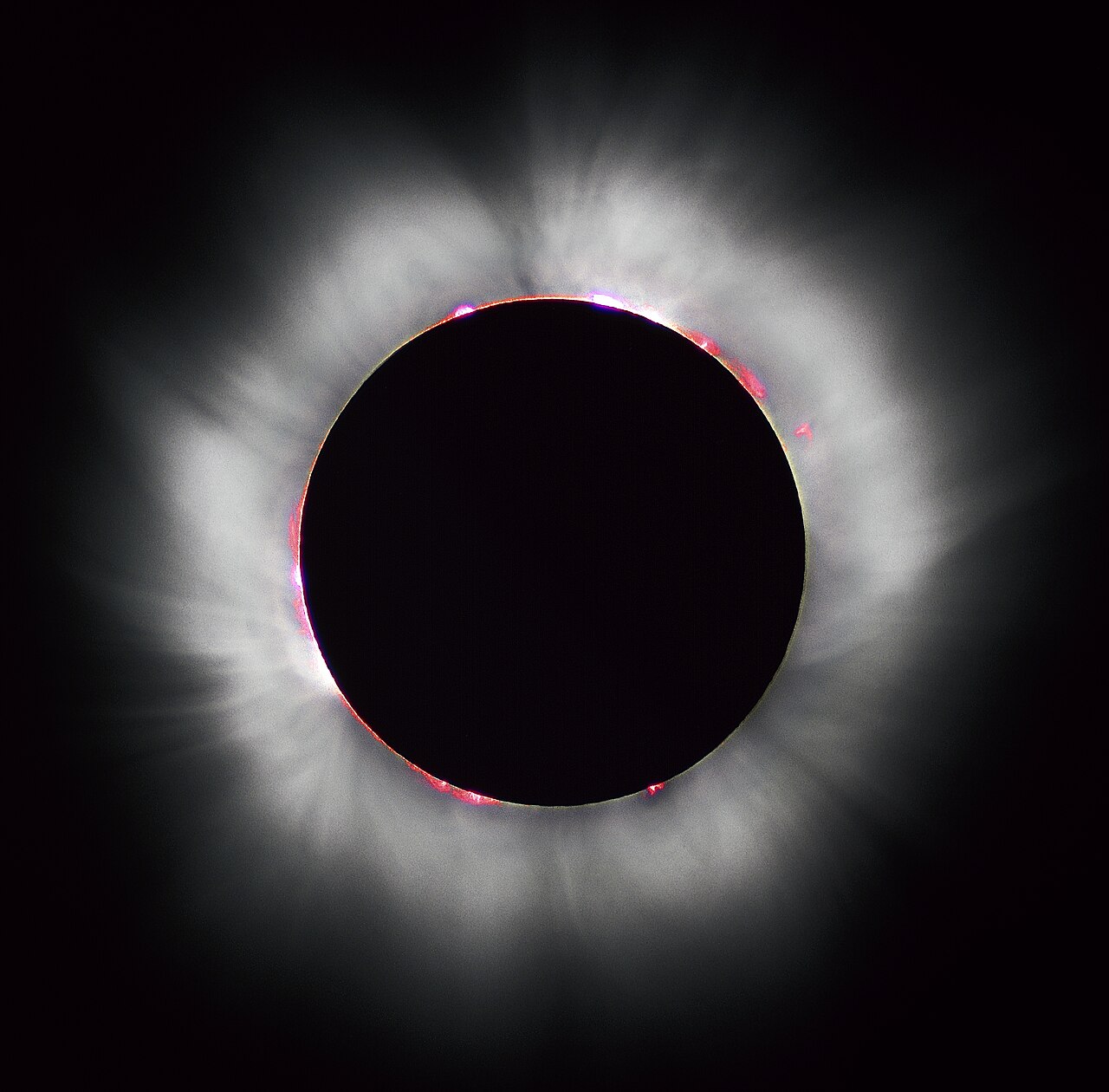





Physical characteristics
Compared with the photosphere beneath it, the corona is extremely hot yet extremely tenuous. Typical coronal temperatures range from about one to several million kelvin, far hotter than the photosphere's roughly 5,800 K. At the same time the corona's particle density is many orders of magnitude lower than the visible surface, so it emits far less visible light. The corona grades into an extended outer region where the star's magnetic field channels charged particles and, for the Sun, opens into the heliosphere as the solar wind.
Why the corona is so hot
The mechanisms that heat the corona to temperatures far above the photosphere remain active research topics. Leading explanations invoke the star's magnetic field: small-scale energy release through magnetic reconnection and the conversion of wave energy (magnetohydrodynamic waves) into heat are both thought to contribute. Observations in extreme ultraviolet and X-rays show rapid, localized heating events and dynamic structures that support these ideas, though a complete, quantitative account is still being refined.
Common coronal structures and phenomena
- Coronal loops: Arched plasma confined by magnetic field lines above active regions.
- Streamers and helmet streamers: Bright, extended features seen in eclipse images and coronagraph data.
- Coronal holes: Darker, cooler regions with open magnetic fields that permit high-speed wind streams.
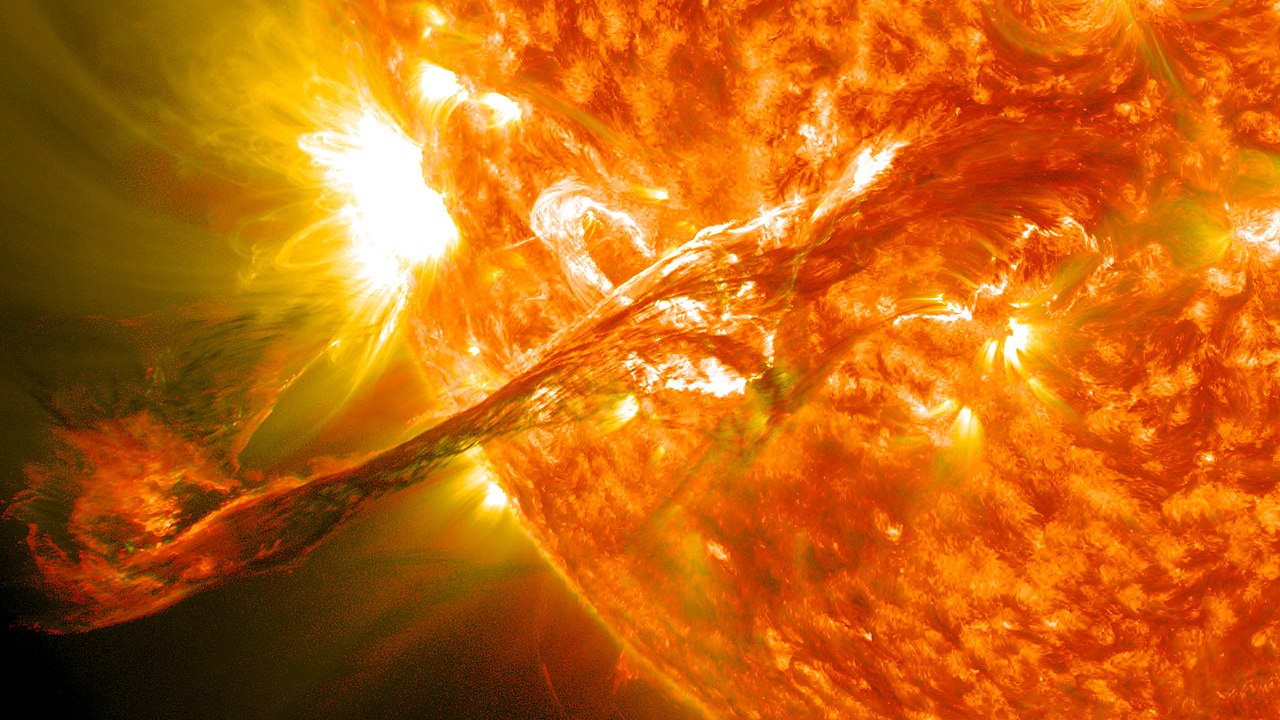
- Solar flares and coronal mass ejections (CMEs): Sudden releases of magnetic energy that eject plasma into space and drive space weather.
These features are the visible manifestations of complex magnetized plasma processes. Instruments sensitive to different wavelengths — for example, extreme ultraviolet and X-ray imagers — reveal complementary aspects of coronal activity.
Observing and studying the corona
Historically, eclipses provided the first clear views of the corona. Modern observations rely on space-based observatories and specialized instruments. A coronagraph can block direct starlight to reveal nearby faint coronal emission, and spectrographs record the coronal composition and flow speeds. Space missions have advanced knowledge by taking repeated, high-resolution images and in situ measurements of the solar wind. Recent spacecraft travel closer to the Sun to sample the near-coronal environment and to study heating and acceleration processes at their source.
Importance and impacts
Understanding the corona is important for both fundamental astrophysics and practical concerns. Coronal activity governs the variability of a star's high-energy radiation and the properties of its wind, which can influence planetary atmospheres and produce space weather effects such as geomagnetic storms and auroras at Earth. Studies of the solar corona therefore inform models of stellar magnetism, the evolution of planetary environments, and efforts to predict disruptive space weather.
Notable distinctions and historical notes
"Corona" can refer to the solar case specifically or to stellar coronae more generally; coronal properties vary with stellar type and magnetic activity. Early systematic study of the solar corona advanced with photographic, spectroscopic, and eclipse expeditions, and continues with dedicated space observatories and probes that aim to resolve the remaining questions about heating, structure, and the connection to the wind.
For further reading and instrument details see sources on plasma physics, solar magnetism, and observational techniques: photosphere, temperature, kelvin, and additional technical summaries at research archives and mission pages referenced by catalogs such as those listed by major space agencies and observatories (plasma overview, solar studies).
Related articles
Author
AlegsaOnline.com Corona (solar and stellar outer atmosphere) Leandro Alegsa
URL: https://en.alegsaonline.com/art/23181