
Cosmic microwave background radiation
Relic microwave radiation from the early universe: a near–blackbody glow with small anisotropies that records conditions at photon decoupling and constrains cosmological models.
Overview
The cosmic microwave background (CMB) is a nearly uniform bath of low-energy electromagnetic radiation that fills the observable universe. It is observed today in the microwave portion of the electromagnetic spectrum and represents the oldest photons that reach us, emitted when the expanding universe cooled enough for matter and radiation to decouple. As a relic of the early cosmos, the CMB provides a snapshot of conditions roughly 380,000 years after the Big Bang, before the first stars and galaxies formed. Its uniformity across the sky is a primary empirical input for modern cosmology.
Image gallery
8 Images





Thermal spectrum and temperature
The CMB has a thermal, blackbody-like spectrum with an effective temperature of about 2.7 kelvin. That spectrum is concentrated in the microwave band of wavelengths and is measured with high precision; deviations from a perfect blackbody are very small. The present low photon energies are the result of cooling as the universe expanded from the hot, dense initial state, shifting originally higher-energy radiation into microwaves.
Origin and last scattering
When the universe was hot and ionized, photons scattered frequently from free electrons and remained tightly coupled to the baryonic plasma. As the expanding universe cooled, electrons and protons combined into neutral atoms in a process called recombination. At that point photons decoupled and began to travel freely; the spherical surface from which they last scattered is called the last scattering surface. These freely streaming photons are the CMB we observe today. The photons that make up the CMB were at the time of decoupling still affected by acoustic oscillations and density variations in the primordial plasma; those imprinted patterns are visible as tiny temperature differences across the sky.
Anisotropies and power spectrum
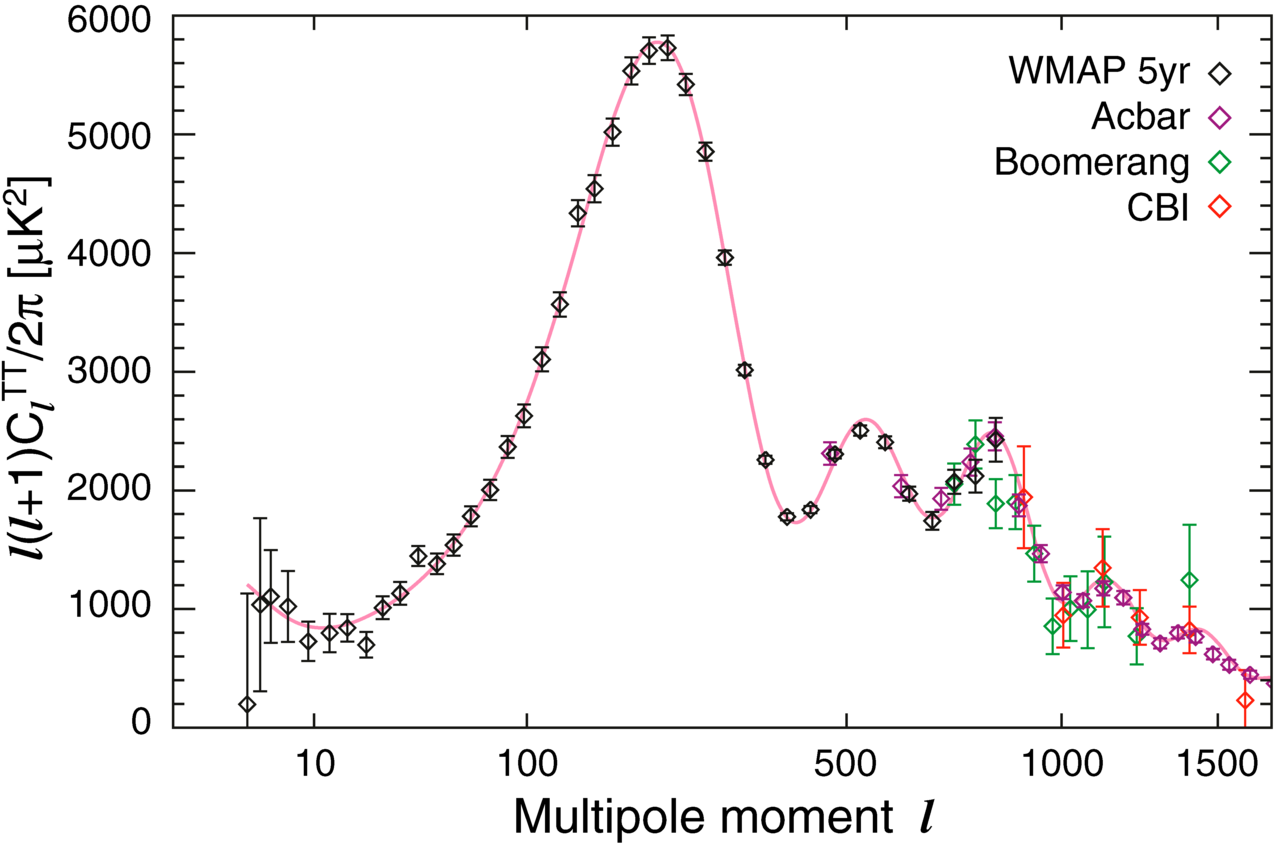
Although the CMB is highly isotropic, it exhibits anisotropies at the level of roughly one part in 100,000. These small temperature fluctuations are characterized by an angular power spectrum that shows a series of acoustic peaks. The positions and amplitudes of those peaks depend on fundamental cosmological parameters such as the total matter density, baryon fraction, dark matter, dark energy, and the spatial curvature of the universe. Analysis of the power spectrum is one of the most powerful methods for precise cosmological parameter estimation.
Polarization and secondary effects
In addition to temperature anisotropies, the CMB is polarized. Polarization patterns help separate signals generated at recombination from later distortions introduced by intervening matter. Secondary anisotropies arise from effects that altered CMB photons after last scattering, such as the Sunyaev–Zel'dovich effect caused by hot gas in galaxy clusters, gravitational lensing that distorts CMB maps, and the Integrated Sachs–Wolfe effect related to evolving gravitational potentials. These signatures provide complementary information about the growth of structure and the distribution of matter.
Discovery and measurement history
The pervasive microwave background was discovered in the 1960s by radio astronomers Arno Penzias and Robert Wilson, an observation that strongly supported the hot early-universe model. Subsequent missions and experiments refined the measurement of the blackbody spectrum and revealed anisotropies: space missions mapped the sky with increasing resolution and sensitivity. Ground-based and balloon experiments also measured fine angular scales and polarization. Notable satellite contributions culminated in high-precision all-sky data from the Planck spacecraft, building on earlier surveys and complementary observations performed by other instruments and teams.
Cosmological significance
Measurements of the CMB constrain the age, composition, and geometry of the universe and provide evidence for the existence of dark matter and dark energy in combination with other probes. The observed anisotropy pattern supports a period of rapid inflation in the very early universe, which explains the origin of the initial density perturbations and the large-scale uniformity. CMB data are typically combined with galaxy surveys, supernova distances, and redshift measurements to form a consistent cosmological model; the relation between observed wavelengths and cosmological expansion is described using redshift.
Anomalies and open questions
High-precision maps reveal a few unexpected features, sometimes called anomalies, including a hemispheric power asymmetry, alignments of the largest-scale multipoles, and a prominent cold spot larger than typical fluctuations. These features are the subject of active research. Explanations under consideration range from statistical flukes and residual foreground contamination to unmodeled astrophysical processes or new physics beyond the simplest inflationary scenarios. No consensus explanation has been established.
Observational practice and experiments
Modern CMB research combines observations across frequencies to separate the cosmological signal from galactic and extragalactic foregrounds. Instruments span radio to microwave bands and use different platforms—ground-based telescopes, stratospheric balloons, and satellites—to access complementary scales and sensitivities. Instrument teams routinely publish maps, power spectra, and polarization products, and they provide public data releases and analysis tools to the scientific community. For technical overviews and experiment pages see references from mission teams and project pages for microwave experiments and survey archives; general sky survey and multiwavelength context are discussed in broader observational summaries (observations across the sky).
Resources and further reading
Introductory reviews and textbooks cover the physics of recombination, acoustic oscillations, and the interpretation of anisotropies. Public data releases and documentation from experimental collaborations provide practical resources for analysis. For concise background material on the relevant physical concepts see summaries of the microwave properties of the CMB, the role of photons in the early plasma, and how measurements connect to the expanding universe. Technical discussions often reference instrumental details and calibration methods available from mission archives and collaboration publications.
Questions and answers
Q: What is cosmic microwave background radiation?
A: Cosmic microwave background radiation (CMB radiation) is a type of electromagnetic radiation in the microwave part of the spectrum that comes from all directions in outer space. It is believed to originate from our earliest infant universe.
Q: How do we know that CMB light arrives as the oldest signal?
A: We know that CMB light arrives as the oldest signal because the universe is very large, and the speed of light is constant. Therefore, when it reaches us from the infant universe, it has been traveling for a long time without hitting anything.
Q: Who first detected CMB radiation?
A: Arno Penzias and Robert Wilson were the first to detect CMB radiation.
Q: What evidence does its existence provide for Big Bang theory?
A: The existence of CMB radiation provides important evidence, along with red shift data, that supports Big Bang theory.
Q: What was Planck spacecraft designed to observe?
A: The Planck spacecraft was designed to observe differences in cosmic microwave background at microwave and infra-red frequencies with high sensitivity and small angular resolution.
Q: What unexpected findings have been discovered by researchers analyzing data from Planck spacecraft?
A: Researchers analyzing data from Planck spacecraft have found an asymmetry in average temperatures on opposite hemispheres of sky which runs counter to predictions made by standard model that Universe should be broadly similar in any direction we look. Furthermore, they also found a cold spot extending over a patch of sky much larger than expected which currently has no explanation.
Related articles
Author
AlegsaOnline.com Cosmic microwave background radiation Leandro Alegsa
URL: https://en.alegsaonline.com/art/23307