
Colugo — the gliding mammals of the order Dermoptera
Colugos are nocturnal, arboreal gliders from Southeast Asia (order Dermoptera). Two living species use an extensive skin membrane to glide between trees and feed mainly on leaves, shoots and fruit.
Overview
Colugos are small to medium-sized mammals in the order Dermoptera known for their exceptional ability to glide. Often called "flying lemurs," that name is misleading because they are not true lemurs; colugos belong to a distinct order and are most closely associated with other euarchontans. Their most striking feature is a broad, thin patagium — a skin membrane that stretches from neck to tail and between the limbs — which enables controlled parachuting and long-distance glides through the forest canopy.
Image gallery
10 Images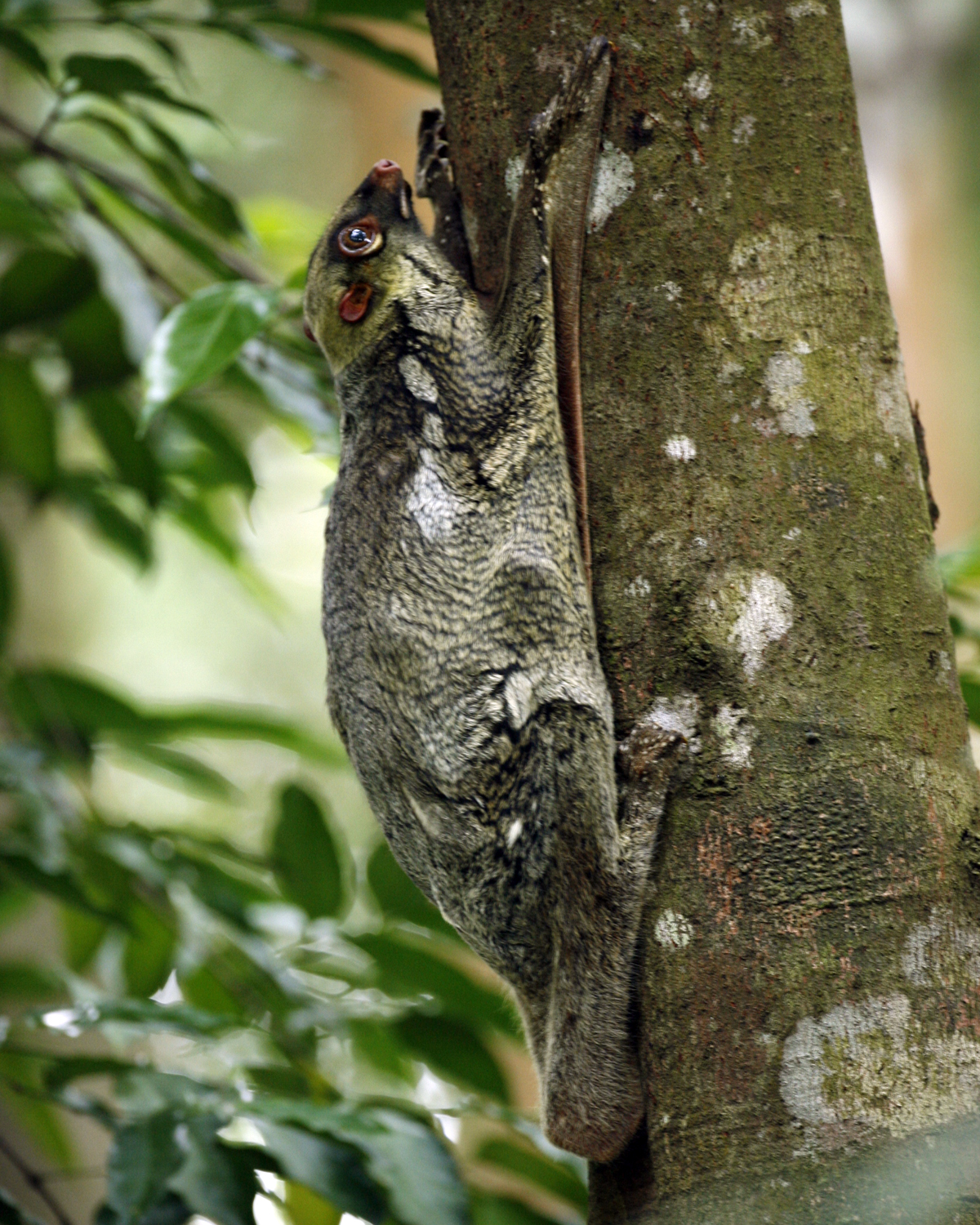


Species and taxonomy
Only two living species are widely recognized, both native to Southeast Asia. They are typically treated as distinct genera and can be listed as:
- Sunda (or Malayan) colugo — a widespread form on mainland and island Sundaland.
- Philippine colugo — restricted to parts of the Philippine archipelago.
Colugos are classified in their own order, Dermoptera. For an overview of mammalian gliders and related groups see gliding mammals, and for placement within mammal classification see annotations under Dermoptera.
Anatomy and gliding
The patagium is fur-covered and continuous around the body, creating a large surface area for lift. Limbs end in sharp claws for gripping bark, and the head is flattened with large eyes suited for low-light activity. These adaptations permit efficient, quiet travel between trees while avoiding ground predators. Reported glide distances vary by terrain and vegetation structure; individuals regularly traverse dozens of meters in a single glide.
Behavior, diet and reproduction
Colugos are primarily nocturnal and spend almost all of their lives in trees. Their diet is mainly composed of leaves, young shoots, flowers and some fruit, classifying them as largely folivorous with occasional frugivory. Reproduction tends toward small litters — commonly a single offspring — which clings to the mother following birth. Social behavior is generally solitary or in small family groups.
Distribution, conservation and significance
Found across lowland and hill forests in parts of mainland Southeast Asia and many islands of the region, colugos depend on intact canopy to move and forage. Habitat loss from logging and conversion to agriculture poses the greatest threat in many locales, and they are sometimes hunted locally for food. For conservation context and regional notes see resources indexed under related primate and mammal pages and distribution notes at Southeast Asian fauna references.
Fossil and molecular evidence indicate Dermoptera has an ancient lineage and a long evolutionary relationship with other euarchontans (primates and tree-shrews). Their specialized morphology and quiet, arboreal lifestyle make colugos an important subject for studies of gliding locomotion, forest ecology and the evolution of mammalian aerial movement.
Related articles
Author
AlegsaOnline.com Colugo — the gliding mammals of the order Dermoptera Leandro Alegsa
URL: https://en.alegsaonline.com/art/21778