
Chromium(III) chloride (CrCl3)
Inorganic salt chromium(III) chloride (CrCl3): green hydrated and purple anhydrous forms, octahedral Cr3+, common laboratory reagent and synthetic precursor; less toxic than hexavalent chromium.
Overview
Chromium(III) chloride is an inorganic salt composed of chromium in the +3 oxidation state and chloride anions. Its simple formula is commonly written as CrCl3, although crystalline samples often occur as hydrates. Hydrated material typically appears green, while the anhydrous solid is distinctive purple. As a source of Cr3+ it is widely used in teaching laboratories and as a starting point for preparing other chromium compounds. For a general reference see the compound.
Image gallery
9 Images


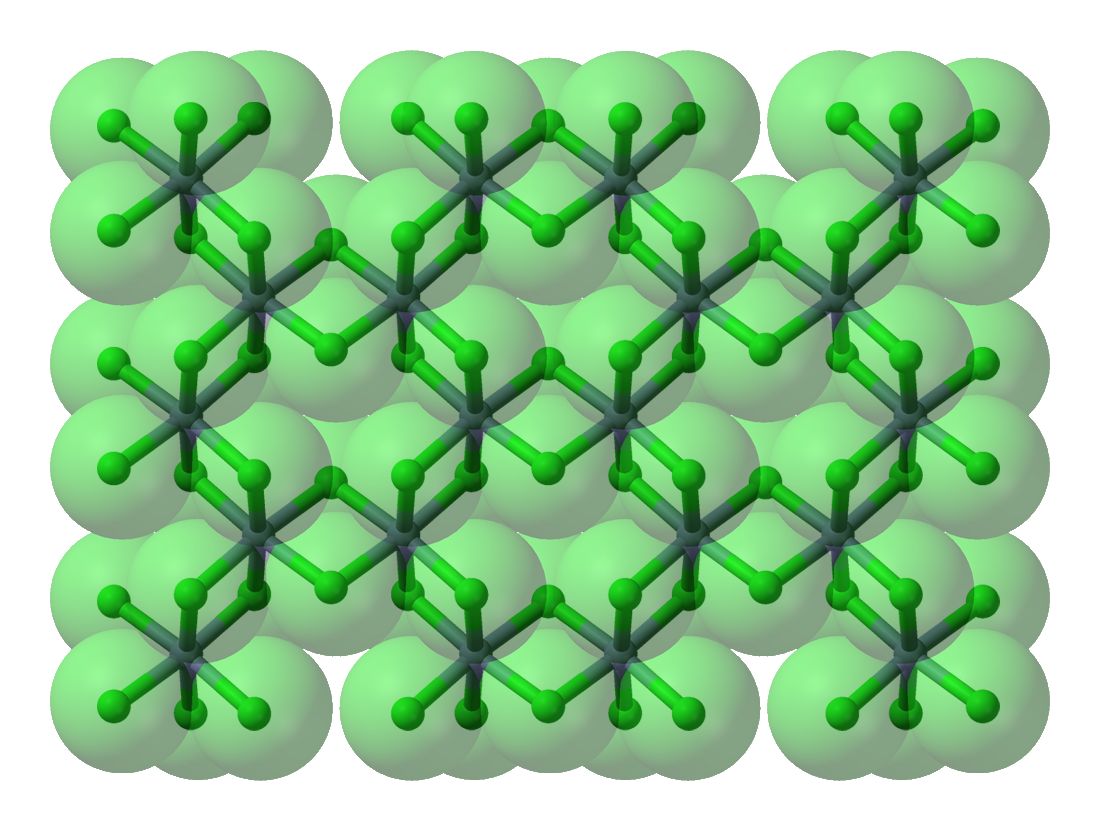


Structure and physical properties
Chromium in this salt exists as the trivalent ion; the +3 oxidation state is relatively stable and forms octahedral coordination complexes. Many hydrates exist, the hexahydrate CrCl3·6H2O being among the best known. The chromium center has a d3 electronic configuration, which typically makes Cr3+ paramagnetic and spectroscopically active. The salt is ionic, featuring chromium cations and chloride anions; more on the oxidation state is available at oxidation state and on the anionic partner at chloride ions.
Preparation and common reactions
Laboratory and industrial preparations include dissolving chromium metal in hydrochloric acid or treating chromium(III) oxide with hydrochloric acid to form the chloride hydrate; these routes are convenient for producing aqueous Cr(III) solutions. Evaporation and controlled heating can convert hydrates to the anhydrous purple salt. Typical precursors and reagents used in synthesis are discussed in sources such as metallic chromium, hydrochloric acid and chromium(III) oxide. The compound also participates in ligand-exchange and redox reactions common to chromium coordination chemistry.
Uses and importance
Chromium(III) chloride serves primarily as a laboratory reagent and a precursor for preparing a wide variety of chromium complexes used in catalysis and organic synthesis. It is useful in research on coordination compounds and can be converted into other oxidation states or organochromium species for specialized transformations. In industry and applied chemistry it has roles as a mordant or intermediate, though more modern processes often favor other chromium sources. Typical applications are summarized below.
- Reagent in synthesis and coordination chemistry
- Precursor to catalysts and specialty chromium complexes
- Educational demonstrations of color changes and hydration chemistry
Safety, environmental notes and distinctions
Chromium(III) salts are considered significantly less hazardous than hexavalent chromium compounds. However, normal laboratory precautions—gloves, eye protection and proper ventilation—are recommended because inhalation or ingestion of metal salts can be harmful. For comparison with more toxic forms see chromates. The term chloride in the name emphasizes the anionic partner that defines much of its solubility and reactivity. Distinguishing CrCl3 from chromium(II) chloride, chromates or mixed-valence materials is important for both safety and chemical behavior.
Further technical details and data tables are provided in specialized chemical references and databases; introductory summaries and supplier information are accessible via general chemical guides and catalogs represented by links such as compound overview and reagent pages linked above.
Related articles
Author
AlegsaOnline.com Chromium(III) chloride (CrCl3) Leandro Alegsa
URL: https://en.alegsaonline.com/art/20211