
Oxidation state (oxidation number)
The oxidation state (oxidation number) is a bookkeeping value assigned to atoms to track electron transfer in compounds and redox reactions; it helps predict reactivity, balance equations, and name compounds.
The oxidation state, often called the oxidation number, is an assigned integer that represents the hypothetical charge an atom would have if all bonds to it were ionic. Chemists use oxidation states as a bookkeeping tool to describe electron transfer in chemical reactions, to balance redox equations, and to classify the chemical behavior of elements in compounds. Although the number is not always equal to the real electrical charge on an atom in a molecule, it provides a consistent framework for comparing how different atoms gain or lose electrons.
Image gallery
3 Images

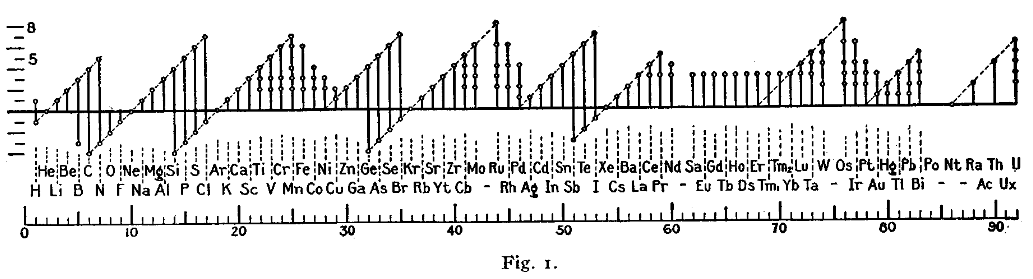
Assigning oxidation states: basic rules
A small set of conventions makes it straightforward to assign oxidation states in most compounds. The most commonly used rules are:
- Atoms in their elemental form have an oxidation state of 0 (for example, O2, H2, Cl2). See oxygen and related elements for examples.
- For monoatomic ions, the oxidation state equals the ion charge (Na+ is +1, Cl− is −1). Elements such as sodium commonly form +1 ions.
- Hydrogen is usually +1 when bonded to nonmetals and −1 when bonded to metals.
- Oxygen is usually −2 in most compounds, with important exceptions: peroxides (O2^2−, each O −1) and superoxides (each O −1/2). Historical work on oxygen helped define the concept; see Antoine Lavoisier.
- The sum of oxidation states for all atoms in a neutral molecule equals zero; in a polyatomic ion it equals the ion charge.
- More electronegative elements are assigned negative oxidation states when bonded to less electronegative elements. Electronegativity trends can guide assignments; consult resources on electronegativity.
Common examples and quick calculations
- Water, H2O: oxygen −2, each hydrogen +1, so 2(+1) + (−2) = 0. See hydrogen and oxygen.
- Sodium chloride, NaCl: Na +1 and Cl −1; this reflects transfer of an electron from sodium to chlorine.
- Carbon dioxide, CO2: each O is −2, so C must be +4 to balance (2×(−2) + (+4) = 0).
- Iron(III) oxide, Fe2O3: three O atoms contribute −6 total, so two Fe atoms share +6; each Fe is +3.
- Molecular oxygen O2: each O is 0 (elemental form). Peroxides and other oxygen-containing species are exceptions.
History and development
The idea of oxidation traces to late 18th-century studies of combustion and chemical combination, notably the work of Lavoisier, who linked chemical change to interaction with oxygen. Over time the concept broadened: "oxidation" came to mean loss of electrons and "reduction" gain of electrons, independent of oxygen involvement. Systematic rules for oxidation states were later formalized to support nomenclature and redox balancing in inorganic chemistry; many periodic tables list typical oxidation states for each element (periodic tables are a practical reference).
Uses, importance, and practical notes
Oxidation states are essential in: balancing redox reactions, understanding corrosion and metallurgy, interpreting electrochemical cells, naming coordination compounds, and predicting product types. They are a simplified model: real electron distribution is described by bonding theory and molecular orbital models, but oxidation numbers remain a practical tool for many problems. The concept also helps explain charge movement during redox processes; when an atom's oxidation state increases it has been oxidized, when it decreases it has been reduced — a transfer of effective electron density governed by differences in electronegativity and ionic tendencies (charge movement).
Notes, exceptions and contrasts
Some important cautions: oxidation states are formal assignments and not always equal to an atom's formal charge or true partial charge. Transition metals commonly exhibit multiple oxidation states; determining the correct state can require structural or spectroscopic data. Special cases—peroxides, superoxides, metal-metal bonds, and delocalized systems—require care. For practical examples and element data consult reputable references for periodic tables and element pages such as oxygen reactions or tutorials on chlorine and hydrogen.
Related articles
Author
AlegsaOnline.com Oxidation state (oxidation number) Leandro Alegsa
URL: https://en.alegsaonline.com/art/73817