
Al-Kindi: Arab Philosopher and Polymath of the Early Abbasid Era
Al-Kindi (c. 801–873) was an Arab philosopher and polymath whose work in philosophy, mathematics, optics, music and translation helped shape early Islamic science and preserve Hellenistic thought.
Overview
Abu Yūsuf Yaʻqūb ibn ʼIsḥāq al-Kindī, often called al-Kindī, is traditionally remembered as "the Philosopher of the Arabs." His Arabic name appears in many medieval catalogues (Arabic form), and he is widely described as a leading philosopher of the first centuries of Islamic intellectual activity. Living under the Abbasid caliphate, he occupied a prominent position in what is now called the classical period of the Islamic world. Sources place his origins in a family connected to the Yemeni Kinda tribe and note an upbringing with resources that allowed him to pursue studies in many fields; some accounts identify his family links with areas of southern Arabia (Yemen).
Image gallery
8 Images



Scope of his work
Al-Kindī wrote on a broad spectrum of subjects and sought to apply reasoned, mathematical, and experimental approaches where possible. He participated in the translation movement that made Greek and Hellenistic writings available in Arabic and composed original treatises that adapted those traditions for Arab-speaking audiences. He combined a philosophical preference for Aristotelian methods with practical investigation across sciences. His surviving and referenced writings address areas such as:
- astronomy
- alchemy and practical chemistry
- mathematics, including arithmetic and applied calculations
- medicine and therapeutic theory
- geography and related measurements
- theories of vision and optics
- materials and jeweler's knowledge such as precious stones
- metallurgical discussion, including studies of swords and general metallurgy
Method and distinctive approaches
Al-Kindī is notable for encouraging the use of mathematical reasoning to clarify physical and perceptual problems: for example, he used geometry and ratios in musical theory and attempted to describe visual perception through a combination of philosophical analysis and physical explanation. He wrote both commentaries on translated Greek works and original essays that adapted concepts to the intellectual and practical needs of his time. He often presented stepwise arguments intended to make complex ideas accessible to a learned Arabic readership.
Historical context and influence
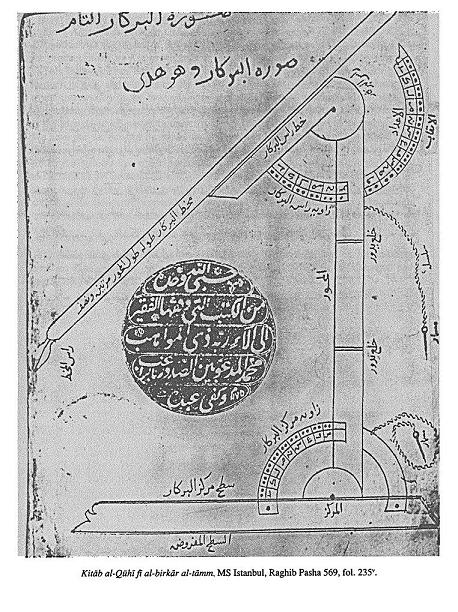
Operating during the early Abbasid period, al-Kindī worked in intellectual circles that included translators, court scholars, and instrument makers. He is associated with Baghdad's scholarly environment and the institutions that fostered the translation of Hellenistic material into Arabic. Through his writings and editorial activity he helped preserve and reinterpret Greek philosophy for later Islamic thinkers. His fusion of reasoned inquiry with religiously framed concerns influenced subsequent philosophers and scientists in the Islamic world, and some of his works circulated into Latin Europe in later centuries, contributing indirectly to medieval scholastic debates.
Notable contributions and legacy
Al-Kindī's legacy rests in the combination of breadth and a pragmatic intellectual style. He produced treatises on optical theory, music and harmonics, mineralogy and metallurgy, and practical manuals that addressed crafts and instruments. While not every claim in later sources is equally well attested, scholars credit him with helping to institutionalize a learned, philosophically informed approach to scientific problems in Arabic. His label as "the Philosopher of the Arabs" reflects both the esteem later generations held for him and his role as an early bridge between Hellenistic ideas and Islamic scholarly practice.
Further notes
Because many of his writings survive only in excerpts or later catalogues, modern assessments of al-Kindī must weigh fragmentary evidence cautiously. He remains a central figure in studies of the early translation movement and the development of scientific and philosophical inquiry in the medieval Islamic world.
Related articles
Author
AlegsaOnline.com Al-Kindi: Arab Philosopher and Polymath of the Early Abbasid Era Leandro Alegsa
URL: https://en.alegsaonline.com/art/1882