
Central Florida: geography, climate, population and development
Overview of Central Florida: geography and boundaries, climate, major cities and counties, growth and economy, transportation and planning, and notable features and attractions.

Central Florida denotes the central portion of the U.S. state of Florida and is commonly understood as the region around metropolitan Orlando. Its informal limits vary by context and source, and debates over the exact boundary are common: some definitions emphasize the Orlando metro and adjacent counties, while others extend to nearby coastal or inland areas. The phrase also describes a cultural and economic zone characterized by rapid population growth, a tourism-driven economy, and a mix of urban, suburban and rural landscapes.
Image gallery
10 Images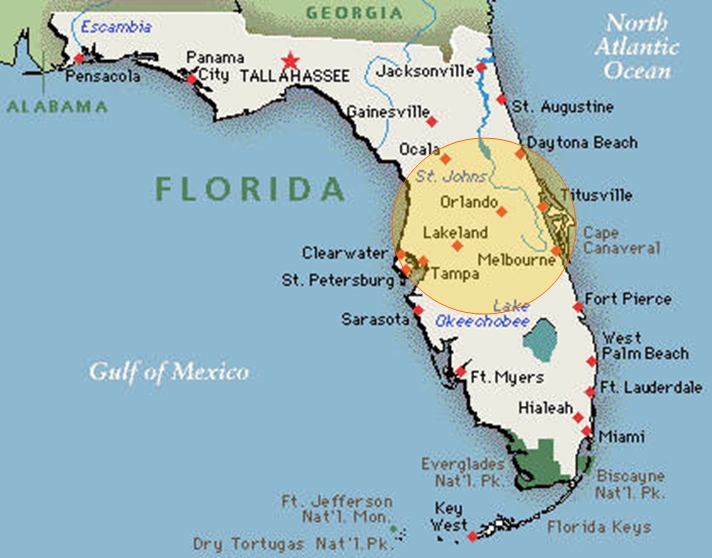


Geography and principal counties
Central Florida sits on the peninsula between the state's Atlantic and Gulf coasts and includes a mosaic of lakes, pine flatwoods, wetlands and developed areas. Counties often associated with the region include Orange, Osceola, Seminole, Lake, Brevard and Volusia. Some definitions also count inland counties such as Polk and Sumter. By contrast, the adjacent west-central coast — including Hillsborough, Pinellas, Pasco and Hernando counties — is usually treated as the Tampa Bay or Suncoast area rather than part of Central Florida. The interstate corridor formed by I‑4 links many of these population centers and frames regional planning debates.
Climate and environment
The region has a warm, humid climate that supports subtropical ecosystems and seasonal agriculture. Summers are hot and wet, with frequent afternoon thunderstorms and a hurricane season that brings periodic tropical storms and hurricanes. Winters are mild and drier, making the area attractive for year-round visitors and seasonal residents. Natural features include freshwater lakes, coastal estuaries on the Atlantic side, and pockets of native scrub and pine habitat that are important for wildlife and water recharge.
Population, cities and economy
Central Florida has grown into a densely populated region anchored by the city of Orlando. Other principal municipalities include Palm Bay, Lakeland, Melbourne, Deltona, Daytona Beach, Kissimmee, Altamonte Springs and Sanford. The regional economy is diverse: tourism and hospitality are dominant because of theme parks and beaches, while aerospace, information technology, education, health care and agriculture (notably citrus and horticulture) also contribute substantially.
Growth, land use and transportation
Over recent decades Central Florida experienced rapid expansion and suburbanization. Unchecked development produced significant urban sprawl in some corridors, which has strained road networks and local infrastructure and increased commute times and vehicle reliance. Local governments have moved toward regional coordination on land use, transit and environmental protections to address these challenges. Major corridors and transit initiatives aim to relieve congestion and link employment centers, tourist destinations and residential areas while protecting remaining green spaces.
Culture, history and attractions
The region blends elements of deep-southern and Floridian cultures, with a modern civic identity shaped by tourism, migration and a growing technology and research presence. Indigenous peoples and Spanish and later American settlers shaped early history; in the 20th century the arrival of major attractions and improved air travel transformed Central Florida into a global tourist hub. Visitors and residents alike are drawn to world-class theme parks, coastal beaches, cultural venues, natural springs and outdoor recreation opportunities.
Notable facts and distinctions
- Central Florida is sometimes referred to as part of the I‑4 corridor because Interstate 4 connects many of its major cities.
- The region balances rapid urban growth with conservation priorities for lakes, wetlands and native habitats.
- Transportation, water management and growth planning remain central policy issues as the area continues to expand.
For more detailed information on local counties, cities and planning efforts consult county and municipal resources or regional planning agencies, which provide up-to-date maps, demographic data and project descriptions through official portals and reports. To explore related topics use local government websites or regional planning authorities as starting points.
Related links: United States overview, vehicle use and mobility.
Questions and answers
Q: What is Central Florida?
A: Central Florida is the central region of the United States state of Florida, located on the East Coast. It includes Orange, Osceola, Seminole, Lake, Brevard, and Volusia counties as well as Polk and Sumter counties for some people.
Q: What type of climate does Central Florida have?
A: Central Florida has a hot but stormy climate with many thunderstorms and hurricanes threatening often.
Q: What are some of the largest cities in Central Florida?
A: The largest cities in Central Florida are Orlando, Palm Bay, Lakeland, Melbourne, Deltona, Daytona Beach, Kissimmee Altamonte Springs and Sanford.
Q: How has the region changed over time?
A: The region has grown over the last two decades due to a lack of growth management which has led to massive urban sprawl in the area. Outdated and unplanned building has led to an overload of vehicle traffic. Local governments have now started taking a more regional approach and several transportation programs.
Q: What makes Central Florida unique?
A:Central Florida is a mix of deep south culture and typical Floridian culture which makes it unique from other parts of the state.
Q: Is Tampa Bay considered part of Central Florida?
A: No - Tampa Bay (including Hillsborough County Pinellas County Pasco County Hernando County) is usually considered its own area known as the I-4 corridor or Suncoast rather than part of Central Florida.
Related articles
Author
AlegsaOnline.com Central Florida: geography, climate, population and development Leandro Alegsa
URL: https://en.alegsaonline.com/art/18041
Sources
- nhc.noaa.gov : NOAA