
Cavity magnetron
A compact high-power vacuum tube that generates microwaves by converting electron motion into resonant cavity oscillations; key to WWII centimetre-wave radar and later microwave ovens.
Overview
The cavity magnetron is a compact, high-power vacuum tube that generates electromagnetic energy in the microwave band. It produces intense pulses or continuous microwave radiation useful where large power and small size are needed. By storing oscillations in metal cavities and coupling that energy out as microwaves, the device became a practical source of centimetre-wavelength radiation from the 1940s onward.
Image gallery
10 Images



How it works
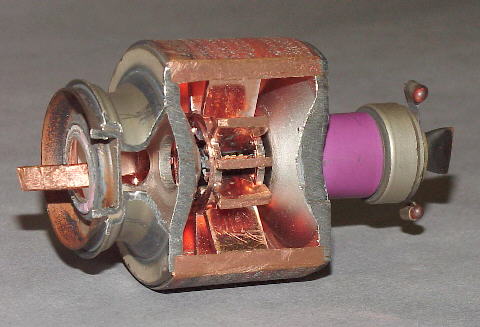
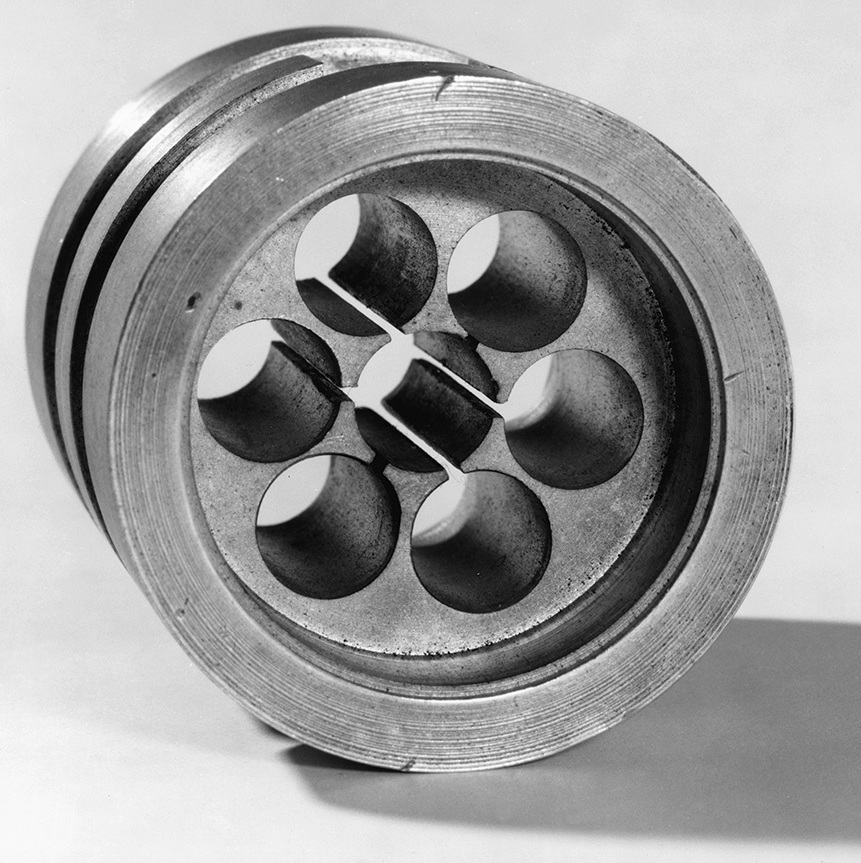
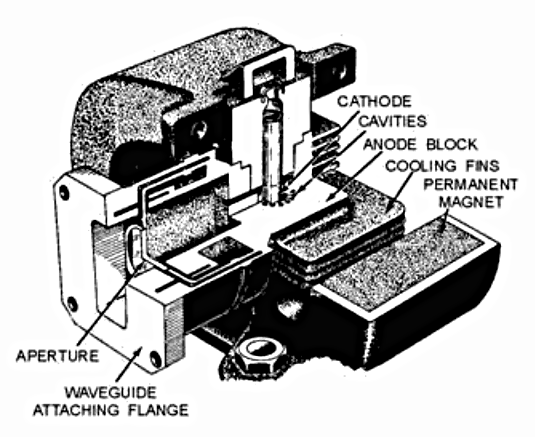
At its core the cavity magnetron contains a heated cathode at the center and an annular anode with a ring of resonant cavities machined into it. Electrons emitted from the cathode move outward but are forced into curved paths by a perpendicular magnetic field, while the electric field of the anode accelerates them. As the moving electrons interact with the fields near the cavities they induce oscillations; the cavities act as tuned resonators and convert electron kinetic energy into microwaves. The behavior is often compared to blowing across holes in a flute: the geometry selects and amplifies certain frequencies through resonance, a comparison sometimes called the flute analogy.
Main parts
- Cathode: a central filament or cylinder that emits electrons when heated.
- Anode block and cavities: a metal structure with a set of tuned cavities where standing electromagnetic modes form.
- Magnets: permanent magnets or electromagnets that apply the radial magnetic field controlling electron orbits.
- Output coupler: a loop or probe that extracts microwave power from a selected cavity.
- Vacuum envelope and heater supply: maintain the vacuum and provide the emission current.
History and impact
The cavity magnetron in its practical form was developed around 1940 and rapidly adopted during the Second World War. Its ability to produce high power at centimetre wavelengths made compact, high-resolution radar systems possible, enabling smaller antennas and installation aboard aircraft and ships. That miniaturization improved detection of small or low-signature objects and proved important in anti-submarines warfare and other naval and aerial operations.
Uses, advantages and limitations
Cavity magnetrons remain widespread in household microwave ovens and in many radar transmitters because they deliver large microwave power in a compact, low-cost package. They are, however, less frequency-stable and exhibit greater phase noise than alternative sources such as klystrons or modern solid-state transmitters, which restricts their use where precise frequency or phase control is required. Practical use also requires careful high-voltage design and shielding to protect users from microwave exposure.
Notable facts and distinctions
The wartime development of the cavity magnetron accelerated microwave engineering and helped spawn many postwar civilian technologies. Its distinguishing trade-off—high power and compactness versus lower frequency stability—explains why it still appears in applications that prioritize raw output and cost over tight spectral control.
Related articles
Author
AlegsaOnline.com Cavity magnetron Leandro Alegsa
URL: https://en.alegsaonline.com/art/17745
Sources
- explainthatstuff.com : "How do magnetrons work?"
- histru.bournemouth.ac.uk : "The Magnetron"
- www3.imperial.ac.uk : "How important was Tizard's Box of Tricks?"
- doramusic.com : "Who Was Alan Dower Blumlein?"
- elec.qmul.ac.uk : 3D Computer Modeling of Magnetrons