
Cathode ray: stream of electrons and the basis of cathode ray tubes
Cathode rays are streams of electrons emitted from a cathode in vacuum tubes. They underpinned discoveries of the electron and powered cathode ray tubes used in displays, oscilloscopes and early electronics.
Overview
Cathode rays are beams of electrons produced in evacuated tubes when a negative electrode, the cathode, emits charged particles that travel through the residual vacuum toward an anode or other structures. Early investigators observed visible effects of these rays as glowing spots and shadows on glass walls. The phenomenon is central to the development of vacuum electronics and the cathode ray tube (CRT).
Image gallery
10 Images



Physical characteristics and behaviour
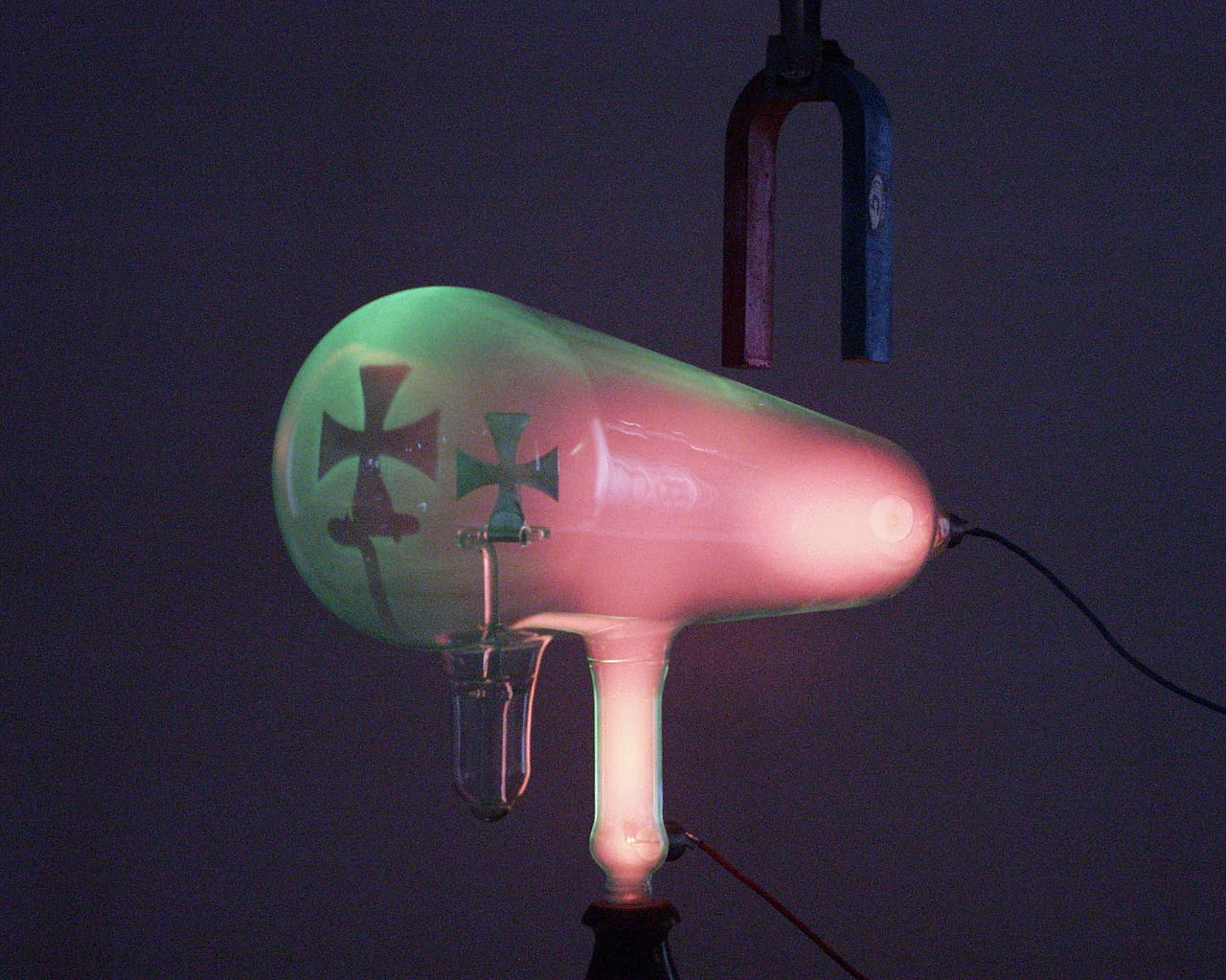
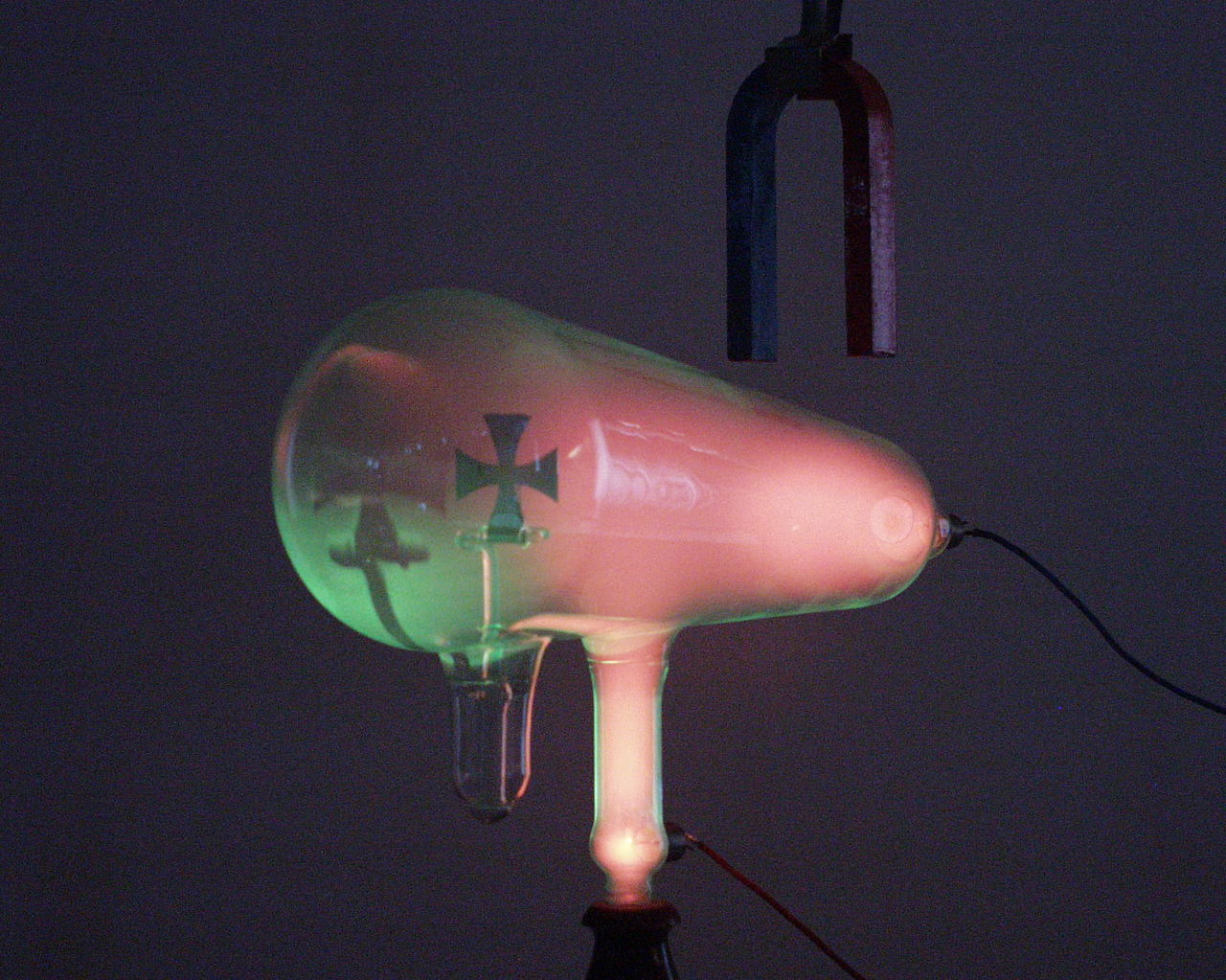
Cathode rays are best understood as moving electrons that can be accelerated, focused and deflected by electric and magnetic fields. Their key properties include:
- Charge and mass: they carry negative electric charge and respond to electromagnetic forces.
- Straight-line propagation: in uniform vacuum and without external fields they travel in straight paths from the emitting cathode.
- Deflection: they are bent by applied electric or magnetic fields, which allows control of the beam for imaging or measurement.
- Interaction with matter: striking a phosphor-coated surface produces light; striking residual gas can cause visible glow or ionisation.
Historical development
Observations of glow and dark regions in discharge tubes date from the 19th century; German physicist Johann Hittorf first reported beam-like effects in 1869. The term "cathode rays" (Kathodenstrahlen) was used by Eugen Goldstein in the 1870s. Experiments by J. J. Thomson and contemporaries established in 1897 that these rays are composed of a fundamental negatively charged particle, later named the electron. The identification of electrons from cathode-ray experiments was pivotal for atomic and electrical theory.
How cathode ray tubes work
A typical CRT contains an electron gun that emits electrons from a heated or field-emitting cathode. The beam is shaped by electrodes and focusing elements, then steered across a display or detector by deflection plates or coils. When the beam strikes a phosphor-coated screen it produces visible light. Modern descriptions emphasise these components:
- Electron source (cathode)
- Accelerating and focusing electrodes
- Deflection system using electric or magnetic fields (deflection)
- Phosphor screen to convert electron impact into visible light
Applications and legacy
Cathode rays enabled the first electronic displays, oscilloscopes, radar screens and early television sets (television). They were indispensable tools for scientific instruments and for visualising time-varying electrical signals. Though most consumer displays have been superseded by solid-state technologies, CRTs remained important in specialised fields for many decades.
Related terms and notable facts
"Cathode" denotes the negatively charged electrode that emits electrons in these devices; see the general article on cathode for electrode nomenclature. The general concept of a stream of electrons in a vacuum also appears in particle-beam instruments and electron microscopes. Early laboratory tubes and CRTs are types of vacuum tubes whose behaviour helped establish modern electronics. For further reading on experimental techniques and historical sources, consult technical and historical archives (J. J. Thomson studies) and museum collections (CRT exhibits).
Distinction: Goldstein also studied canal rays (positive ions) that travel in the opposite direction to cathode rays; these complement the historical picture of discharge-tube physics.
Tags
Related articles
Author
AlegsaOnline.com Cathode ray: stream of electrons and the basis of cathode ray tubes Leandro Alegsa
URL: https://en.alegsaonline.com/art/17632
Sources
- books.google.com : "Vorläufige Mittheilungen über elektrische Entladungen in verdünnten Gasen"