
CAS Registry Number
A CAS Registry Number (CAS RN) is a unique numeric identifier assigned by the Chemical Abstracts Service to chemical substances, used worldwide for unambiguous identification in databases, literature, and regulation.
Overview
The CAS Registry Number, often called a CAS RN or CAS number, is a unique identifier allocated by the Chemical Abstracts Service. It provides a concise label to refer to a specific chemical substance in publications, inventories, regulatory documents and supplier catalogs. The identifier itself does not describe a molecule’s structure or properties; it simply serves as a stable key that points to the registry record.
Image gallery
1 Image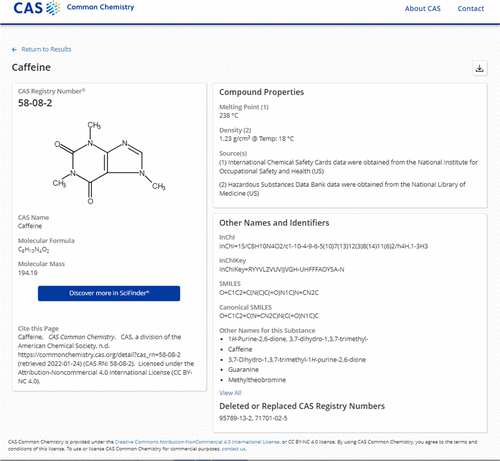
Format and validation
CAS numbers are presented as three groups of digits separated by hyphens. The final single digit is a check digit that helps detect transcription errors. The check digit is calculated from the preceding digits using a deterministic arithmetic rule so that incorrect sequences are likely to be caught. Importantly, a CAS RN conveys no chemical structure—unlike structural identifiers such as InChI or SMILES—so it must be looked up in a database to obtain formulas, connectivity or stereochemistry information (structure information).
Scope and scale
The registry covers a broad variety of materials: small organic molecules (organic), metal salts and coordination species (inorganic), naturally occurring minerals (minerals), different isotopic forms (isotopes), engineered metal blends and compositions (alloys), and even large biological sequences such as protein and DNA sequences. The registry has grown to include many millions of records and is updated continuously as new substances are reported in the literature and patents.
Uses and examples
Practical uses of CAS numbers include searching scientific literature, cross-referencing regulatory lists, ordering chemicals from suppliers, and mapping between databases. Because CAS RNs are compact and widely adopted, they reduce ambiguity when names or synonyms vary between languages, disciplines or vendors. Typical workflows combine a CAS RN lookup with database queries to retrieve safety data sheets, spectral data, legal status or supplier information.
Limitations and alternatives
Caution is needed: different salts, hydrates, stereoisomers or polymer grades may receive distinct CAS numbers, and conversely some complex mixtures may lack a single CAS RN. Also, CAS is a proprietary registry: access to full records requires a subscription or third‑party indexing. For encoding chemical structure and facilitating algorithmic comparison, public structural identifiers (InChI, InChIKey, SMILES) and database-specific identifiers (for example PubChem CID or EC numbers) are commonly used alongside CAS numbers as complementary references.
- Key points: CAS RN = unique label, not a structural descriptor.
- Validation: final digit is a check digit for error detection.
- Coverage: small molecules to biomolecules and materials.
Related articles
Author
AlegsaOnline.com CAS Registry Number Leandro Alegsa
URL: https://en.alegsaonline.com/art/17367