
Cai Lun — Han dynasty court official traditionally credited with refining papermaking
Han-dynasty eunuch and court official generally credited with developing an improved method of papermaking around 105 CE; influential in the history and spread of paper.
Cai Lun (Chinese: simplified characters / traditional characters; pinyin; Wade–Giles) (c. 50–121 CE) was a Han dynasty court official often remembered for introducing an improved technique for making paper. He served at the imperial court as a eunuch and political attendant, rising to positions that brought him close to the emperor. Historically he is frequently described as the person who systematized and promoted a practical form of paper that became widely used in China and later beyond its borders.
Image gallery
4 Images


Life and historical context
Cai Lun was born in what is now Hunan province and spent much of his career at the Han court. As a palace attendant he had access to official workshops and resources. The date most often associated with his papermaking contribution is 105 CE, when he reported a new process to the emperor and was rewarded. Archaeological discoveries since the 20th century have shown that forms of writing surfaces, including earlier paper-like sheets, existed before Cai Lun — for example, reed papyrus and primitive paper fragments — but historical records credit him with refining and promoting a more convenient and consistent manufacturing method.
Technique and materials
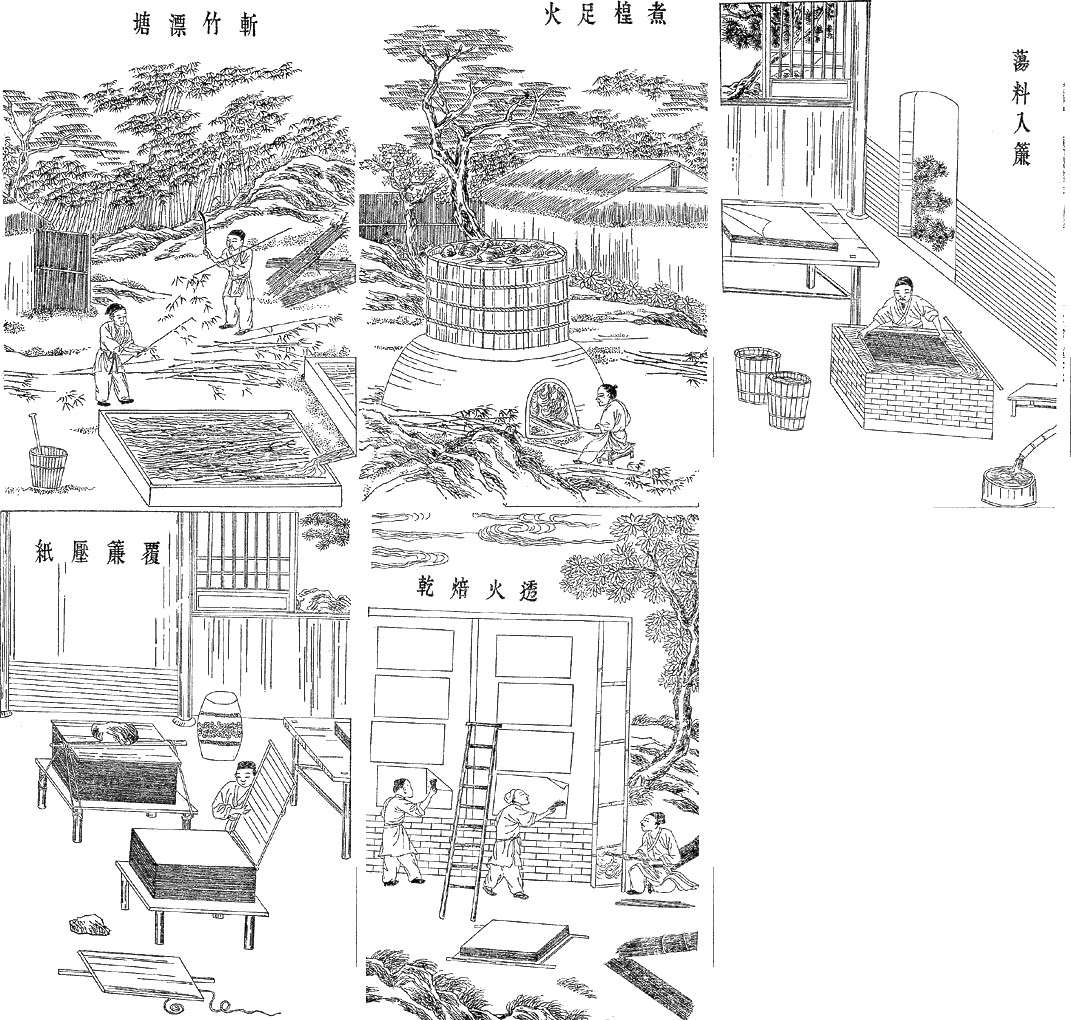
The method attributed to Cai Lun transformed discarded and plant materials into a sheet-form writing surface. Traditional descriptions say he mixed fibers from tree bark, hemp, rags and other soft plant or textile waste, pounded them into a pulp, suspended the pulp in water, and then drained it through a screen to form a mat of interwoven fibers. After pressing and drying, the resulting paper was more uniform and easier to produce at scale than earlier alternatives. Common raw materials referenced in accounts include tree bark, old cloth, and plant fibres; older sources also contrast this with papyrus, which originated elsewhere and used a different technique.
Uses and impact
The practical advantages of Cai Lun’s paper — relative lightness, adaptability, and lower cost — made it suitable for official records, correspondence, and eventually for books and art. Over subsequent centuries, papermaking spread along trade routes such as the Silk Road and was adopted and adapted by craftsmen in Central Asia and the Islamic world, from where it later reached Europe. Paper’s wider availability contributed to changes in administration, literacy, record keeping and the visual arts.
Legacy and scholarly perspective
Cai Lun’s reputation as the inventor of paper has endured in Chinese tradition: he was honored after his death and later regarded as a patron figure of papermakers, with legends about tools such as a mortar connected to his grave. Modern scholarship treats the picture as more nuanced. Archaeological finds demonstrate earlier sheets and varied techniques, so many historians prefer to describe Cai Lun as an important innovator and promoter who standardized and popularized an effective method rather than as the sole inventor. His story illustrates how technical improvements, official endorsement and the needs of bureaucracy can accelerate technological adoption.
Notable facts
- Traditional accounts place Cai Lun’s papermaking report at the imperial court around 105 CE.
- Earlier writing surfaces such as papyrus and bamboo slips coexisted with paper in ancient China.
- His birthplace is recorded as Guiyang (in modern Hunan) and his courtesy name was Jingzhong; he is remembered in a range of later sources and commemorations.
For further reading on terminology and historical sources associated with Cai Lun and early papermaking, see entries on the Chinese language forms and phonetic systems (simplified, traditional, pinyin, Wade–Giles), discussions of his role at court (eunuchs, political), and general overviews of papermaking (paper, inventor, history, Hunan, materials, tools).
Related articles
Author
AlegsaOnline.com Cai Lun — Han dynasty court official traditionally credited with refining papermaking Leandro Alegsa
URL: https://en.alegsaonline.com/art/15976