
Broca's area: brain region involved in speech and language production
Broca's area is a region of the dominant frontal lobe associated with speech production and certain language functions; clinically linked to expressive aphasia and studied with modern neuroimaging.
Overview
Broca's area is a section of the cerebral cortex located in the dominant hemisphere, most often the left, and plays a central role in producing spoken language. It is commonly described as part of the frontal lobe and is associated with planning and coordinating the movements required for speech as well as aspects of grammar and sentence structure. The region is a frequent subject in studies of the brain and in comparative work on human evolution and other hominids.
Image gallery
8 Images




Anatomy and functional characteristics
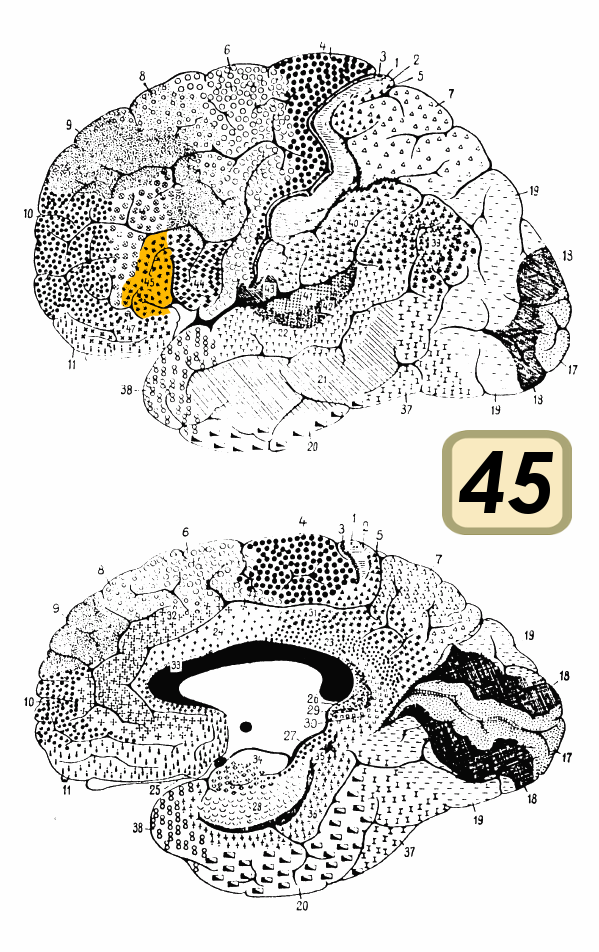
Broca's area usually encompasses parts of the posterior inferior frontal gyrus and corresponds roughly to Brodmann areas 44 and 45. It lies near motor regions that control the mouth and face and connects with temporal language areas via white-matter pathways. Key features include:
- Location: in the dominant frontal lobe, anterior to the motor cortex for the face and tongue.
- Connectivity: linked to language comprehension regions, auditory areas, and motor planning networks.
- Functions: involved in speech production, syntactic processing, and sequencing of actions for articulation; also contributes to verbal working memory and aspects of language learning.
History and discovery
The association between this region and expressive language emerged in the 19th century from clinical observations and post-mortem studies. Physician Pierre Paul Broca reported patients with severe difficulties producing speech who had damage to the posterior inferior frontal region identified during autopsies. That pattern of impairment became known as Broca's aphasia and helped establish the idea of localized brain functions for language.
Clinical significance
Damage to Broca's area is classically linked to nonfluent or expressive aphasia: affected individuals often produce slow, effortful speech with simplified grammar while retaining better comprehension. However, real-world presentations vary because language is distributed across networks. Modern neuroimaging methods such as fMRI have revealed that Broca's area participates in multiple language tasks and interacts with other regions.
Research, plasticity and notable distinctions
Contemporary research emphasizes that Broca's area is not an isolated "speech center" but a hub within a larger, flexible language network. For example, slow-growing brain tumors sometimes allow nearby areas to assume language functions, demonstrating cortical plasticity. Functional studies also show involvement of Broca's area in nonverbal sequencing and cognitive control, and comparative studies examine homologous frontal regions in other primates to better understand the evolution of human language. Ongoing work refines how syntax, motor planning, and working memory are distributed across this network.
Importance and examples
Understanding Broca's area matters for clinical neurology, speech-language therapy, neurosurgery planning, and cognitive neuroscience. Assessments of language after stroke or injury take into account both classical syndromes and the variable recovery patterns that reflect individual differences in brain organization. In research settings, tasks invoking sentence production, grammatical judgment, or verbal fluency commonly activate this region, illustrating its multifaceted role in human communication.
speech and language researchers continue to study Broca's area across disciplines, integrating historical observations with modern imaging and behavioral methods to build a nuanced picture of how humans produce and process language.
Questions and answers
Q: Where is Broca's area located in the brain?
A: Broca's area is located in the frontal lobe of the dominant hemisphere, typically the left side.
Q: What is the function of Broca's area?
A: Broca's area works as part of "speech production" and is responsible for language processing.
Q: Who first linked language processing to Broca's area?
A: Pierre Paul Broca was the first to link language processing to Broca's area after doing autopsies on patients who had trouble speaking when they were alive.
Q: What is Broca's aphasia?
A: Broca's aphasia, also called "expressive aphasia," is the deficit in language production that occurs when there is damage in the posterior inferior frontal gyrus of the brain.
Q: What have fMRI studies shown about Broca's area?
A: fMRI studies have identified activation patterns in Broca's area associated with various language tasks.
Q: Can speech remain intact even with slow destruction of Broca's area?
A: Yes, slow destruction of Broca's area by brain tumors can leave speech relatively intact. This suggests that, given time, its functions can shift to nearby areas in the brain.
Q: What is the significance of the name "Broca's area"?
A: The name "Broca's area" comes from the French physician Pierre Paul Broca, who identified the specific area of the brain responsible for language production after conducting Autopsies on patients who had difficulties speaking when they were alive.
Related articles
Author
AlegsaOnline.com Broca's area: brain region involved in speech and language production Leandro Alegsa
URL: https://en.alegsaonline.com/art/14616
Sources
- ncbi.nlm.nih.gov : "Asymmetric Broca's area in great apes"
- ui.adsabs.harvard.edu : 2001Natur.414..505C
- doi.org : 10.1038/35107134
- pubmed.ncbi.nlm.nih.gov : 11734839
- webspace.ship.edu : "Speech and the brain"
- doi.org : 10.1093/brain/awm042
- pubmed.ncbi.nlm.nih.gov : 17405763
- doi.org : 10.1080/13554790902729473
- pubmed.ncbi.nlm.nih.gov : 19274574